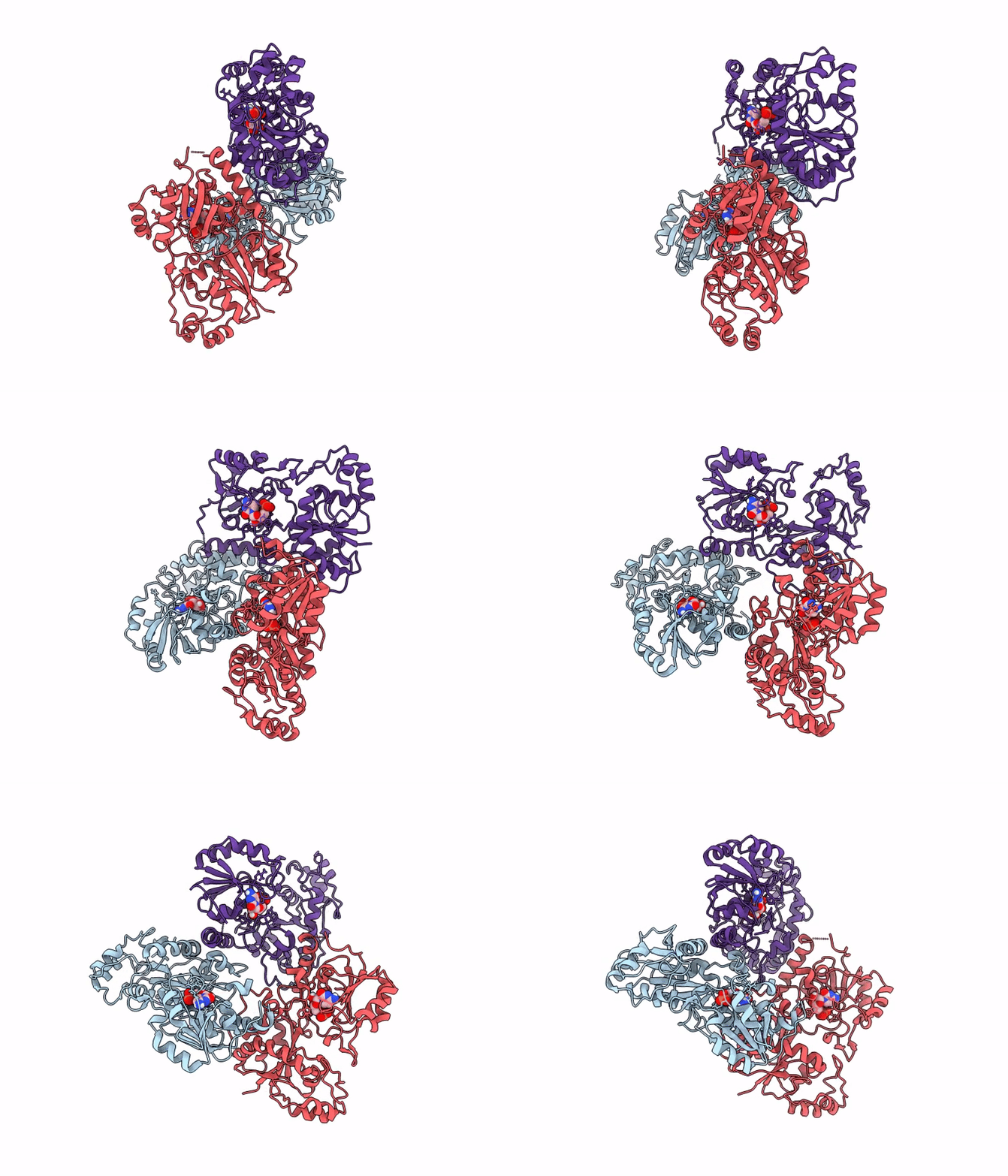
9YFX image
Deposition Date 2025-09-27
Release Date 2026-01-28
Last Version Date 2026-01-28
Entry Detail
PDB ID:
9YFX
Keywords:
Title:
KrKA retaining Kdo transferase CMP complex
Biological Source:
Source Organism(s):
Escherichia coli (Taxon ID: 562)
Expression System(s):
Method Details:
Experimental Method:
Resolution:
2.70 Å
R-Value Free:
0.22
R-Value Work:
0.20
R-Value Observed:
0.20
Space Group:
P 43 21 2
Macromolecular Entities
Structures with similar UniProt ID
Protein Blast
Polymer Type:polypeptide(L)
Molecule:KrKA
Gene (Uniprot):AWP47_21535
Chain IDs:A, B, C
Chain Length:364
Number of Molecules:3
Biological Source:Escherichia coli
Primary Citation
The retaining Kdo transferase that synthesizes Escherichia coli K13 capsule is deeply divergent from structurally homologous enzymes.
J.Biol.Chem. ? 111162 111162 (2026)
PMID: 41539565 DOI: 10.1016/j.jbc.2026.111162

Abstact

3-Deoxy-D-manno-octulosonic acid (Kdo) is an eight-carbon monosaccharide that, in Gram-negative bacteria, is an essential structural component of both lipopolysaccharide and the polymeric linker in Group 2 and 3 capsules. Kdo is also an important building block of the variable region of various capsular structures, but the responsible enzymes have, to date, not been investigated. Here, we structurally and functionally characterize the protein KrkA from E. coli capsular serotype K13, showing that it has both ribosyltransferase and Kdo-transferase activity, consistent with this protein being solely responsible for synthesizing the K13 (and the closely related K20 and K23) capsular polysaccharide repeat. We show that the N-terminal module of this protein is the Kdo-transferase. This module's x-ray structure (at 2.7 Å resolution) resembles that of two characterized Kdo-transferases: the GT99 module of WbbB, and the GT107 module of KpsC, despite sharing negligible sequence similarity. KrkA is therefore the founding member of a new GT family, GTXXX. KrkAGTXXX is organized into a trimer, where a single residue contributes to a neighboring protomer's acceptor binding site. Using a D193C mutation, we determined the Kdo adduct and ternary complex structures at 2.0 and 2.2 Å resolution, respectively. These structures, along with site-directed mutagenesis, confirm the critical nature of the nucleophile Asp193 and the general base Glu102 (contributed by a secondary structure element distinct from that in GT99 and GT107), as well as important adduct and acceptor binding residues. E. coli isolates collectively encode four distinct clusters of related proteins, suggesting polyphyletic origins for this capsular serotype.

Legend

Protein

Chemical

Disease

Primary Citation of related structures
Feedback Form
Name
Email
Institute
Feedback