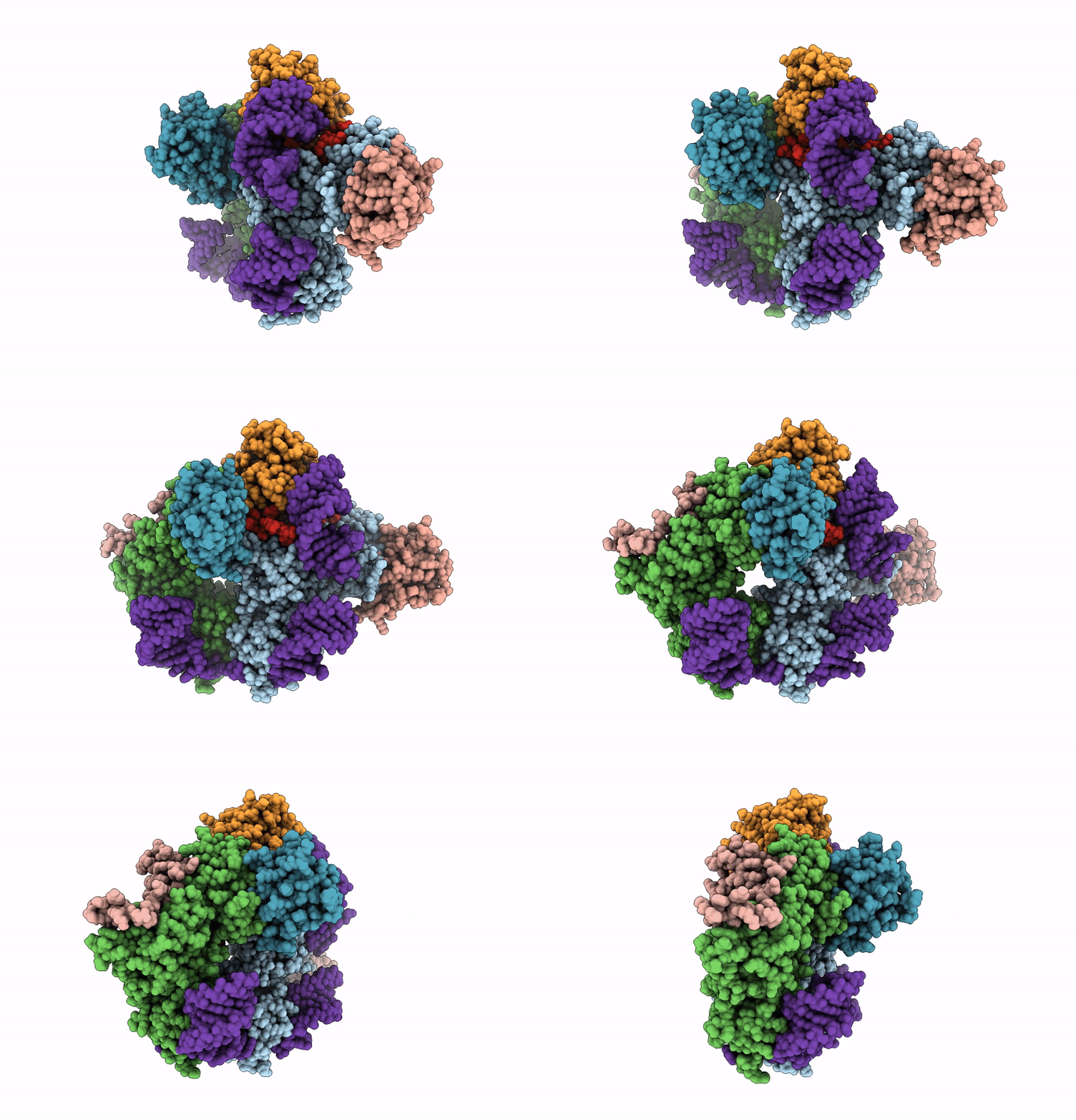
9YFN image
Deposition Date 2025-09-26
Release Date 2025-12-10
Last Version Date 2025-12-31
Entry Detail
PDB ID:
9YFN
Title:
insect H/ACA snoRNP class III
Biological Source:
Source Organism(s):
Trichoplusia ni (Taxon ID: 7111)
Method Details:
Experimental Method:
Resolution:
3.14 Å
Aggregation State:
PARTICLE
Reconstruction Method:
SINGLE PARTICLE
Macromolecular Entities
Structures with similar UniProt ID
Protein Blast
Polymer Type:polypeptide(L)
Molecule:H/ACA ribonucleoprotein complex subunit 4-like
Gene (Uniprot):LOC113492352
Chain IDs:A, C (auth: D)
Chain Length:514
Number of Molecules:2
Biological Source:Trichoplusia ni
Structures with similar UniProt ID
Protein Blast
Polymer Type:polypeptide(L)
Molecule:H/ACA ribonucleoprotein complex subunit
Gene (Uniprot):LOC113500981
Chain IDs:B, D (auth: E)
Chain Length:233
Number of Molecules:2
Biological Source:Trichoplusia ni
Structures with similar UniProt ID
Protein Blast
Polymer Type:polypeptide(L)
Molecule:H/ACA ribonucleoprotein complex subunit 3
Gene (Uniprot):LOC113498901
Chain IDs:E (auth: F), G (auth: H)
Chain Length:64
Number of Molecules:2
Biological Source:Trichoplusia ni
Structures with similar UniProt ID
Protein Blast
Polymer Type:polypeptide(L)
Molecule:H/ACA ribonucleoprotein complex subunit 2-like protein
Gene (Uniprot):LOC113498906
Chain IDs:F (auth: G)
Chain Length:156
Number of Molecules:1
Biological Source:Trichoplusia ni
Polymer Type:polyribonucleotide
Molecule:RNA (76-MER)
Chain IDs:H (auth: J)
Chain Length:76
Number of Molecules:1
Biological Source:Trichoplusia ni
Ligand Molecules
Primary Citation
Interprotomer communication and functional asymmetry in H/ACA snoRNPs.
Proc.Natl.Acad.Sci.USA 122 e2514683122 e2514683122 (2025)
PMID: 41410763 DOI: 10.1073/pnas.2514683122

Abstact

H/ACA small nucleolar ribonucleoproteins (H/ACA snoRNPs) facilitate essential cellular processes such as RNA modification, folding, and stability. Here, we present multiple cryo-EM structures of endogenous insect H/ACA snoRNPs containing two protomers assembled on a two-hairpin H/ACA snoRNA. By characterizing key protein-protein and protein-RNA interactions, we reveal the coordination of pseudouridylation activity across the two protomers which explains the predominance of two-hairpin structures in eukaryotic H/ACA snoRNAs. Moreover, we found that several mutations in H/ACA proteins associated with dyskeratosis congenita (DC) directly impair pseudouridine formation suggesting how these mutations disrupt RNA modification and ribosome biogenesis in this disease. Additionally, we uncover coordinated structural changes between Nop10, Nhp2, and the N-terminal extensions of Cbf5 in the 3' protomer that resemble active and inactive conformations and may regulate H/ACA snoRNP activity. In summary, this study provides detailed insight into the structure and function of RNA modification-competent H/ACA snoRNPs, which play pivotal roles in cellular processes including ribosome biogenesis, rRNA folding, (m)RNA modification, and telomere maintenance.

Legend

Protein

Chemical

Disease

Primary Citation of related structures
Feedback Form
Name
Email
Institute
Feedback