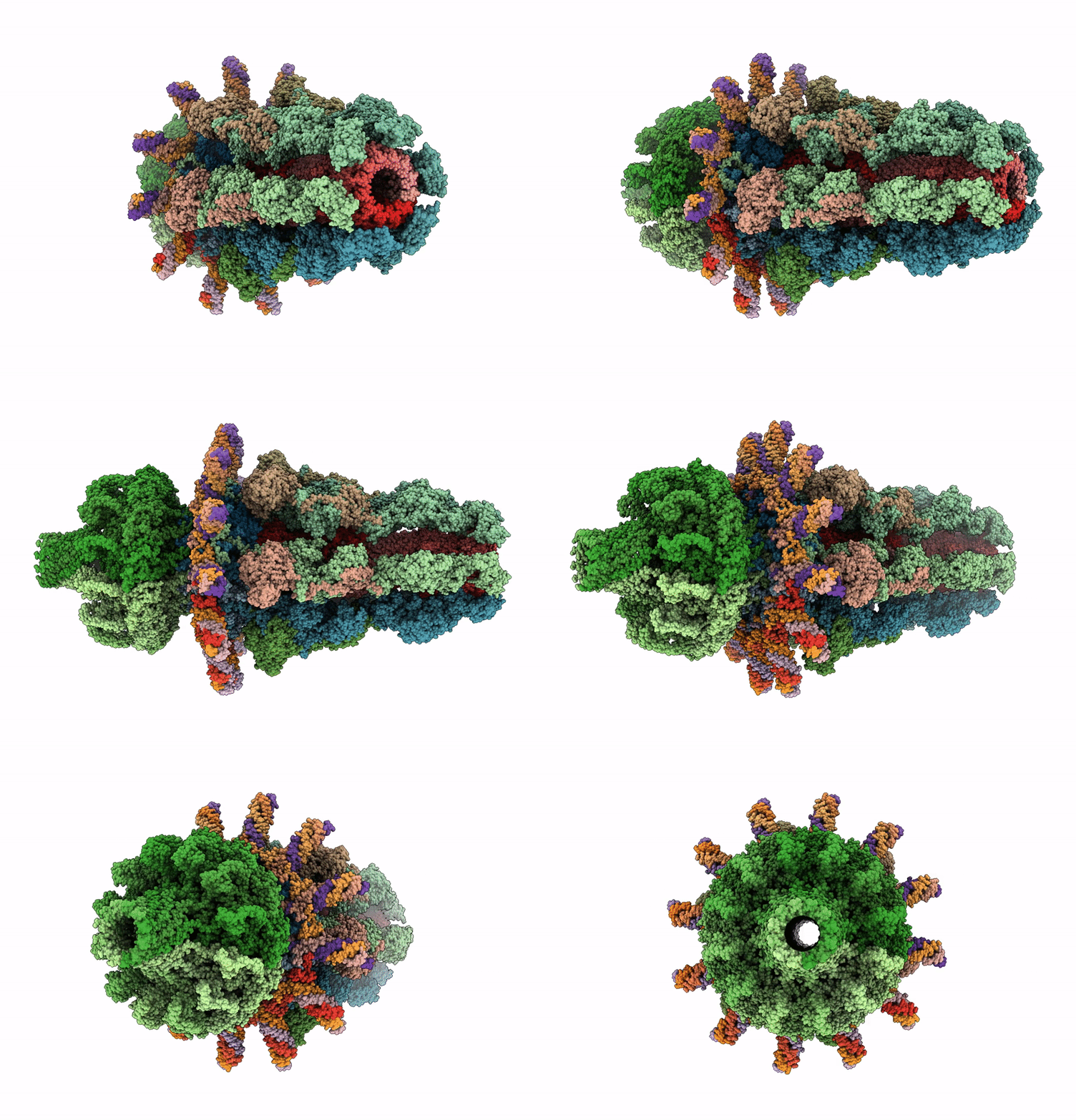
9YF5 image
Deposition Date 2025-09-25
Release Date 2025-12-24
Last Version Date 2025-12-24
Entry Detail
PDB ID:
9YF5
Keywords:
Title:
N4 Empty Particle C6 Tail
Biological Source:
Source Organism:
Method Details:
Experimental Method:
Resolution:
3.65 Å
Aggregation State:
PARTICLE
Reconstruction Method:
SINGLE PARTICLE
Macromolecular Entities
Structures with similar UniProt ID
Protein Blast
Polymer Type:polypeptide(L)
Molecule:30 kDa protein
Chain IDs:A (auth: AA), B (auth: AB), N (auth: AC), O (auth: AD), Z (auth: AE), AA (auth: AF), LA (auth: AG), MA (auth: AH), XA (auth: AI), YA (auth: AJ), JB (auth: AK), KB (auth: AL)
Chain Length:236
Number of Molecules:12
Biological Source:Escherichia phage N4
Structures with similar UniProt ID
Protein Blast
Polymer Type:polypeptide(L)
Molecule:Non-contractile tail sheath
Gene (Uniprot):65
Chain IDs:C (auth: LA), P (auth: LB), BA (auth: LC), NA (auth: LD), ZA (auth: LE), LB (auth: LF)
Chain Length:1382
Number of Molecules:6
Biological Source:Escherichia phage N4
Structures with similar UniProt ID
Protein Blast
Polymer Type:polypeptide(L)
Molecule:Probable portal protein
Gene (Uniprot):59
Chain IDs:M (auth: PA), VB (auth: PB), WB (auth: PC), XB (auth: PD), YB (auth: PE), ZB (auth: PF), AC (auth: PG), BC (auth: PH), CC (auth: PI), DC (auth: PJ), EC (auth: PK), FC (auth: PL)
Chain Length:763
Number of Molecules:12
Biological Source:Escherichia phage N4
Structures with similar UniProt ID
Protein Blast
Polymer Type:polypeptide(L)
Molecule:Gp64
Chain IDs:D (auth: SA), Q (auth: SB), CA (auth: SC), OA (auth: SD), AB (auth: SE), MB (auth: SF)
Chain Length:417
Number of Molecules:6
Biological Source:Escherichia phage N4
Structures with similar UniProt ID
Protein Blast
Polymer Type:polypeptide(L)
Molecule:Gp54
Chain IDs:E (auth: TA), F (auth: TB), R (auth: TC), S (auth: TD), DA (auth: TE), EA (auth: TF), PA (auth: TG), QA (auth: TH), BB (auth: TI), CB (auth: TJ), NB (auth: TK), OB (auth: TL)
Chain Length:299
Number of Molecules:12
Biological Source:Escherichia phage N4
Structures with similar UniProt ID
Protein Blast
Polymer Type:polypeptide(L)
Molecule:60 kDa protein
Chain IDs:G (auth: XA), H (auth: XB), I (auth: YA), J (auth: YB), K (auth: ZA), L (auth: ZB), T (auth: XC), U (auth: XD), V (auth: YC), W (auth: YD), X (auth: ZC), Y (auth: ZD), FA (auth: XE), GA (auth: XF), HA (auth: YE), IA (auth: YF), JA (auth: ZE), KA (auth: ZF), RA (auth: XG), SA (auth: XH), TA (auth: YG), UA (auth: YH), VA (auth: ZG), WA (auth: ZH), DB (auth: XI), EB (auth: XJ), FB (auth: YI), GB (auth: YJ), HB (auth: ZI), IB (auth: ZJ), PB (auth: XK), QB (auth: XL), RB (auth: YK), SB (auth: YL), TB (auth: ZK), UB (auth: ZL)
Chain Length:556
Number of Molecules:36
Biological Source:Escherichia phage N4
Ligand Molecules
Primary Citation
Structure of the giant RNA polymerase ejected from coliphage N4.
Res Sq ? ? ? (2025)
PMID: 41282253 DOI: 10.21203/rs.3.rs-7746245/v1

Abstact

Schitoviruses are widespread prokaryotic viruses that encapsidate a giant (~3,500-residue) virion-associated RNA polymerase (vRNAP). During infection, vRNAP is expelled into Gram-negative bacteria, along with two additional ejection proteins, to assemble a transient DNA-ejectosome that becomes transcriptionally active, initiating viral replication. Here, we present an integrative structural analysis of the coliphage N4 vRNAP (gp50). We find that this 383 kDa enzyme is a multi-domain, single-chain RNA polymerase, structurally distinct from both compact single-chain RNAPs and large multi-subunit holoenzymes. vRNAP is composed of loosely connected domains and exhibits an intramolecular mode of allosteric regulation through its C-terminal domain. Comparative analysis of intact and genome-released virions identified gp51, which forms an outer-membrane complex, and gp52, which assembles a periplasmic tunnel. These proteins generate heterogeneous pores that facilitate the release of vRNAP. We further uncover a signaling hub in the phage tail, composed of the receptor-binding protein, tail tube, and tail plug, that detects receptor engagement and orchestrates the release of ejection proteins. We propose that the beads-on-a-string architecture of vRNAP enables the translocation of megadalton-scale protein complexes through the ~35 Å channel formed by the tail and ejection proteins. These findings establish N4 as a distinctive model for protein translocation through biological channels.

Legend

Protein

Chemical

Disease

Primary Citation of related structures
Feedback Form
Name
Email
Institute
Feedback