9YDR image
Deposition Date 2025-09-23
Release Date 2025-12-10
Last Version Date 2025-12-10
Entry Detail
PDB ID:
9YDR
Title:
Human delta opioid receptor complex with mini-Gi and agonist DADLE and allosteric modulator MIPS3983
Biological Source:
Source Organism:
Homo sapiens (Taxon ID: 9606)
Lama glama (Taxon ID: 9844)
Host Organism:
Method Details:
Experimental Method:
Resolution:
2.14 Å
Aggregation State:
PARTICLE
Reconstruction Method:
SINGLE PARTICLE
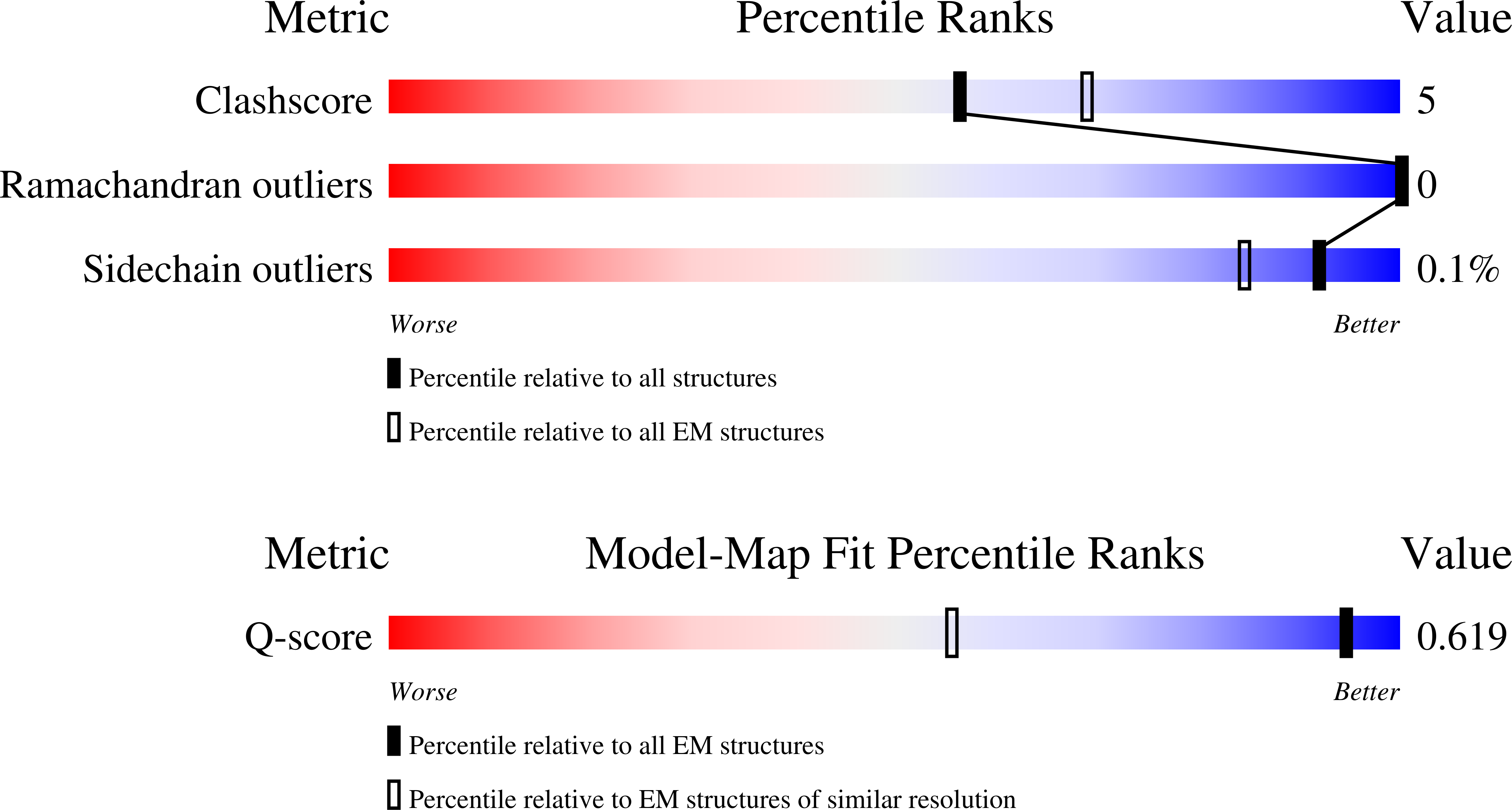
Macromolecular Entities
Polymer Type:polypeptide(L)
Molecule:Guanine nucleotide-binding protein G(s) subunit alpha isoforms XLas
Chain IDs:A
Chain Length:245
Number of Molecules:1
Biological Source:Homo sapiens
Structures with similar UniProt ID
Protein Blast
Polymer Type:polypeptide(L)
Molecule:Guanine nucleotide-binding protein G(I)/G(S)/G(T) subunit beta-1
Gene (Uniprot):GNB1
Chain IDs:B
Chain Length:350
Number of Molecules:1
Biological Source:Homo sapiens
Structures with similar UniProt ID
Protein Blast
Polymer Type:polypeptide(L)
Molecule:Guanine nucleotide-binding protein G(I)/G(S)/G(O) subunit gamma-2
Gene (Uniprot):GNG2
Chain IDs:C (auth: G)
Chain Length:71
Number of Molecules:1
Biological Source:Homo sapiens
Polymer Type:polypeptide(L)
Molecule:Nanobody 35
Chain IDs:D (auth: N)
Chain Length:156
Number of Molecules:1
Biological Source:Lama glama
Polymer Type:polypeptide(L)
Molecule:DADLE
Chain IDs:E (auth: P)
Chain Length:5
Number of Molecules:1
Biological Source:Homo sapiens
Structures with similar UniProt ID
Protein Blast
Polymer Type:polypeptide(L)
Molecule:OPRD1 isoform 1
Gene (Uniprot):OPRD1
Chain IDs:F (auth: R)
Chain Length:387
Number of Molecules:1
Biological Source:Homo sapiens
Ligand Molecules
Primary Citation

Abstact

Opioid analgesics remain essential for pain management but are associated with significant adverse effects, including respiratory depression, tolerance, and dependence. The δ-opioid receptor (δOR) represents a promising therapeutic target for developing safer opioid analgesics with reduced adverse effects compared to conventional μ-opioid receptor-targeting drugs. Positive allosteric modulators (PAMs) offer advantages over direct agonists by enhancing endogenous opioid signaling while preserving natural spatiotemporal activation patterns, potentially avoiding tolerance and dependence issues. Here, we present high-resolution cryo-EM structures of δOR complexed with the peptide agonist DADLE and the PAM MIPS3614, revealing a novel lipid-facing allosteric binding site formed by transmembrane helices 2, 3, and 4. MIPS3614 stabilizes the active receptor conformation through a critical hydrogen bond with residue N1313.35 in the conserved sodium binding site, a key regulatory region controlling GPCR activation. Comprehensive mutagenesis, molecular dynamics simulations, and structure-activity relationships validate this proposed mechanism. Structure-guided optimization yielded MIPS3983 with enhanced binding affinity and retained cooperativity. Our findings establish the first molecular framework for δOR allosteric modulation and provide a structural foundation for the rational design of safer opioid therapeutics.

Legend

Protein

Chemical

Disease

Primary Citation of related structures
Feedback Form
Name
Email
Institute
Feedback