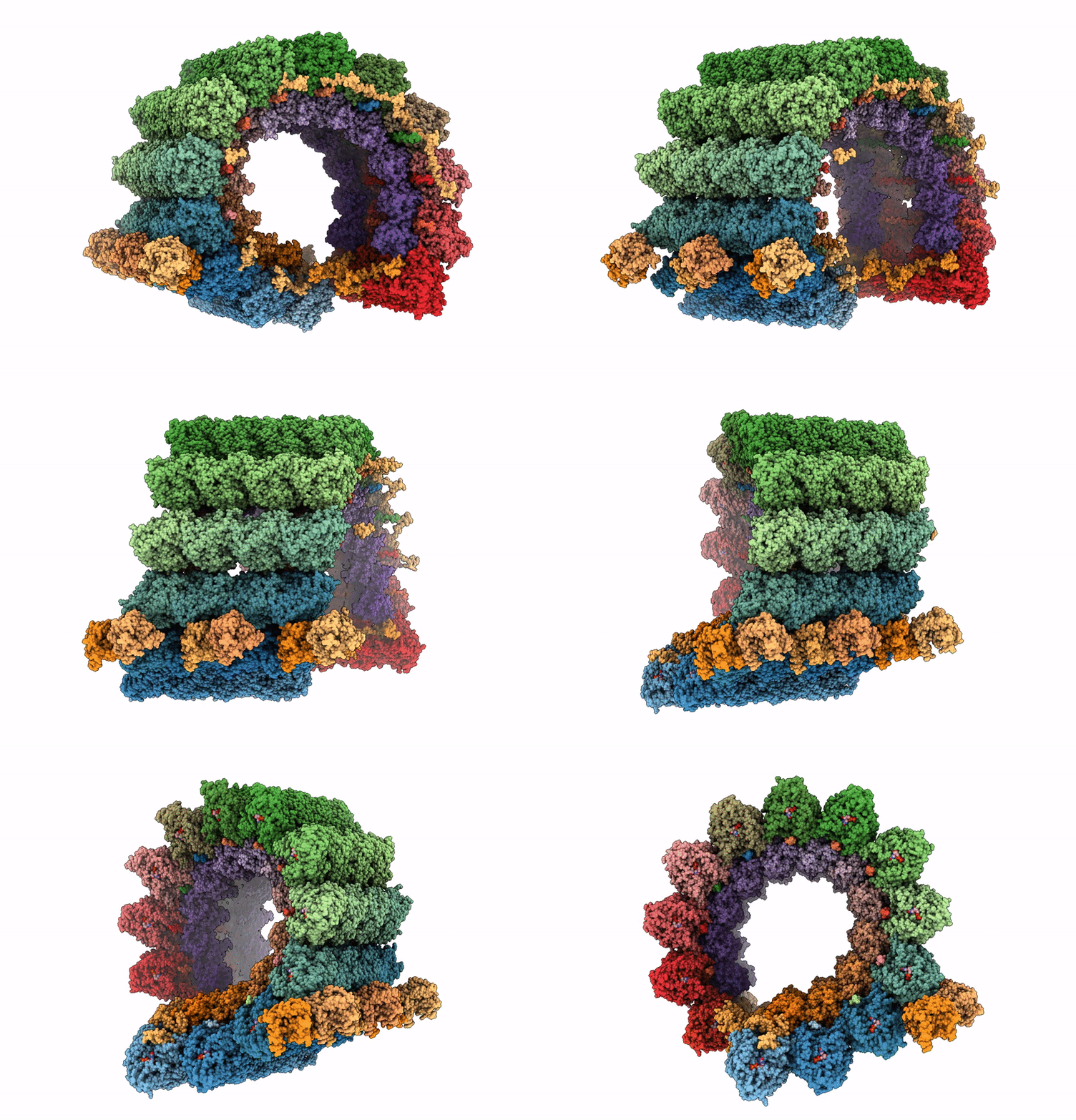
9YA2 image
Deposition Date 2025-09-15
Release Date 2025-12-03
Last Version Date 2025-12-24
Entry Detail
PDB ID:
9YA2
Title:
Cryo-EM structure of intraconoidal microtubule 1 (ICMT1) from Toxoplasma gondii (8-nm repeat)
Biological Source:
Source Organism(s):
Method Details:
Experimental Method:
Resolution:
3.34 Å
Aggregation State:
FILAMENT
Reconstruction Method:
SINGLE PARTICLE
Macromolecular Entities
Structures with similar UniProt ID
Protein Blast
Polymer Type:polypeptide(L)
Molecule:Microtubule associated protein SPM1
Gene (Uniprot):TGRH88_067480
Chain IDs:A, L (auth: B), W (auth: C), HA (auth: D), SA (auth: E), DB (auth: F), GB (auth: G), HB (auth: H), IB (auth: I), JB (auth: J), KB (auth: K)
Chain Length:220
Number of Molecules:11
Biological Source:Toxoplasma gondii
Structures with similar UniProt ID
Protein Blast
Polymer Type:polypeptide(L)
Molecule:Tubulin alpha chain
Chain IDs:B (auth: A0), D (auth: A2), F (auth: A4), H (auth: A6), J (auth: A8), M (auth: B0), O (auth: B2), Q (auth: B4), S (auth: B6), U (auth: B8), X (auth: C0), Z (auth: C2), BA (auth: C4), DA (auth: C6), FA (auth: C8), IA (auth: D0), KA (auth: D2), MA (auth: D4), OA (auth: D6), QA (auth: D8), TA (auth: E0), VA (auth: E2), XA (auth: E4), ZA (auth: E6), BB (auth: E8), EB (auth: F0)
Chain Length:453
Number of Molecules:26
Biological Source:Toxoplasma gondii
Structures with similar UniProt ID
Protein Blast
Polymer Type:polypeptide(L)
Molecule:Tubulin beta chain
Gene (Uniprot):BTUB
Chain IDs:C (auth: A1), E (auth: A3), G (auth: A5), I (auth: A7), K (auth: A9), N (auth: B1), P (auth: B3), R (auth: B5), T (auth: B7), V (auth: B9), Y (auth: C1), AA (auth: C3), CA (auth: C5), EA (auth: C7), GA (auth: C9), JA (auth: D1), LA (auth: D3), NA (auth: D5), PA (auth: D7), RA (auth: D9), UA (auth: E1), WA (auth: E3), YA (auth: E5), AB (auth: E7), CB (auth: E9), FB (auth: F1)
Chain Length:449
Number of Molecules:26
Biological Source:Toxoplasma gondii
Structures with similar UniProt ID
Protein Blast
Polymer Type:polypeptide(L)
Molecule:ICMAP2, TGME49_224700
Gene (Uniprot):TGDOM2_224700
Chain IDs:LB (auth: L), MB (auth: M), NB (auth: N), QB (auth: Q), VB (auth: V), WB (auth: W)
Chain Length:189
Number of Molecules:6
Biological Source:Toxoplasma gondii
Structures with similar UniProt ID
Protein Blast
Polymer Type:polypeptide(L)
Molecule:TLAP3 (apical cap protein AC5), TGME49_235380
Gene (Uniprot):TGPRC2_235380
Chain IDs:OB (auth: O), PB (auth: P)
Chain Length:220
Number of Molecules:2
Biological Source:Toxoplasma gondii
Structures with similar UniProt ID
Protein Blast
Polymer Type:polypeptide(L)
Molecule:TLAP4 (thioredoxin-like associated protein), TGME49_201760
Gene (Uniprot):TGRH88_037200
Chain IDs:RB (auth: R), SB (auth: S), TB (auth: T), UB (auth: U)
Chain Length:336
Number of Molecules:4
Biological Source:Toxoplasma gondii
Structures with similar UniProt ID
Protein Blast
Polymer Type:polypeptide(L)
Molecule:TRXL1, TGME49_232410
Gene (Uniprot):p25
Chain IDs:XB (auth: a), YB (auth: b), ZB (auth: c), AC (auth: d), BC (auth: e), CC (auth: f), DC (auth: g), EC (auth: h), FC (auth: i), GC (auth: j), JC (auth: m), KC (auth: n), LC (auth: o), MC (auth: p), NC (auth: q), OC (auth: r), PC (auth: s), QC (auth: t), RC (auth: u), SC (auth: v), TC (auth: w), UC (auth: x)
Chain Length:220
Number of Molecules:22
Biological Source:Toxoplasma gondii
Structures with similar UniProt ID
Protein Blast
Polymer Type:polypeptide(L)
Molecule:TRXL2, TGME49_225790
Gene (Uniprot):TGRH88_045420
Chain IDs:HC (auth: k), IC (auth: l)
Chain Length:189
Number of Molecules:2
Biological Source:Toxoplasma gondii
Primary Citation
Atomic models of the Toxoplasma cell invasion machinery.
Nat.Struct.Mol.Biol. ? ? ? (2025)
PMID: 41366525 DOI: 10.1038/s41594-025-01728-w

Abstact

Apicomplexan parasites, responsible for toxoplasmosis, cryptosporidiosis and malaria, invade host cells through a unique gliding motility mechanism powered by actomyosin motors and a dynamic organelle called the conoid. Here, using cryo-electron microscopy, we determined structures of four essential complexes of the Toxoplasma gondii conoid: the preconoidal P2 ring, tubulin-based conoid fibers, and the subpellicular and intraconoidal microtubules. Our analysis identified 40 distinct conoid proteins, several of which are essential for parasite lytic growth, as revealed through genetic disruption studies. Comparative analysis of the tubulin-containing complexes sheds light on their functional specialization by microtubule-associated proteins, while the structure of the preconoidal ring pinpoints the site of actin polymerization and initial translocation, enhancing our mechanistic understanding of gliding motility and, therefore, parasite invasion.

Legend

Protein

Chemical

Disease

Primary Citation of related structures
Feedback Form
Name
Email
Institute
Feedback