9Y6V image
Deposition Date 2025-09-09
Release Date 2026-02-04
Last Version Date 2026-02-04
Entry Detail
PDB ID:
9Y6V
Keywords:
Title:
attPsym bound large serine integrase and RDF complex in the dimeric state
Biological Source:
Source Organism(s):
Method Details:
Experimental Method:
Resolution:
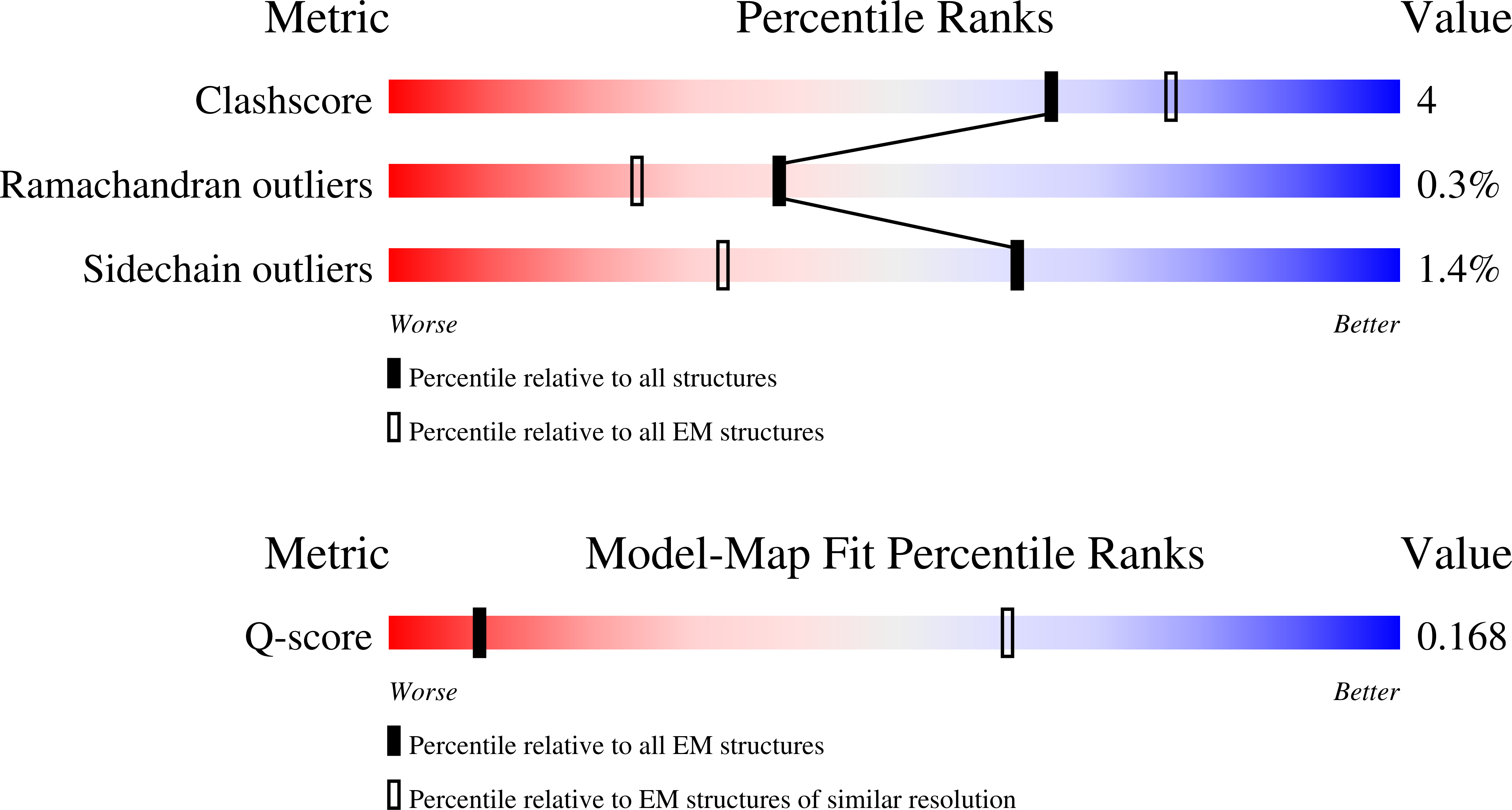
7.10 Å
Aggregation State:
PARTICLE
Reconstruction Method:
SINGLE PARTICLE
Macromolecular Entities
Protein Blast
Polymer Type:polypeptide(L)
Molecule:Resolvase homolog YokA,SPbeta prophage-derived uncharacterized protein YotN
Gene (Uniprot):yokA, yotN
Chain IDs:A, B, C, D
Chain Length:620
Number of Molecules:4
Biological Source:Spbetavirus SPbeta
Polymer Type:polydeoxyribonucleotide
Molecule:attPsym
Chain IDs:E
Chain Length:67
Number of Molecules:1
Biological Source:Spbetavirus SPbeta
Polymer Type:polydeoxyribonucleotide
Molecule:attPsym
Chain IDs:F
Chain Length:67
Number of Molecules:1
Biological Source:Spbetavirus SPbeta
Ligand Molecules
Primary Citation
Structural basis of directionality control in large serine integrases
bioRxiv ? ? ? (2025)
PMID: 39803483 DOI: 10.1101/2025.01.03.631226

Abstact

Large serine integrases (LSIs) catalyze unidirectional site-specific DNA recombination reactions, yet those reactions are reversed by the presence of a cognate recombination directionality factor (RDF). Mechanistic understanding of directionality control has been hampered by a lack of structural information. Here, we use cryo-electron microscopy (cryo-EM) to determine the structures of six SPbeta integrase-DNA complexes along the integrative (-RDF) and excisive (+RDF) reaction pathways, at 4.16-7.18Å resolution. Our findings reveal how RDF-mediated repositioning of an integrase subdomain (1) dictates which pairs of DNA sites can be assembled into a synaptic complex to initiate recombination and (2) dictates which product complexes will be conformationally locked, preventing the back reaction. These mechanistic insights provide a conceptual framework for engineering efficient and versatile genome editing tools.

Legend

Protein

Chemical

Disease

Primary Citation of related structures
Feedback Form
Name
Email
Institute
Feedback