9Y4D image
Deposition Date 2025-09-03
Release Date 2026-02-18
Last Version Date 2026-02-18
Entry Detail
PDB ID:
9Y4D
Keywords:
Title:
Strand displacement state II of Human mitochondrial DNA polymerase gamma ternary complex
Biological Source:
Source Organism(s):
Method Details:
Experimental Method:
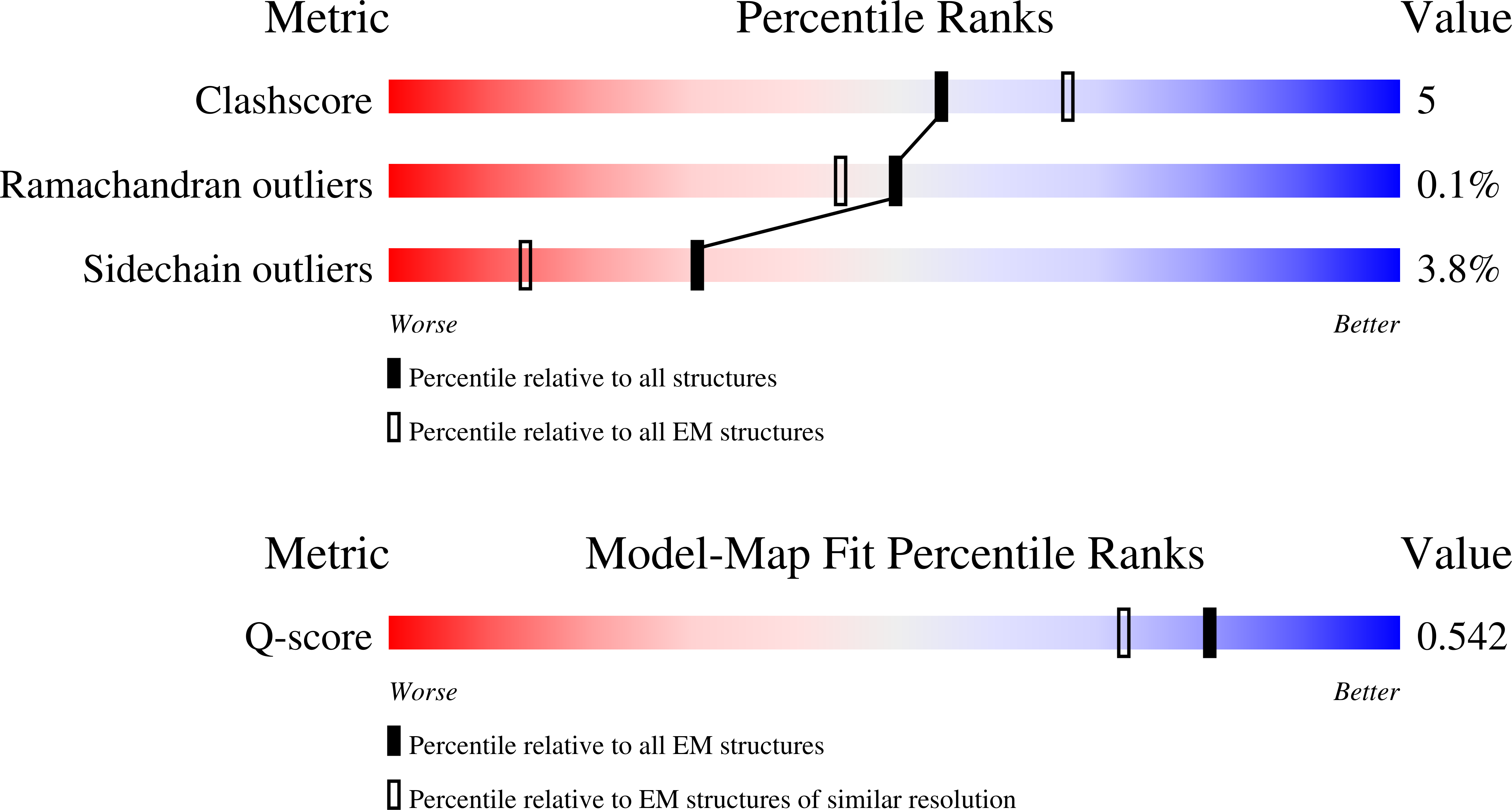
Resolution:
2.94 Å
Aggregation State:
PARTICLE
Reconstruction Method:
SINGLE PARTICLE
Macromolecular Entities
Structures with similar UniProt ID
Protein Blast
Polymer Type:polypeptide(L)
Molecule:DNA polymerase subunit gamma-1
Gene (Uniprot):POLG
Mutagens:D198A, E200A
Chain IDs:A
Chain Length:1239
Number of Molecules:1
Biological Source:Homo sapiens
Structures with similar UniProt ID
Protein Blast
Polymer Type:polypeptide(L)
Molecule:DNA polymerase subunit gamma-2, mitochondrial
Gene (Uniprot):POLG2
Chain IDs:B, C
Chain Length:485
Number of Molecules:2
Biological Source:Homo sapiens
Polymer Type:polydeoxyribonucleotide
Molecule:DNA (59-MER)
Chain IDs:D
Chain Length:77
Number of Molecules:1
Biological Source:synthetic construct
Primary Citation
Pol gamma possesses separate metal binding sites for polymerase and strand displacement functions.
Biorxiv ? ? ? (2026)
PMID: 41648309 DOI: 10.64898/2026.01.25.701366

Abstact

Accurate replication of mitochondrial genome (mtDNA) integrity, which is essential for cellular metabolism and energy supply, relies primarily on DNA polymerase gamma (Pol γ), Twinkle helicase, and mitochondrial single-stranded DNA binding protein (mtSSB). Twinkle alone exhibits little helicase activity while reports indicate that Pol γ displays from modest to limited unwinding activity. This led us to dissect Pol γ strand displacement activity using structural, biochemical and in silico approaches. Here, we show that human Pol γ carries out robust strand displacement synthesis at physiological concentrations of divalent metal ions which reveals that distinct metal-binding sites can independently regulate DNA synthesis and unwinding activities. We further showed that Pol γ can displace RNA/DNA hybrid with comparable efficiency as DNA/DNA duplex, representing a key implication on RNA primer removal to preserve mtDNA integrity. Our cryo-electron microscopy structures of Pol γ complexed with a template containing downstream dsDNA and an incoming nucleotide revealed the structural mechanism for the strand displacement activity. We identified four conformational states that represent successive stages of DNA unwinding, accompanied by coordinated rearrangement of the downstream DNA and Pol γ elements that mediate strand displacement. This work establishes biochemical and structural mechanisms of Pol γ strand displacement activity, providing fundamental insight into human mitochondrial DNA replication and integrity.

Legend

Protein

Chemical

Disease

Primary Citation of related structures
Feedback Form
Name
Email
Institute
Feedback