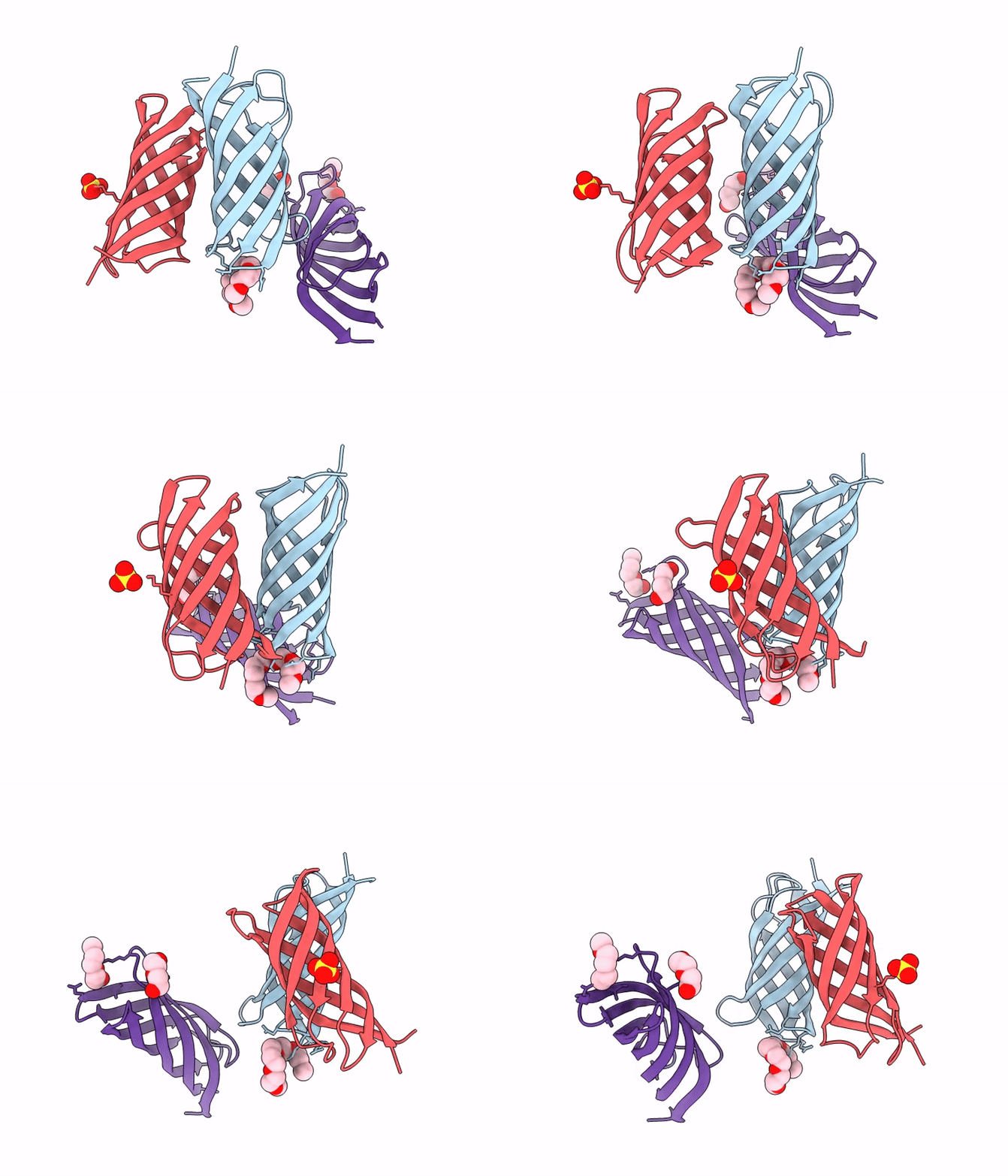
9XZT image
Deposition Date 2025-08-27
Release Date 2025-09-03
Last Version Date 2025-10-01
Entry Detail
PDB ID:
9XZT
Keywords:
Title:
Crystal structure of BBn6
Biological Source:
Source Organism:
Host Organism:
Method Details:
Experimental Method:
Resolution:
2.03 Å
R-Value Free:
0.26
R-Value Work:
0.21
R-Value Observed:
0.22
Space Group:
P 32 2 1
Macromolecular Entities
Polymer Type:polypeptide(L)
Molecule:BBn6
Chain IDs:A, B, C
Chain Length:94
Number of Molecules:3
Biological Source:synthetic construct
Primary Citation
Parametrically guided design of beta barrels and transmembrane nanopores using deep learning.
Proc.Natl.Acad.Sci.USA 122 e2425459122 e2425459122 (2025)
PMID: 40953261 DOI: 10.1073/pnas.2425459122

Abstact

Francis Crick's global parameterization of coiled coil geometry has been widely useful for guiding design of new protein structures and functions. However, design guided by similar global parameterization of beta barrel structures has been less successful, likely due to the deviations from ideal barrel geometry required to maintain interstrand hydrogen bonding without introducing backbone strain. Instead, beta barrels have been designed using two-dimensional structural blueprints; while this approach has successfully generated new fluorescent proteins, transmembrane nanopores, and other structures, it requires expert knowledge and provides only indirect control over the global shape. Here, we show that the simplicity and control over shape and structure provided by parametric representations can be generalized beyond coiled coils by taking advantage of the rich sequence-structure relationships implicit in RoseTTAFold-based design methods. Starting from parametrically generated barrel backbones, both RFjoint inpainting and RFdiffusion readily incorporate backbone irregularities necessary for proper folding with minimal deviation from the idealized barrel geometries. We show that for beta barrels across a broad range of beta sheet parameterizations, these methods achieve high in silico and experimental success rates, with atomic accuracy confirmed by an X-ray crystal structure of a rare barrel topology, and de novo designed transmembrane nanopores with conductances ranging from 200 to 500 pS. By combining the simplicity and control of parametric generation with the high success rates of deep learning-based protein design methods, our approach makes the design of proteins where global shape confers function, such as beta barrel nanopores, more precisely specifiable and accessible.

Legend

Protein

Chemical

Disease

Primary Citation of related structures
Feedback Form
Name
Email
Institute
Feedback