9XQN image
Deposition Date 2025-11-18
Release Date 2026-02-04
Last Version Date 2026-02-04
Entry Detail
PDB ID:
9XQN
Title:
Cryo-EM structure of apo form of GPR75-bRIL-Fab complex
Biological Source:
Source Organism(s):
Homo sapiens (Taxon ID: 9606)
Escherichia coli (Taxon ID: 562)
Expression System(s):
Method Details:
Experimental Method:
Resolution:
3.91 Å
Aggregation State:
PARTICLE
Reconstruction Method:
SINGLE PARTICLE
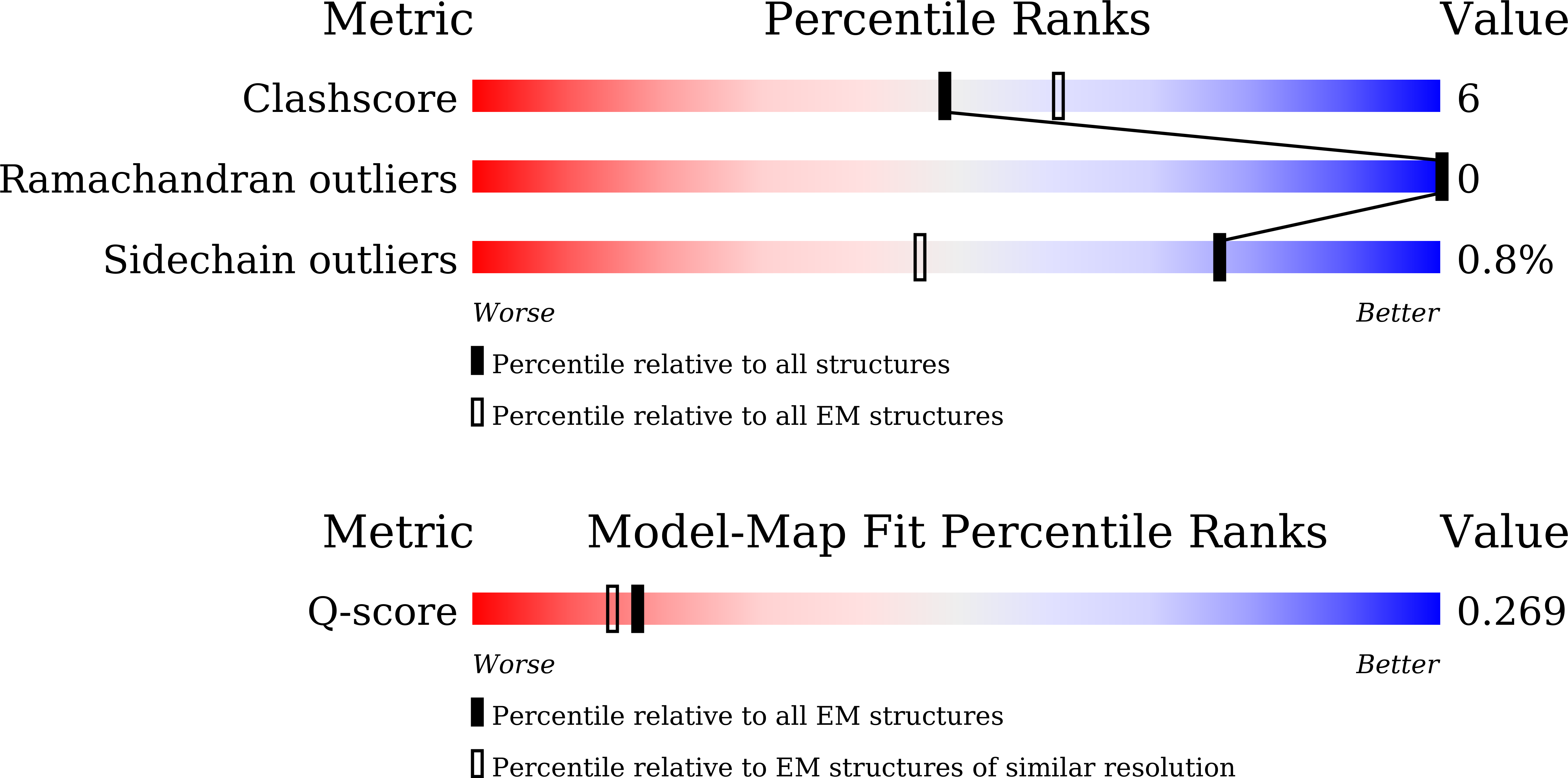
Macromolecular Entities
Structures with similar UniProt ID
Protein Blast
Polymer Type:polypeptide(L)
Molecule:Probable G-protein coupled receptor 75,Soluble cytochrome b562
Gene (Uniprot):GPR75
Chain IDs:A
Chain Length:422
Number of Molecules:1
Biological Source:Homo sapiens, Escherichia coli
Polymer Type:polypeptide(L)
Molecule:Fab24 H
Chain IDs:B
Chain Length:107
Number of Molecules:1
Biological Source:Homo sapiens
Polymer Type:polypeptide(L)
Molecule:Fab24 L
Chain IDs:C
Chain Length:121
Number of Molecules:1
Biological Source:Homo sapiens
Ligand Molecules
Primary Citation
Cryo-EM structures of GPR75 reveal an occluded orthosteric pocket challenging conventional drug discovery paradigms for an anti-obesity target.
Acta Pharmacol.Sin. ? ? ? (2026)
PMID: 41545757 DOI: 10.1038/s41401-025-01720-6

Abstact

The global obesity epidemic, affecting over 650 million adults, demands innovative therapeutics. GPR75 has emerged as a promising anti-obesity target, with genetic evidence linking loss-of-function variants to protection against obesity and type 2 diabetes. However, structural insights have remained elusive due to GPR75's inherent expression and stabilization challenges. Here we present the cryo-EM structures of human GPR75 in apo and Gq-coupled states, achieved through advanced stabilization techniques including NanoBiT and molecular glue approaches. Our structures reveal unique architectural features: a completely collapsed extracellular domain eliminates the traditional orthosteric binding pocket, raising critical questions about previously reported small molecule ligands. GPR75 assumes active-like conformation in both apo and G protein complexed structures through unique molecular switches-the canonical DRY motif is replaced by HRL, abolishing the ionic lock, while a distinctive Lys134-Asp210 salt bridge stabilizes the active conformation without ligand binding. This dramatic structural divergence from conventional GPCRs necessitates alternative therapeutic strategies targeting allosteric sites or protein-protein interactions rather than orthosteric pockets. Our findings establish a crucial structural framework for developing next-generation anti-obesity therapeutics.

Legend

Protein

Chemical

Disease

Primary Citation of related structures
Feedback Form
Name
Email
Institute
Feedback