9XCG image
Deposition Date 2025-10-25
Release Date 2026-01-14
Last Version Date 2026-02-18
Entry Detail
PDB ID:
9XCG
Title:
Cryo-EM structure of csy3 with crRNA
Biological Source:
Source Organism(s):
Expression System(s):
Method Details:
Experimental Method:
Resolution:
4.85 Å
Aggregation State:
PARTICLE
Reconstruction Method:
SINGLE PARTICLE
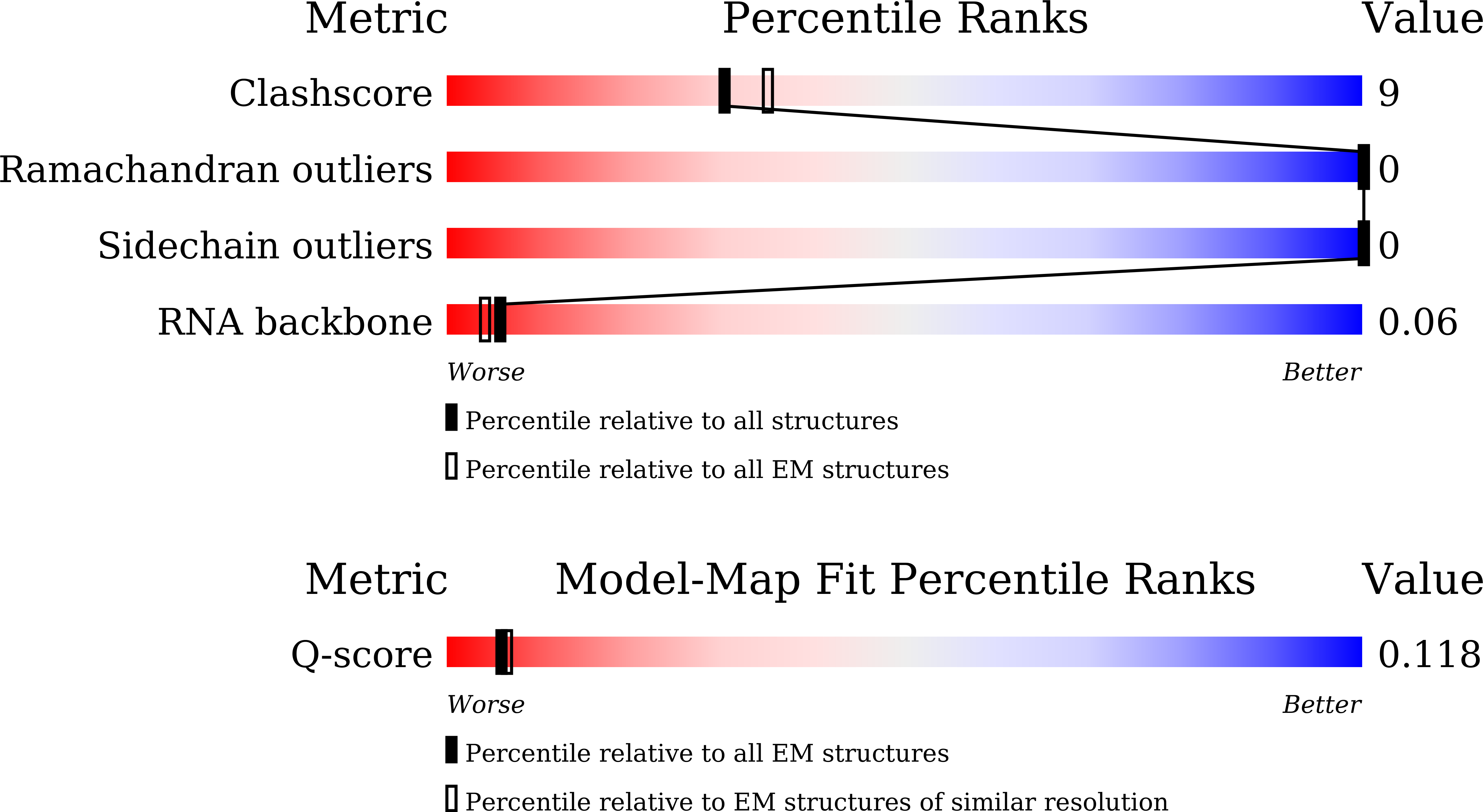
Macromolecular Entities
Structures with similar UniProt ID
Protein Blast
Polymer Type:polypeptide(L)
Molecule:CRISPR-associated protein Csy3
Gene (Uniprot):csy3
Chain IDs:A, B (auth: C), C (auth: D), D (auth: E), E (auth: F), F (auth: G), G (auth: I), H (auth: J), I (auth: K), J (auth: L), L (auth: B), M (auth: H), N, O, P, Q, R (auth: S), S (auth: T), T (auth: U), U (auth: V), V (auth: W), W (auth: Y), X (auth: Z), Y (auth: a), Z (auth: b), AA (auth: f)
Chain Length:337
Number of Molecules:26
Biological Source:Pectobacterium atrosepticum SCRI1043
Polymer Type:polyribonucleotide
Molecule:RNA (159-MER)
Chain IDs:K (auth: M)
Chain Length:159
Number of Molecules:1
Biological Source:Thiocystis violascens
Ligand Molecules
Primary Citation
RNA anti-CRISPRs deplete Cas proteins to inhibit the CRISPR-Cas system.
Mol.Cell 86 317 ? (2026)
PMID: 41475348 DOI: 10.1016/j.molcel.2025.12.005

Abstact

RNA-based anti-CRISPRs (Racrs) interfere with the type I-F CRISPR-Cas system by mimicking the repeats found in CRISPR arrays. Here, we determined the cryo-electron microscopy (cryo-EM) structures of the type I-F crRNA-guided surveillance complex (Csy complex) from Pectobacterium atrosepticum and three RacrIF1-induced aberrant subcomplexes. Additionally, we observed that Cas7f proteins could bind to non-specific nucleic acids, forming right-handed superhelical filaments composed of different Cas7 copies. Mechanistically, RacrIF1 lacks the specific S-conformation observed in the corresponding position of the 5' handle in canonical CRISPR complexes, and it instead adopts a periodic "5 + 1" pattern. This conformation creates severe steric hindrance for Cas5f-Cas8f heterodimer and undermines their binding. Furthermore, Cas7f nonspecifically binds nucleic acids and can form infinite superhelical filaments along Racrs molecules. This oligomerization sequesters Cas6f and Cas7f from binding, therefore blocking the formation of functional CRISPR-Cas effector complexes and ultimately blocking antiviral immunity. Our study provides a structural basis underlying Racrs-mediated CRISPRs inhibition.

Legend

Protein

Chemical

Disease

Primary Citation of related structures
Feedback Form
Name
Email
Institute
Feedback