9WZB image
Deposition Date 2025-09-29
Release Date 2025-12-10
Last Version Date 2025-12-10
Entry Detail
PDB ID:
9WZB
Keywords:
Title:
K21E/K22E-ASC CARD filament
Biological Source:
Source Organism:
Homo sapiens (Taxon ID: 9606)
Host Organism:
Method Details:
Experimental Method:
Resolution:
2.67 Å
Aggregation State:
FILAMENT
Reconstruction Method:
HELICAL
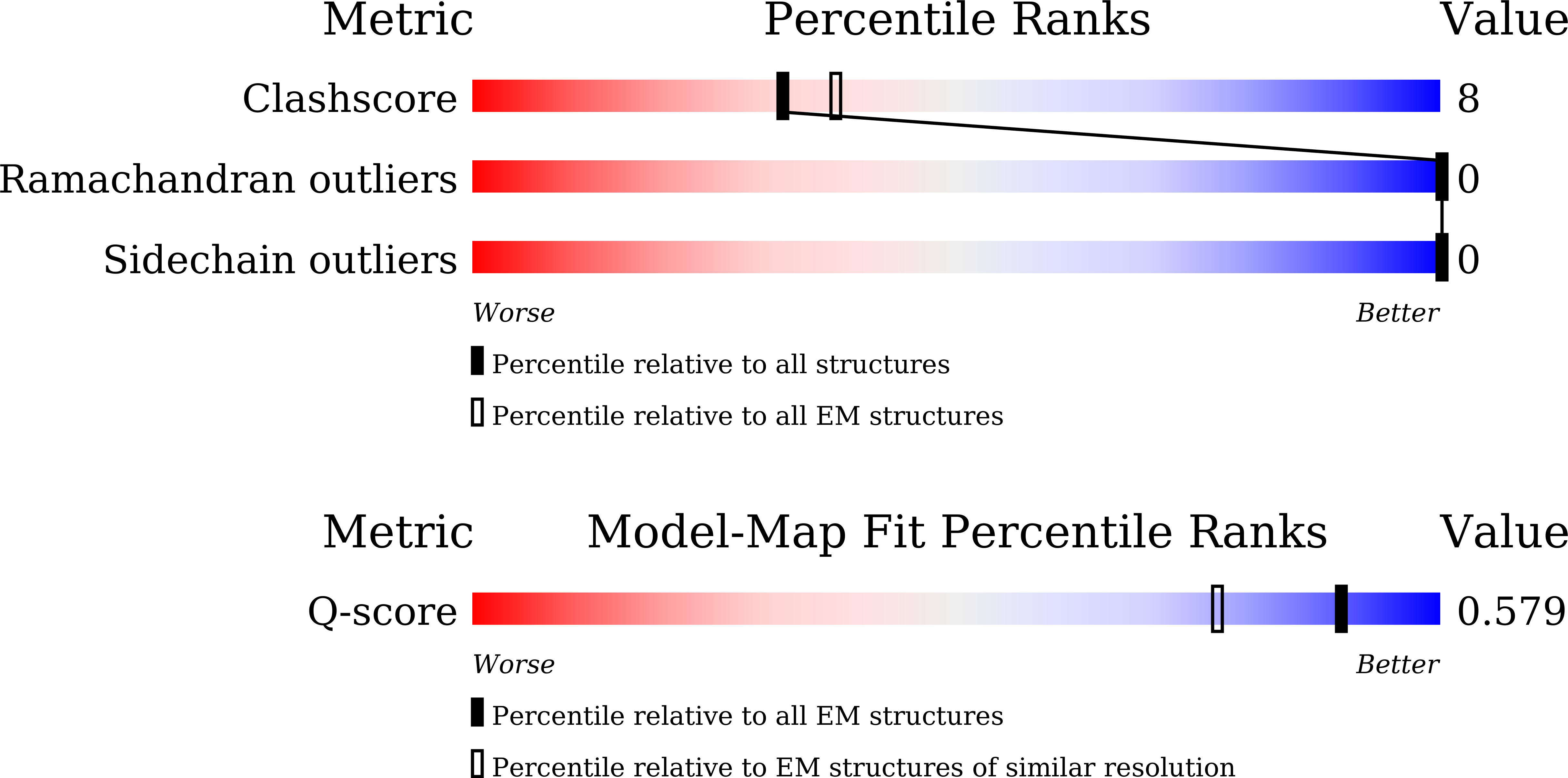
Macromolecular Entities
Structures with similar UniProt ID
Protein Blast
Polymer Type:polypeptide(L)
Molecule:Apoptosis-associated speck-like protein containing a CARD
Gene (Uniprot):PYCARD
Mutagens:K21E,K22E
Chain IDs:A, B, C, D, E, F, G, H, I, J, K, L
Chain Length:195
Number of Molecules:12
Biological Source:Homo sapiens
Ligand Molecules
Primary Citation
Atomic mechanisms of full-length ASC-mediated inflammasome assembly.
Nat Commun 16 10564 10564 (2025)
PMID: 41298390 DOI: 10.1038/s41467-025-65578-2

Abstact

ASC (Apoptosis-associated Speck-like protein containing a CARD) is a key adaptor protein that assembles inflammasomes by linking sensors such as NLRP3 to effectors like Caspase-1 via its PYD and CARD Death Domains. Due to ASC's propensity to self-aggregate, most high-resolution structural studies focused on isolated PYD or CARD domains, leaving the atomic basis of full-length ASC assembly unknown. Here we determine atomic-resolution cryo-EM structures of PYD and CARD filaments from full-length ASC, revealing characteristic multitrack bundles composed of alternating ASCPYD and ASCCARD filaments that expose multiple interfaces for flexible assembly and efficient signaling. We further show that Caspase-1 filaments nucleate specifically from the B-end of ASCCARD filaments, and that the interdomain linker modulates bundle formation. The ASC isoform ASCb, with a four-residue linker, adopts a distinct architecture, correlating with reduced Caspase-1 activation efficiency. In ASC⁻/⁻ THP-1 cells, only wild-type ASC, not interface-disrupting mutants, restored ASC speck formation and Caspase-1 activation, underscoring the requirement for intact multitrack bundles. Cryo-electron tomography captures snapshots of higher-order inflammasome structures. These findings collectively define the structural and functional principles by which ASC organizes inflammasomes to amplify immune signaling.

Legend

Protein

Chemical

Disease

Primary Citation of related structures
Feedback Form
Name
Email
Institute
Feedback