9WY8 image
Deposition Date 2025-09-26
Release Date 2026-01-21
Last Version Date 2026-01-21
Entry Detail
PDB ID:
9WY8
Keywords:
Title:
Cryo-EM structure of the hexameric DRT6
Biological Source:
Source Organism(s):
Expression System(s):
Method Details:
Experimental Method:
Resolution:
2.69 Å
Aggregation State:
PARTICLE
Reconstruction Method:
SINGLE PARTICLE
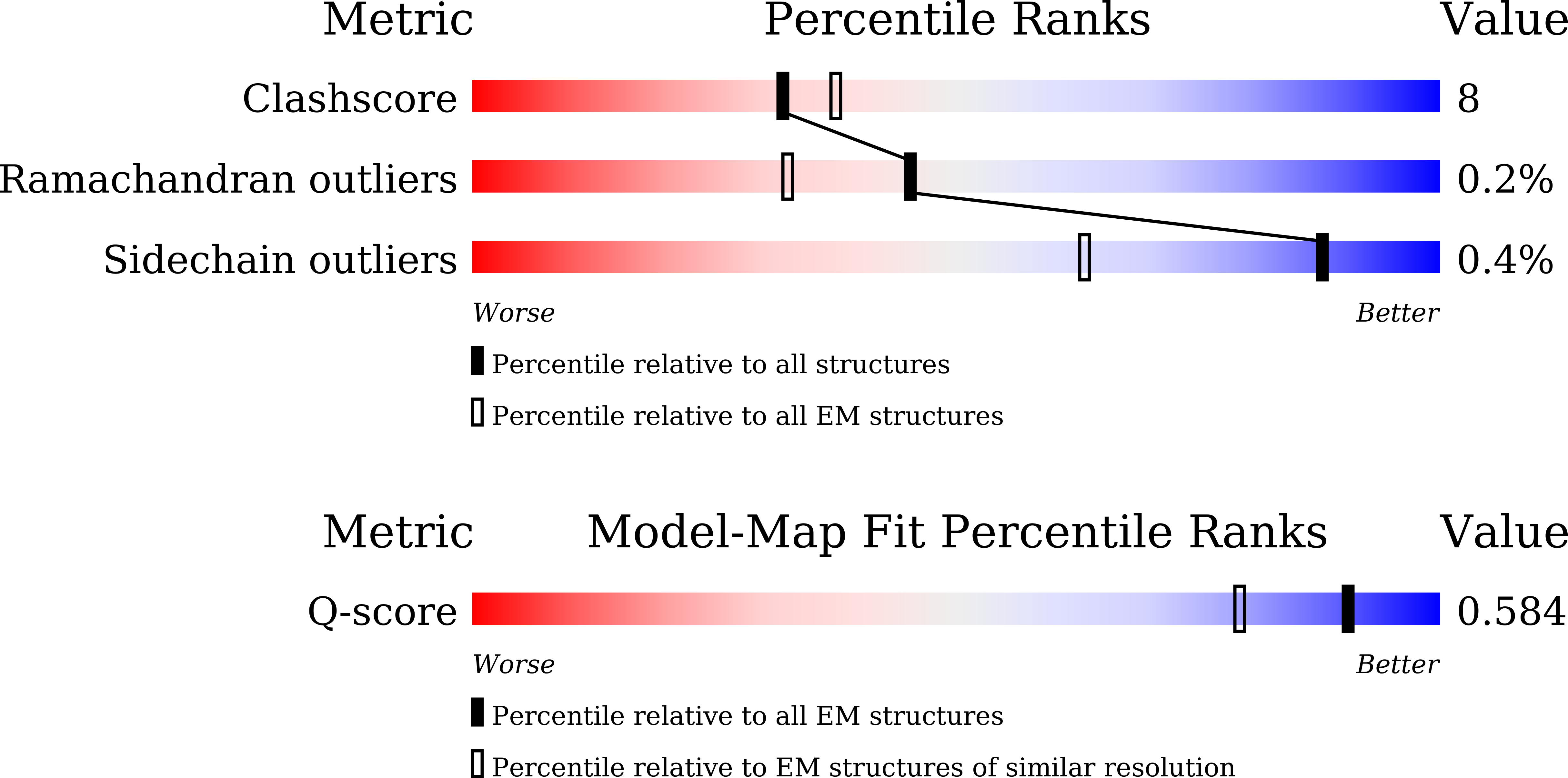
Macromolecular Entities
Structures with similar UniProt ID
Protein Blast
Polymer Type:polypeptide(L)
Molecule:Maltose/maltodextrin-binding periplasmic protein,Reverse transcriptase domain-containing protein
Gene (Uniprot):malE
Chain IDs:A, B, C, D, E, F
Chain Length:962
Number of Molecules:6
Biological Source:Escherichia coli (strain K12), Escherichia coli
Ligand Molecules
Primary Citation
Cryo-EM structure of the bacterial anti-phage defense system DRT6.
Biochem.Biophys.Res.Commun. 791 152955 152955 (2025)
PMID: 41223699 DOI: 10.1016/j.bbrc.2025.152955

Abstact

Defense-associated reverse transcriptases (DRTs) were recently identified with anti-phage function. Among them, DRT6 represents a single-gene-encoded anti-phage system that confers resistance to multiple DNA bacteriophages; however, its structural basis and mechanism of action remain unknown. Here, we determined a high-resolution cryo-EM structure of DRT6, revealing that it assembles into a hexamer composed of two trimers arranged in a back-to-back configuration. Structure-guided mutagenesis demonstrated that the integrity of this hexameric interface is critical for both the stability and anti-phage activity of DRT6. Comparative structural analysis showed that DRT6 shares notable similarity with the anti-phage protein AbiK. Intriguingly, the thumb subdomain of its reverse transcriptase domain is replaced by an α-helical repeat (αRep) domain, forming a positively charged channel that likely mediates nucleic acid binding. Nevertheless, DRT6 differs from AbiK in the position of its priming amino acid, suggesting distinct functional mechanisms. Together, this work reports the first atomic structure of DRT6, elucidates the molecular basis of its functional oligomerization, and provides insights into the anti-phage mechanism.

Legend

Protein

Chemical

Disease

Primary Citation of related structures
Feedback Form
Name
Email
Institute
Feedback