9WSW image
Deposition Date 2025-09-15
Release Date 2025-11-26
Last Version Date 2025-12-24
Entry Detail
PDB ID:
9WSW
Title:
Cryo-EM structure of endomorphin-1-muOR-Gz-scFv16 complex
Biological Source:
Source Organism(s):
Homo sapiens (Taxon ID: 9606)
Mus musculus (Taxon ID: 10090)
synthetic construct (Taxon ID: 32630)
Expression System(s):
Method Details:
Experimental Method:
Resolution:
2.80 Å
Aggregation State:
PARTICLE
Reconstruction Method:
SINGLE PARTICLE
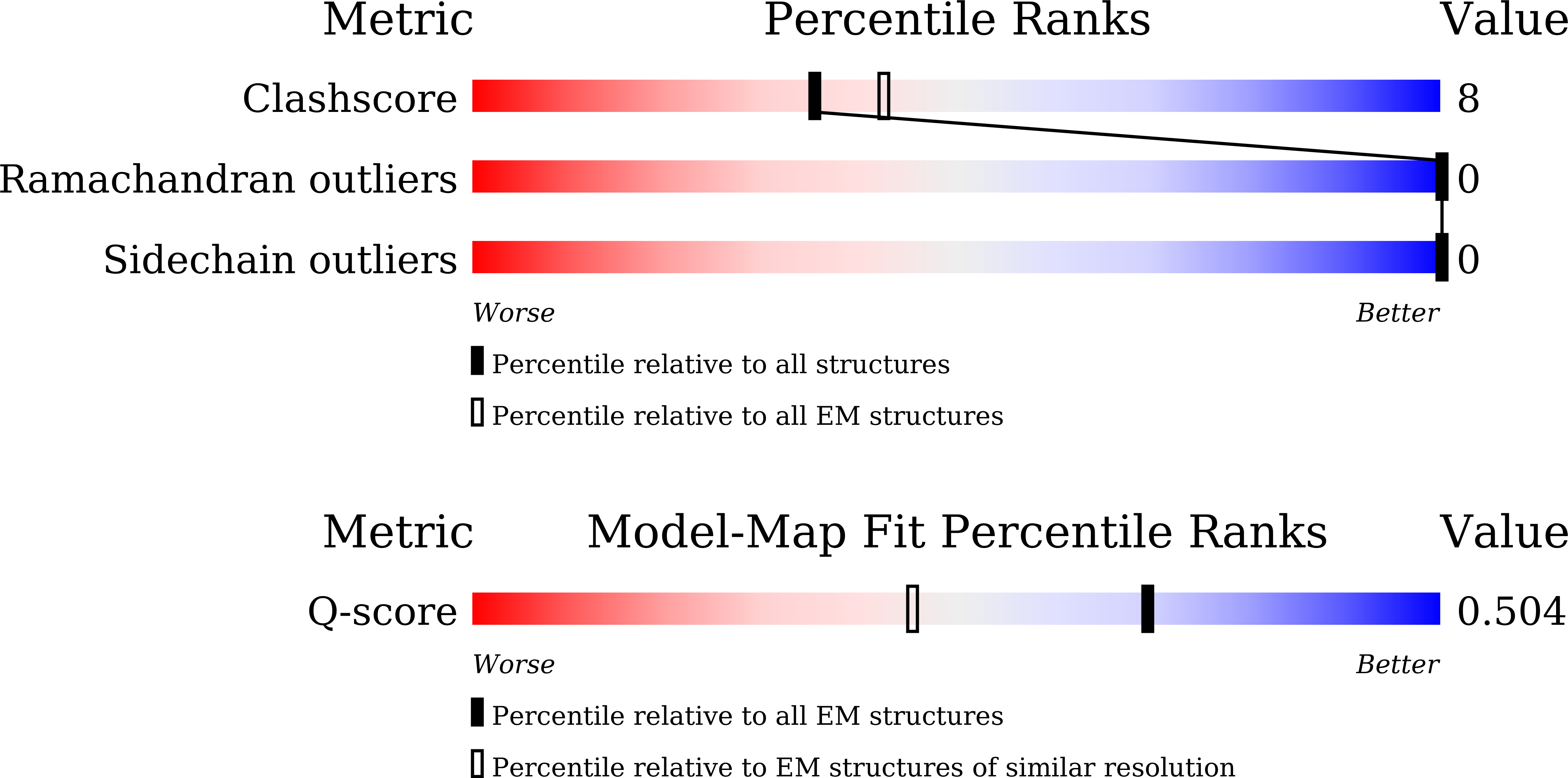
Macromolecular Entities
Polymer Type:polypeptide(L)
Molecule:Engineered guanine nucleotide-binding protein G(z) subunit alpha
Chain IDs:A
Chain Length:355
Number of Molecules:1
Biological Source:Homo sapiens
Structures with similar UniProt ID
Protein Blast
Polymer Type:polypeptide(L)
Molecule:Guanine nucleotide-binding protein G(I)/G(S)/G(T) subunit beta-1
Gene (Uniprot):GNB1
Chain IDs:B
Chain Length:371
Number of Molecules:1
Biological Source:Homo sapiens
Structures with similar UniProt ID
Protein Blast
Polymer Type:polypeptide(L)
Molecule:Guanine nucleotide-binding protein G(I)/G(S)/G(O) subunit gamma-2
Gene (Uniprot):GNG2
Chain IDs:C (auth: G)
Chain Length:71
Number of Molecules:1
Biological Source:Homo sapiens
Polymer Type:polypeptide(L)
Molecule:endomorphin-1
Chain IDs:E (auth: P)
Chain Length:5
Number of Molecules:1
Biological Source:synthetic construct
Protein Blast
Polymer Type:polypeptide(L)
Molecule:Mu-type opioid receptor,Vasopressin V2 receptor
Gene (Uniprot):AVPR2, Oprm1
Chain IDs:D (auth: R)
Chain Length:386
Number of Molecules:1
Biological Source:Mus musculus, Homo sapiens
Primary Citation
The molecular basis of mu-opioid receptor signaling plasticity.
Cell Res. 35 1021 1036 (2025)
PMID: 41199005 DOI: 10.1038/s41422-025-01191-8

Abstact

Activation of the μ-opioid receptor (μOR) alleviates pain but also elicits adverse effects through diverse G proteins and β-arrestins. The structural details of μOR complexes with Gz and β-arrestins have not been determined, impeding a comprehensive understanding of μOR signaling plasticity. Here, we present the cryo-EM structures of the μOR-Gz and μOR-βarr1 complexes, revealing selective conformational preferences of μOR when engaged with specific downstream signaling transducers. Integrated receptor pharmacology, including high-resolution structural analysis, cell signaling assays, and molecular dynamics simulations, demonstrated that transmembrane helix 1 (TM1) acts as an allosteric regulator of μOR signaling bias through differential stabilization of the Gi-, Gz-, and βarr1-bound states. Mechanistically, outward TM1 displacement confers structural flexibility that promotes G protein recruitment, whereas inward TM1 retraction facilitates βarr1 recruitment by stabilizing the intracellular binding pocket through coordinated interactions with TM2, TM7, and helix8. Structural comparisons between the Gi-, Gz-, and βarr1-bound complexes identified a TM1-fusion pocket with significant implications for downstream signaling regulation. Overall, we demonstrate that the conformational and thermodynamic heterogeneity of TM1 allosterically drives the downstream signaling specificity and plasticity of μOR, thereby expanding the understanding of μOR signal transduction mechanisms and providing new avenues for the rational design of analgesics.

Legend

Protein

Chemical

Disease

Primary Citation of related structures
Feedback Form
Name
Email
Institute
Feedback