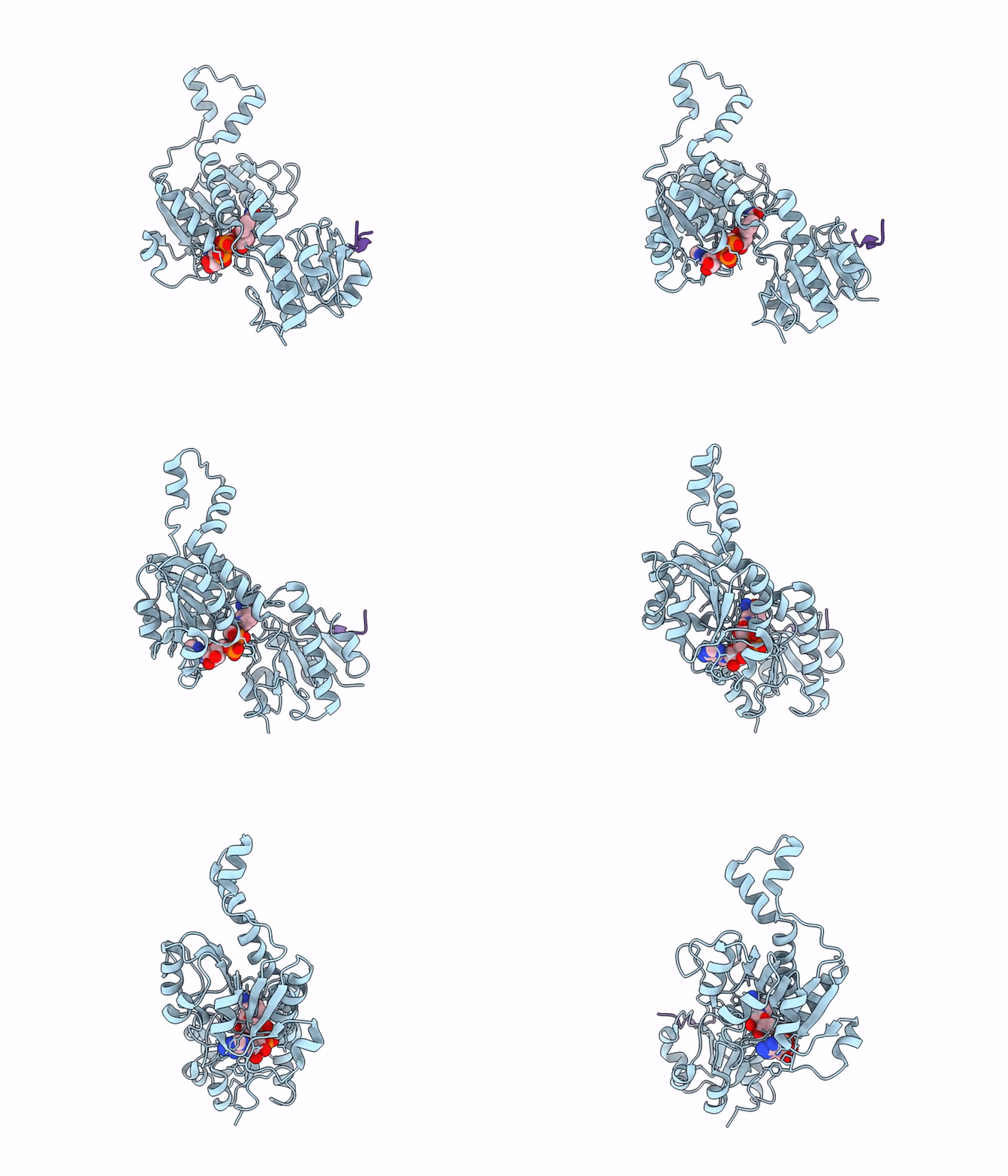
9WRJ image
Deposition Date 2025-09-12
Release Date 2026-01-28
Last Version Date 2026-01-28
Entry Detail
PDB ID:
9WRJ
Keywords:
Title:
Crystal structure of CtBP1 in complex with PALI1
Biological Source:
Source Organism(s):
Homo sapiens (Taxon ID: 9606)
Expression System(s):
Method Details:
Experimental Method:
Resolution:
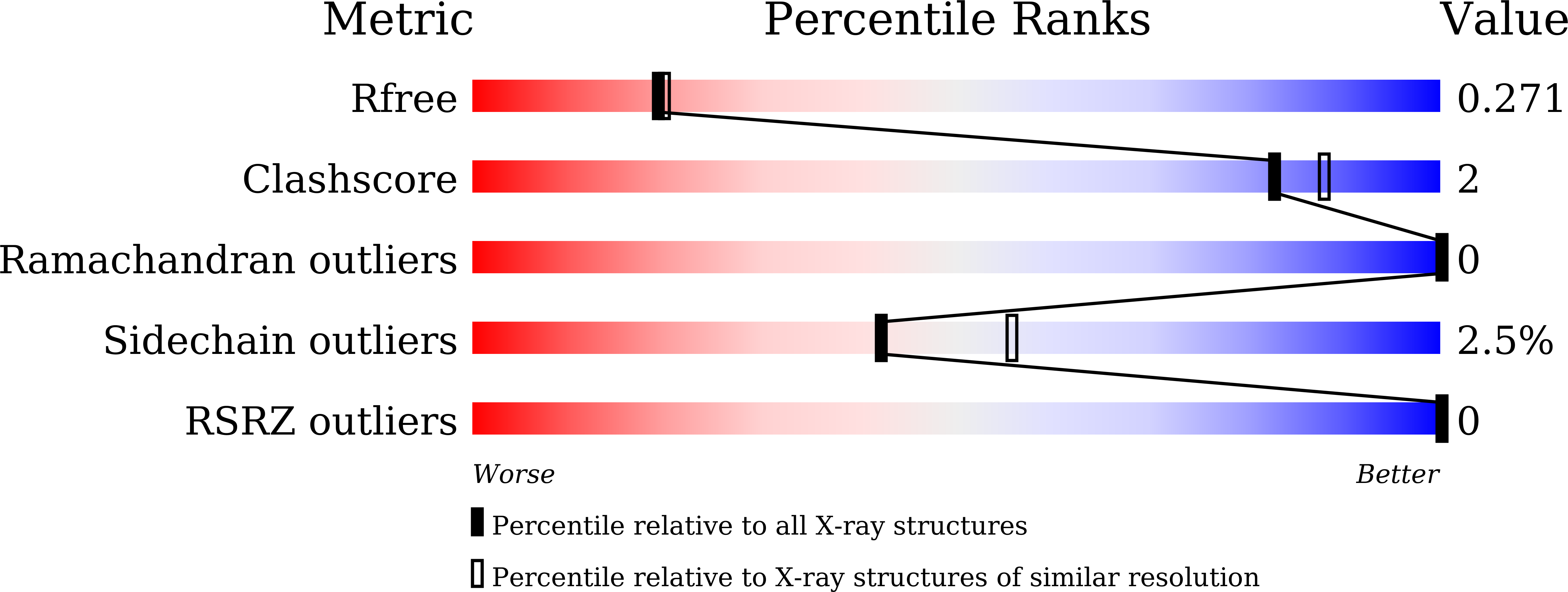
2.20 Å
R-Value Free:
0.26
R-Value Work:
0.19
R-Value Observed:
0.20
Space Group:
P 64 2 2
Macromolecular Entities
Structures with similar UniProt ID
Protein Blast
Polymer Type:polypeptide(L)
Molecule:C-terminal-binding protein 1
Gene (Uniprot):CTBP1
Chain IDs:A
Chain Length:353
Number of Molecules:1
Biological Source:Homo sapiens
Structures with similar UniProt ID
Protein Blast
Polymer Type:polypeptide(L)
Molecule:Ligand-dependent corepressor
Gene (Uniprot):LCOR
Chain IDs:B
Chain Length:20
Number of Molecules:1
Biological Source:Homo sapiens
Ligand Molecules
Primary Citation
PALI1 enhances CtBP1/2 oligomerization and couples CtBP1/2 to PRC2.
Biochem.Biophys.Res.Commun. 800 153295 153295 (2026)
PMID: 41547303 DOI: 10.1016/j.bbrc.2026.153295

Abstact

Polycomb Repressive Complex 2 (PRC2) and C-terminal binding proteins 1 and 2 (CtBP1/2) are key epigenetic regulators that frequently co-occupy chromatin, yet their crosstalk remains poorly understood. Here, we delineate the molecular basis of the interaction between CtBP1/2 and the N-terminal domain of PALI1, an accessory subunit of PRC2. The PALI1 N-terminus contains two DLS-like motifs that bind CtBP1/2 bivalently, enhancing affinity and promoting higher-order oligomerization. Conversely, disruption of CtBP1/2 oligomerization weakens PALI1 binding, revealing a reciprocal mechanism stabilizing the CtBP1/2-PALI1 complex. The 2.20 Å structure of the CtBP1-PALI1 complex reveals the detailed interaction interface, which, together with biochemical data, supports a model where tandem DLS-like motifs drive CtBP1/2 oligomerization and multivalent engagement. Through its C-terminal PRC2-binding domain, PALI1 acts as a dual-interface scaffold linking CtBP1/2 and PRC2, providing a structural framework for their coordinated chromatin recruitment and transcriptional repression.

Legend

Protein

Chemical

Disease

Primary Citation of related structures
Feedback Form
Name
Email
Institute
Feedback