9WRI image
Deposition Date 2025-09-12
Release Date 2026-01-21
Last Version Date 2026-01-21
Entry Detail
PDB ID:
9WRI
Keywords:
Title:
Crystal structure of CtBP2 in complex with G9a
Biological Source:
Source Organism(s):
Homo sapiens (Taxon ID: 9606)
Expression System(s):
Method Details:
Experimental Method:
Resolution:
1.85 Å
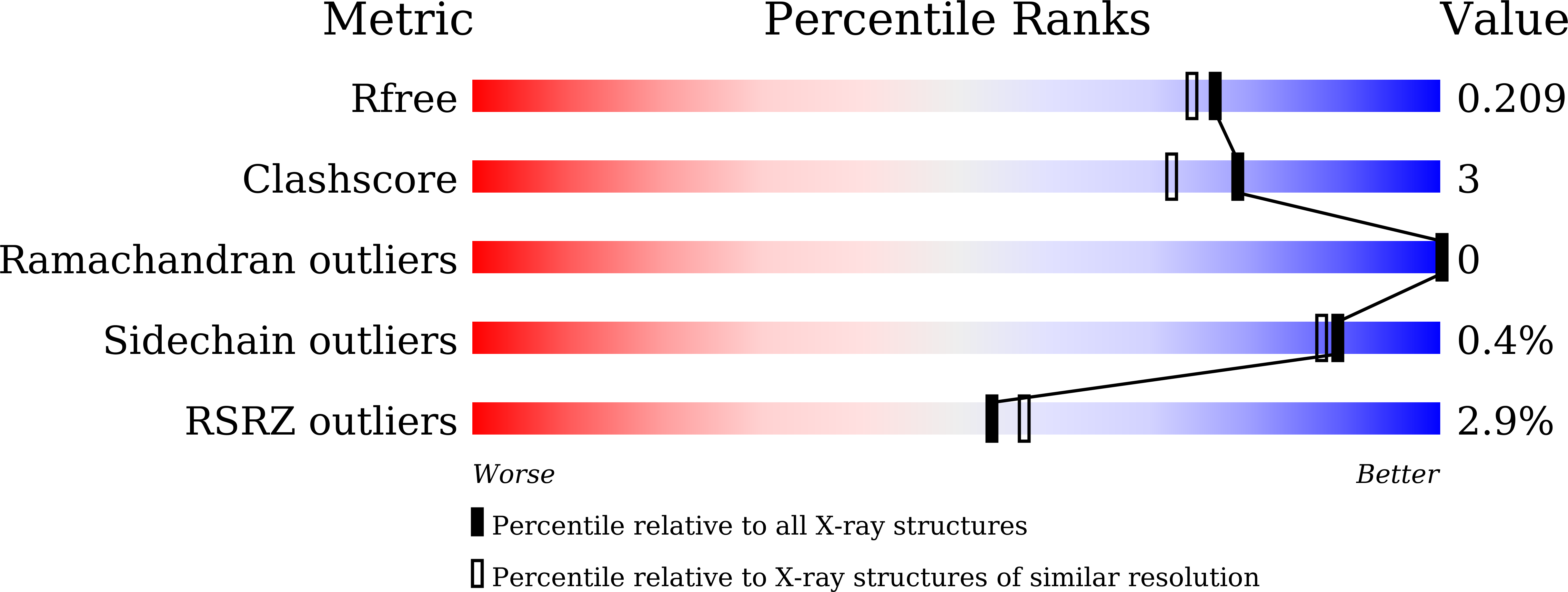
R-Value Free:
0.20
R-Value Work:
0.16
R-Value Observed:
0.16
Space Group:
H 3 2
Macromolecular Entities
Structures with similar UniProt ID
Protein Blast
Polymer Type:polypeptide(L)
Molecule:C-terminal-binding protein 2
Gene (Uniprot):CTBP2
Chain IDs:A, B
Chain Length:336
Number of Molecules:2
Biological Source:Homo sapiens
Structures with similar UniProt ID
Protein Blast
Polymer Type:polypeptide(L)
Molecule:Histone-lysine N-methyltransferase EHMT2
Gene (Uniprot):EHMT2
Chain IDs:C
Chain Length:13
Number of Molecules:1
Biological Source:Homo sapiens
Ligand Molecules
Primary Citation
CtBP1/2 oligomerization promotes G9a-Mediated transcriptional repression.
J.Biol.Chem. 302 111063 111063 (2025)
PMID: 41419197 DOI: 10.1016/j.jbc.2025.111063

Abstact

Corepressors CtBP1 and CtBP2 (CtBP1/2) are evolutionarily conserved transcriptional regulators that repress gene expression by recruiting chromatin modifiers, yet the structural basis of this process remains elusive. Here, we identify a direct interaction between CtBP1/2 and the histone H3 lysine 9 (H3K9) methyltransferase G9a. Crystallographic and biochemical analyses reveal that a CtBP1/2 tetramer simultaneously engages two G9a molecules through a motif within the pre-SET domain of G9a, which is absent in its paralog GLP. This interaction enhances G9a catalytic activity in a manner strictly dependent on the oligomeric state of CtBP1/2. Disruption of CtBP2 tetramerization diminishes its association with G9a and abolishes enzymatic activation, underscoring the functional importance of CtBP1/2 oligomerization. In colorectal cancer (CRC) cells, CtBP2 and G9a co-occupy the PTEN promoter, where disruption of their interface reduces H3K9me2 deposition, derepresses PTEN expression, attenuates PI3K-AKT signaling, and impairs CRC cell proliferation. Together, these findings establish a structural framework for CtBP-mediated regulation of G9a activity and highlight the CtBP1/2-G9a complex as a potential therapeutic target in colorectal cancer.

Legend

Protein

Chemical

Disease

Primary Citation of related structures
Feedback Form
Name
Email
Institute
Feedback