9WJW image
Deposition Date 2025-08-31
Release Date 2025-11-12
Last Version Date 2026-01-28
Entry Detail
PDB ID:
9WJW
Title:
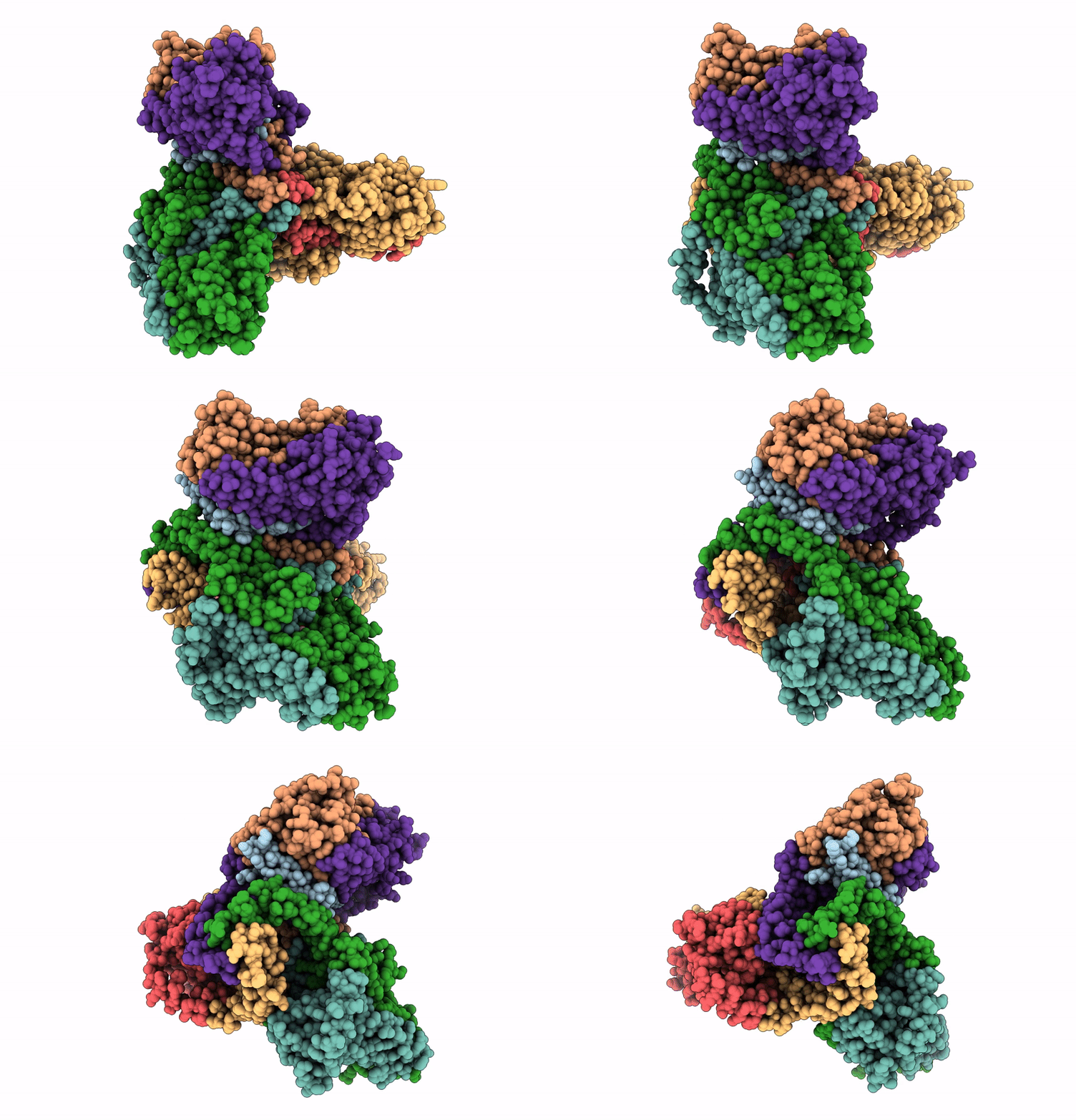
Cryo-EM structure of the GarQ-lmYZ complex
Biological Source:
Source Organism(s):
Method Details:
Experimental Method:
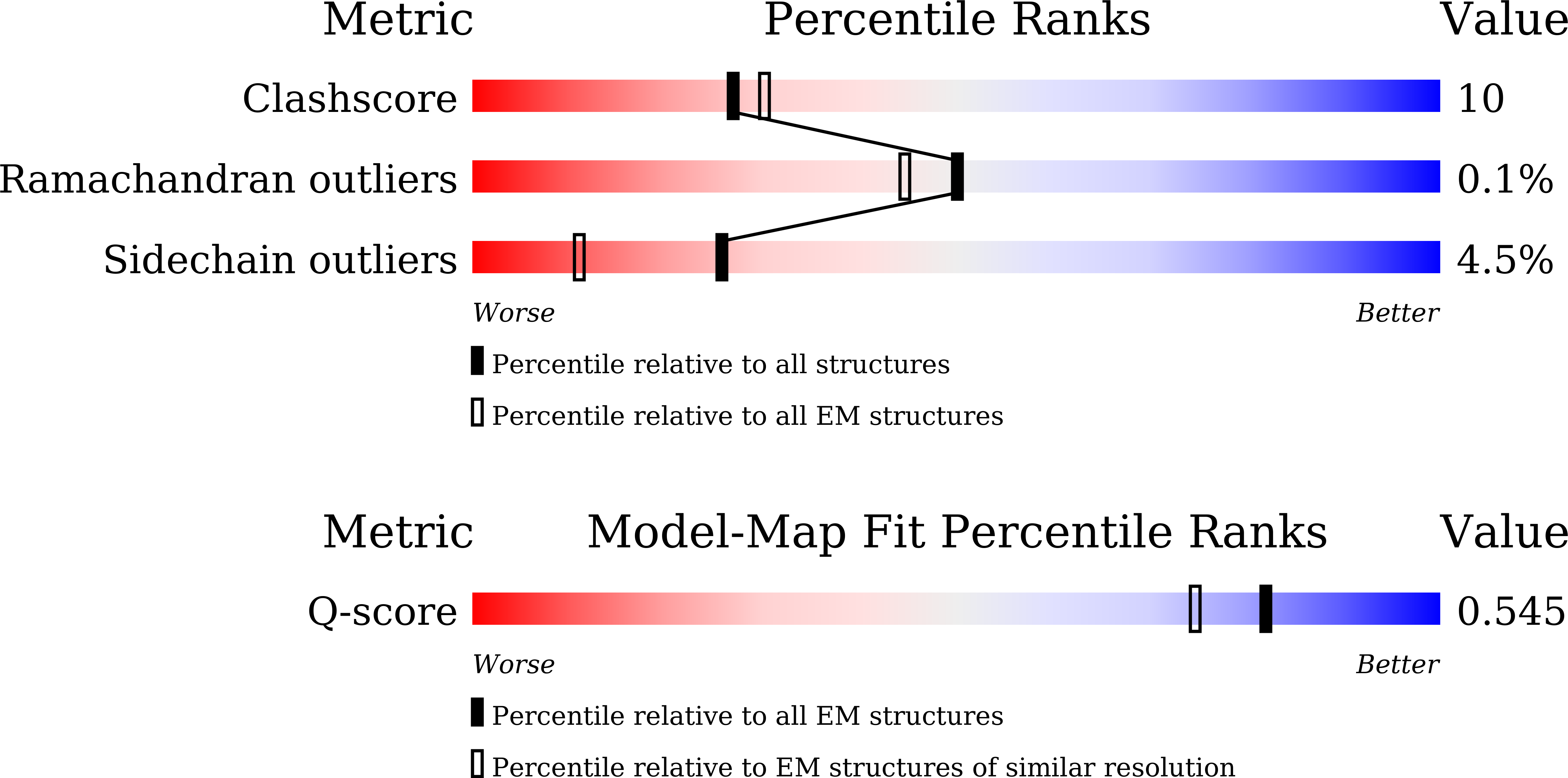
Resolution:
2.96 Å
Aggregation State:
PARTICLE
Reconstruction Method:
SINGLE PARTICLE
Macromolecular Entities
Structures with similar UniProt ID
Protein Blast
Polymer Type:polypeptide(L)
Molecule:Prepeptide GarQ
Gene (Uniprot):garQ
Chain IDs:E (auth: A)
Chain Length:50
Number of Molecules:1
Biological Source:Lactococcus garvieae
Structures with similar UniProt ID
Protein Blast
Polymer Type:polypeptide(L)
Molecule:Mannose/fructose/sorbose family PTS transporter subunit IIC
Gene (Uniprot):sorA
Chain IDs:A (auth: F), C (auth: S), F (auth: Y)
Chain Length:268
Number of Molecules:3
Biological Source:Listeria monocytogenes
Structures with similar UniProt ID
Protein Blast
Polymer Type:polypeptide(L)
Molecule:PTS mannose family transporter subunit IID
Gene (Uniprot):E5H26_12035, FZW82_08485, GIH49_05195, IP987_000531
Chain IDs:B (auth: G), D (auth: T), G (auth: Z)
Chain Length:303
Number of Molecules:3
Biological Source:Listeria monocytogenes
Ligand Molecules
Primary Citation
Structural basis for the extended-spectrum antimicrobial activity of Garvieacin Q.
Appl.Environ.Microbiol. ? e0177325 e0177325 (2026)
PMID: 41562606 DOI: 10.1128/aem.01773-25

Abstact

Class IIa and IId bacteriocins are antimicrobial peptides with potential for combating antibiotic-resistant pathogens. However, their species-specific activity, dictated by recognition of the mannose phosphotransferase system (Man-PTS) receptor, often restricts their spectrum. Garvieacin Q/Garvicin Q (GarQ), a newly identified class IId bacteriocin, is unusual in that it targets both Lactococcus garvieae and the non-lactococcal pathogen Listeria monocytogenes, yet the structural basis for this cross-species activity has remained unclear. Using cryo-electron microscopy, we determined the structures of GarQ bound to Man-PTS receptors from Lactococcus garvieae and Listeria monocytogenes. In Lactococcus garvieae, the receptor contains a unique Tudor-like γ+ domain that sterically constrains the N terminus of incoming bacteriocins, thereby enforcing specificity for GarQ while excluding others such as lactococcin A (LcnA). In Listeria monocytogenes, GarQ engages the receptor through the same conserved binding mode, effectively bypassing the unusual species barrier. We further demonstrate that the C-terminal length of GarQ is a critical determinant of pore size and target specificity. Together, these findings uncover the structural mechanism underlying GarQ's atypical extended-spectrum activity and provide a framework for engineering bacteriocins with customized spectra to combat specific pathogens.IMPORTANCEThis study establishes a structural basis for how the extended-spectrum bacteriocin Garvieacin Q (GarQ) circumvents the canonical species-specificity of class II bacteriocins by engaging mannose phosphotransferase system receptors from different bacterial genera through both conserved and divergent binding modes. We identify a previously unknown Tudor-like γ+ domain in the Lactococcus garvieae receptor that sterically restricts the access of other bacteriocins, thereby defining bacteriocin specificity. Moreover, we demonstrate that the C-terminal length of GarQ critically determines pore size and bacterial targets, revealing an engineerable principle for designing synthetic bacteriocins with customized spectra against clinically relevant pathogens.

Legend

Protein

Chemical

Disease

Primary Citation of related structures
Feedback Form
Name
Email
Institute
Feedback