9VX1 image
Deposition Date 2025-07-18
Release Date 2026-01-14
Last Version Date 2026-01-21
Entry Detail
PDB ID:
9VX1
Keywords:
Title:
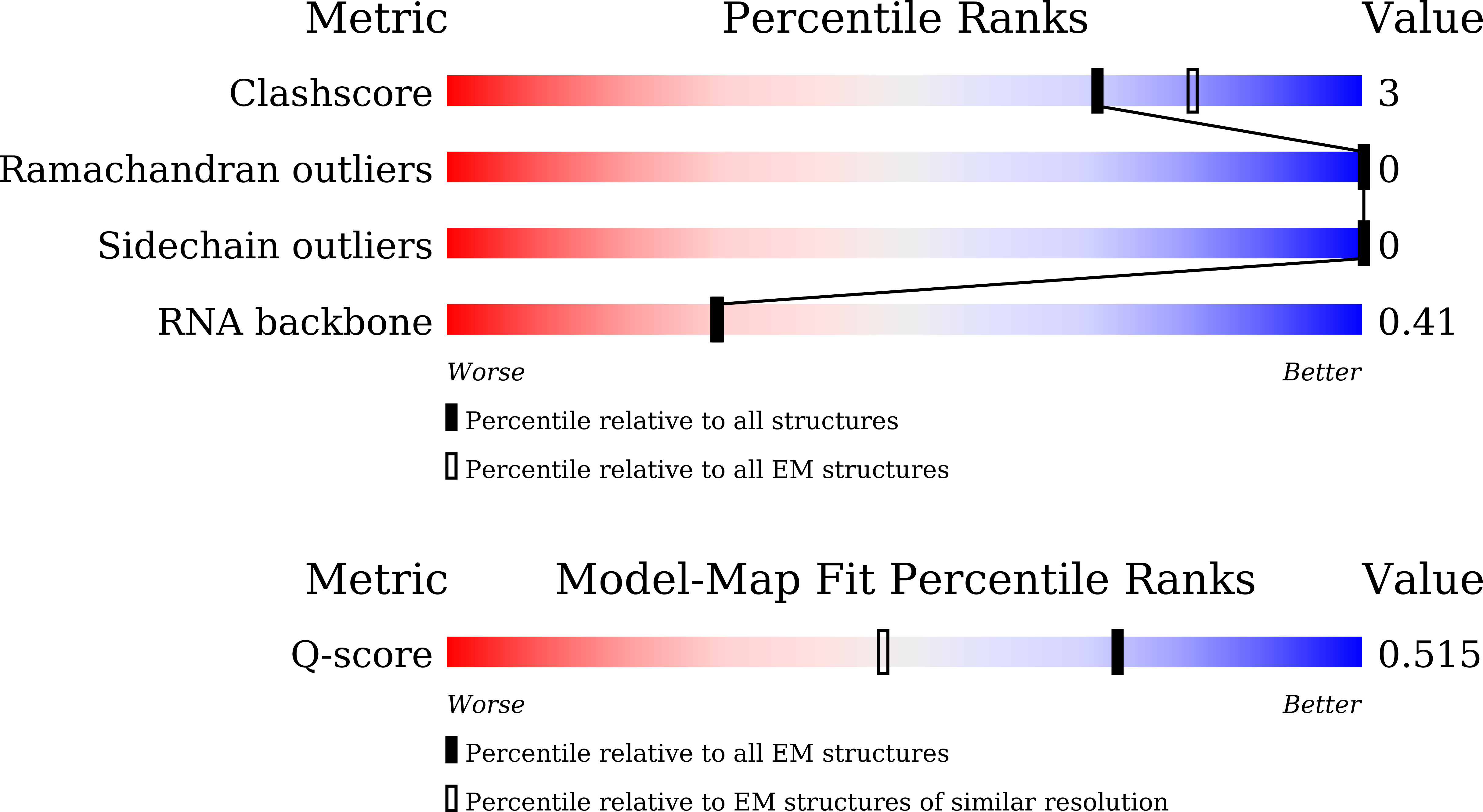
The cryo-EM structure of gRNA-bound SPARDA complex
Biological Source:
Method Details:
Experimental Method:
Resolution:
2.77 Å
Aggregation State:
PARTICLE
Reconstruction Method:
SINGLE PARTICLE
Macromolecular Entities
Polymer Type:polypeptide(L)
Molecule:pAgo
Chain IDs:A, D
Chain Length:485
Number of Molecules:2
Biological Source:Novosphingopyxis baekryungensis
Polymer Type:polypeptide(L)
Molecule:DREN-APAZ
Chain IDs:B, E
Chain Length:442
Number of Molecules:2
Biological Source:Novosphingopyxis baekryungensis
Polymer Type:polyribonucleotide
Molecule:RNA (5'-R(P*AP*UP*AP*CP*UP*GP*CP*AP*CP*AP*GP*CP*UP*GP*AP*CP*GP*AP*UP*A)-3')
Chain IDs:C (auth: Z), F (auth: a)
Chain Length:485
Number of Molecules:2
Biological Source:Novosphingopyxis baekryungensis
Ligand Molecules
Primary Citation
Filament assembly induced by the recognition of target DNA activates the prokaryotic Argonaute SPARDA system.
Nat Commun 17 115 115 (2026)
PMID: 41495039 DOI: 10.1038/s41467-025-68195-1

Abstact

The short prokaryotic Argonaute (pAgo) proteins, in conjunction with their associated effector molecules, constitute a defence mechanism in prokaryotes that protects against phage infections. The SPARDA is characterized by its collateral nuclease activity, which, upon activation through target DNA recognition, non-specifically cleaves a wide range of nucleic acid substrates. Nevertheless, the structural underpinnings of its collateral activity have remained elusive. In this study, we investigate the NbaSPARDA system from Novosphingopyxis baekryungensis and reveal that RNA-guided DNA recognition triggers the assembly of a higher-order filamentous structure. This filamentation is essential for the tetramerization of the DREN nuclease domain, which in turn facilitates the accumulation and cleavage of substrate nucleic acids. Through the determination of the gRNA-bound and RNA-DNA duplex-bound cryo-EM structures, we delineate a sequential monomer-dimer-monomer-filament transition during SPARDA activation. These insights collectively elucidate a filament-dependent activation mechanism underpinning the short pAgo-mediated immune response, which is crucial for antiviral defence.

Legend

Protein

Chemical

Disease

Primary Citation of related structures
Feedback Form
Name
Email
Institute
Feedback