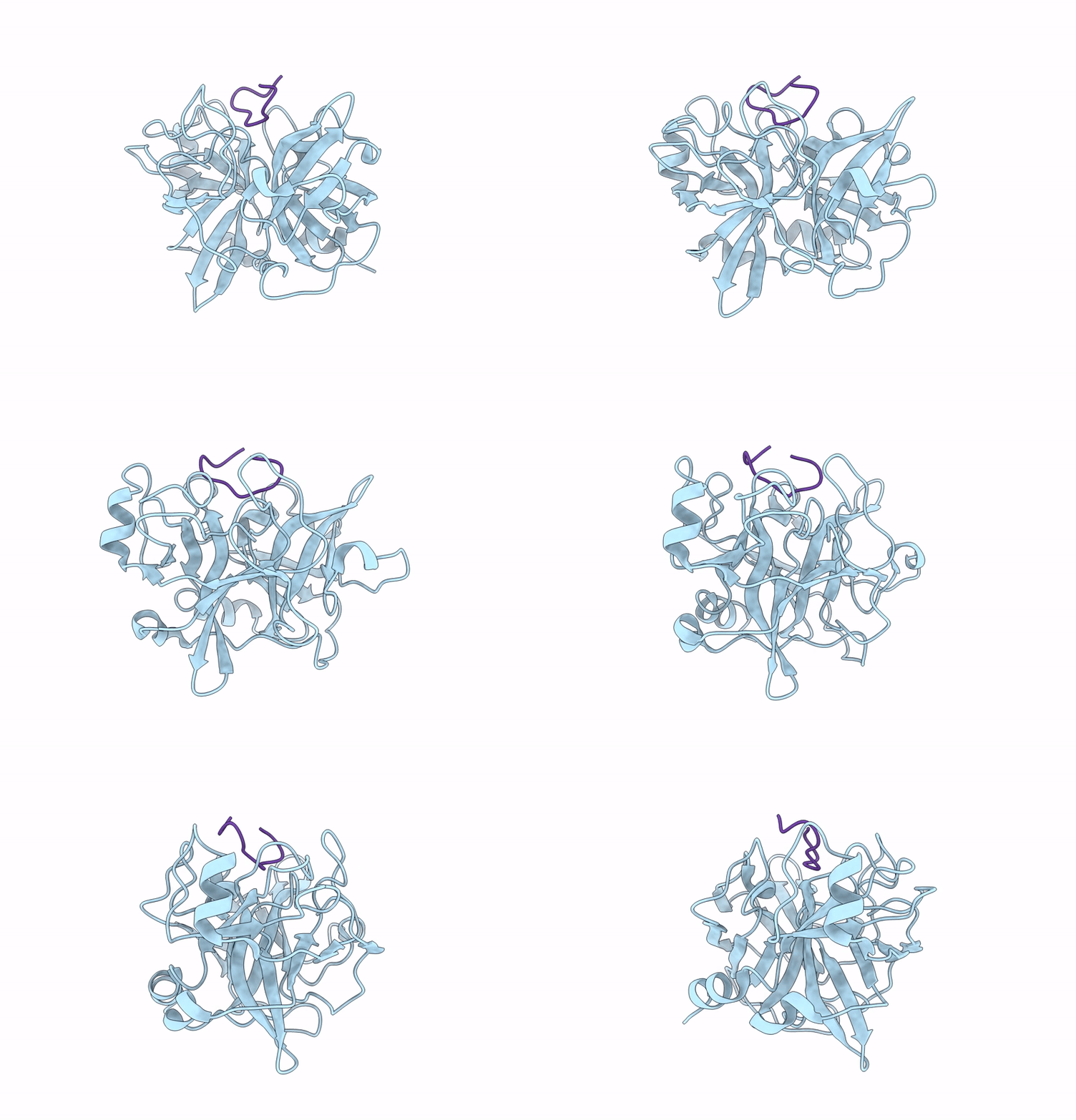
9VWT image
Deposition Date 2025-07-17
Release Date 2025-08-06
Last Version Date 2025-08-13
Entry Detail
PDB ID:
9VWT
Title:
The catalytic domain of human plasma kallikrein with peptide inhibitor 070
Biological Source:
Source Organism:
Host Organism:
Method Details:
Experimental Method:
Resolution:
1.77 Å
R-Value Free:
0.20
R-Value Work:
0.18
R-Value Observed:
0.18
Space Group:
P 65

Macromolecular Entities
Structures with similar UniProt ID
Protein Blast
Polymer Type:polypeptide(L)
Molecule:Plasma kallikrein light chain
Gene (Uniprot):KLKB1
Mutagens:C122S
Chain IDs:A
Chain Length:237
Number of Molecules:1
Biological Source:Homo sapiens
Polymer Type:polypeptide(L)
Molecule:peptide inhibitor
Chain IDs:B
Chain Length:10
Number of Molecules:1
Biological Source:synthetic construct
Primary Citation
Water-medicated specifically targeting the S1 pockets among serine proteases using an arginine analogue.
Bioorg.Chem. 152 107734 107734 (2024)
PMID: 39167871 DOI: 10.1016/j.bioorg.2024.107734

Abstact

Because of the high similarity in structure and sequence, it is challenging to distinguish the S1 pocket among serine proteases, primarily due to the only variability at residue 190 (A190 and S190). Peptide or protein-based inhibitors typically target the negatively charged S1 pocket using lysine or arginine as the P1 residue, yet neither discriminates between the two S1 pocket variants. This study introduces two arginine analogues, L-4-guanidinophenylalanine (12) and L-3-(N-amidino-4-piperidyl)alanine (16), as novel P1 residues in peptide inhibitors. 16 notably enhances affinities across all tested proteases, whereas 12 specifically improved affinities towards proteases possessing S190 in the S1 pocket. By crystallography and molecular dynamics simulations, we discovered a novel mechanism involving a water exchange channel at the bottom of the S1 pocket, modulated by the variation of residue 190. Additionally, the specificity of 12 towards the S190-presenting S1 pocket is dependent on this water channel. This study not only introduces novel P1 residues to engineer inhibitory potency and specificity of peptide inhibitors targeting serine proteases, but also unveils a water-mediated molecular mechanism of targeting serine proteases.

Legend

Protein

Chemical

Disease

Primary Citation of related structures
Feedback Form
Name
Email
Institute
Feedback