9VTP image
Deposition Date 2025-07-11
Release Date 2026-02-11
Last Version Date 2026-02-11
Entry Detail
PDB ID:
9VTP
Title:
Target DNA-bound type I-F3 TniQ-Cascade of Vibrio parahaemolyticus in partial R-loop state
Biological Source:
Source Organism(s):
Expression System(s):
Method Details:
Experimental Method:
Resolution:
2.68 Å
Aggregation State:
PARTICLE
Reconstruction Method:
SINGLE PARTICLE
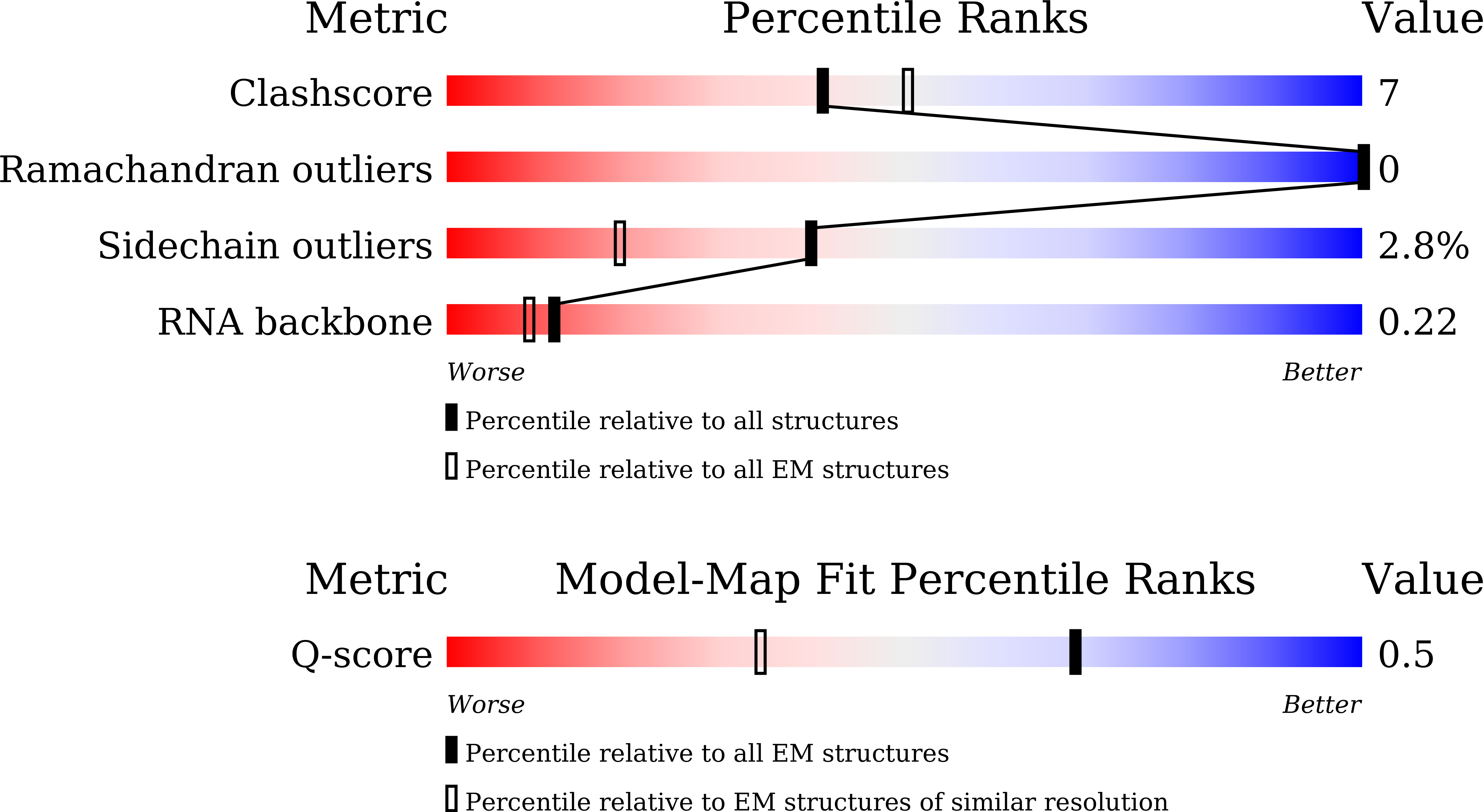
Macromolecular Entities
Polymer Type:polyribonucleotide
Molecule:crRNA from Vibrio parahaemolyticus
Chain IDs:A (auth: 1)
Chain Length:60
Number of Molecules:1
Biological Source:Vibrio parahaemolyticus RIMD 2210633
Polymer Type:polydeoxyribonucleotide
Molecule:Target strand DNA from Vibrio alginolyticus K08M03 plasmid pL300
Chain IDs:B (auth: 2)
Chain Length:75
Number of Molecules:1
Biological Source:Vibrio alginolyticus
Polymer Type:polydeoxyribonucleotide
Molecule:Non-target strand DNA from Vibrio alginolyticus strain K08M3 plasmid pL300
Chain IDs:C (auth: 3)
Chain Length:75
Number of Molecules:1
Biological Source:Vibrio alginolyticus
Structures with similar UniProt ID
Protein Blast
Polymer Type:polypeptide(L)
Molecule:Type I-F CRISPR-associated protein Csy3
Gene (Uniprot):VPA1389
Chain IDs:D (auth: A), E (auth: B), F (auth: C), G (auth: D), H (auth: E), I (auth: F)
Chain Length:347
Number of Molecules:6
Biological Source:Vibrio parahaemolyticus RIMD 2210633
Structures with similar UniProt ID
Protein Blast
Polymer Type:polypeptide(L)
Molecule:CRISPR-associated protein Csy2
Gene (Uniprot):VPA1388
Chain IDs:J (auth: G)
Chain Length:640
Number of Molecules:1
Biological Source:Vibrio parahaemolyticus RIMD 2210633
Structures with similar UniProt ID
Protein Blast
Polymer Type:polypeptide(L)
Molecule:CRISPR-associated protein, Csy4 family
Gene (Uniprot):VPA1390
Chain IDs:K (auth: H)
Chain Length:198
Number of Molecules:1
Biological Source:Vibrio parahaemolyticus RIMD 2210633
Structures with similar UniProt ID
Protein Blast
Polymer Type:polypeptide(L)
Molecule:TniQ
Gene (Uniprot):VPA1387
Chain IDs:L (auth: I), M (auth: J)
Chain Length:406
Number of Molecules:2
Biological Source:Vibrio parahaemolyticus RIMD 2210633
Ligand Molecules
Primary Citation
Sequential structural rearrangements at the PAM-distal site of a type I-F3 CRISPR-Cas effector enabling RNA-guided DNA transposition.
Nucleic Acids Res. 54 ? ? (2026)
PMID: 41495894 DOI: 10.1093/nar/gkaf1415

Abstact

Some prokaryotes carry CRISPR-associated transposons (CASTs), Tn7-like elements that incorporate genes encoding CRISPR-Cas effectors. CAST insertion is directed by CRISPR-Cas effectors through RNA-guided DNA binding and interactions with transposition-associated proteins. Although efficient sequence-specific DNA integration requires both precise target DNA recognition and coordinated interactions between effectors and transposition-associated proteins, the underlying mechanism remains elusive. Here, we determined three cryo-EM structures of target DNA-bound type I-F3 TniQ-Cascade from Vibrio parahaemolyticus, revealing how Cas8/5 recognizes the protospacer adjacent motif (PAM) and identifying a key residue responsible for the cytidine preference at position -2 of the PAM. We revealed mismatch tolerance at the PAM-proximal site. Structural analyses showed that correct base pairing at the PAM-distal site correlates with conformational changes in the Cas8/5 helical bundle and TniQ, bending the DNA to guide its downstream region toward the transposition machinery. Together, these dynamic rearrangements at the PAM-distal region provide insights into the licensing mechanism of type I-F3 CAST transposition and highlight its potential for genome engineering applications.

Legend

Protein

Chemical

Disease

Primary Citation of related structures
Feedback Form
Name
Email
Institute
Feedback