9VMQ image
Deposition Date 2025-06-29
Release Date 2026-02-18
Last Version Date 2026-02-18
Entry Detail
PDB ID:
9VMQ
Keywords:
Title:
Crystal structure of Dot/Icm T4SS effector Ceg10(C159S)
Biological Source:
Source Organism(s):
Expression System(s):
Method Details:
Experimental Method:
Resolution:
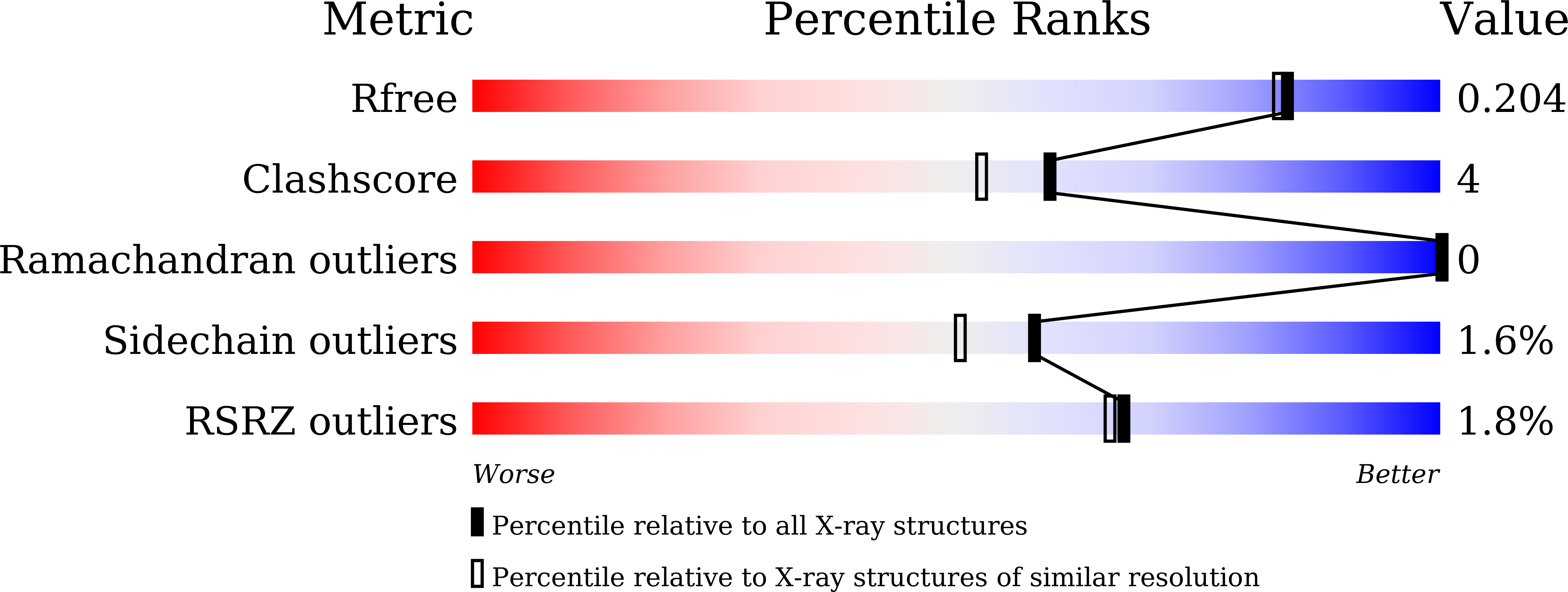
1.79 Å
R-Value Free:
0.19
R-Value Work:
0.15
R-Value Observed:
0.15
Space Group:
P 1
Macromolecular Entities
Polymer Type:polypeptide(L)
Molecule:Dot/Icm T4SS effector Ceg10
Mutagens:C159S
Chain IDs:A, B, C, D
Chain Length:231
Number of Molecules:4
Biological Source:Legionella pneumophila
Primary Citation
Legionella effector Ceg10 acetylates RPS20 to inhibit host translation and induce cell cycle arrest.
Proc.Natl.Acad.Sci.USA 123 e2517995123 e2517995123 (2026)
PMID: 41468429 DOI: 10.1073/pnas.2517995123

Abstact

Legionella pneumophila, the causative agent of Legionnaires' disease, utilizes a type IV secretion system (T4SS) to translocate effectors into host cells, modulating diverse cellular processes to create a replication-permissive niche. Here, we characterize Ceg10, a T4SS-translocated effector, as a nucleus-targeting acetyltransferase that interferes with host ribosome biogenesis and cell cycle progression. Structural analysis reveals that Ceg10 harbors a conserved Cys-His-Asp (CHD) catalytic triad required for its acetyltransferase activity. Upon nuclear import mediated by the host transport adaptor HEATR3, Ceg10 selectively acetylates the ribosomal protein RPS20 at Thr64, Thr65, and Arg66, which have not been annotated as posttranslational modification sites. This acetylation impairs RPS20's interaction with RPS29 and 18S rRNA, two components critical for 40S ribosomal subunit assembly, leading to translation inhibition and G1/S cell cycle arrest. These host perturbations are essential for efficient early-stage intracellular replication of L. pneumophila. Our findings identify a distinct mechanism by which a bacterial effector co-opts nuclear import machinery and directly modifies ribosomal proteins to subvert host biosynthesis and cell cycle control, highlighting ribosomal protein acetylation as a hitherto unrecognized role in host-pathogen interactions.

Legend

Protein

Chemical

Disease

Primary Citation of related structures
Feedback Form
Name
Email
Institute
Feedback