Planned Maintenance: Some services may turn out to be unavailable from 15th January, 2026 to 16th January, 2026. We apologize for the inconvenience!

9VMK image
Deposition Date 2025-06-28
Release Date 2025-11-26
Last Version Date 2025-11-26
Entry Detail
PDB ID:
9VMK
Keywords:
Title:
Crystal structure of TeGH116 from Thermosynechococcus elongatus with glucose
Biological Source:
Source Organism(s):
Expression System(s):
Method Details:
Experimental Method:
Resolution:
2.00 Å
R-Value Free:
0.18
R-Value Work:
0.16
Space Group:
C 1 2 1
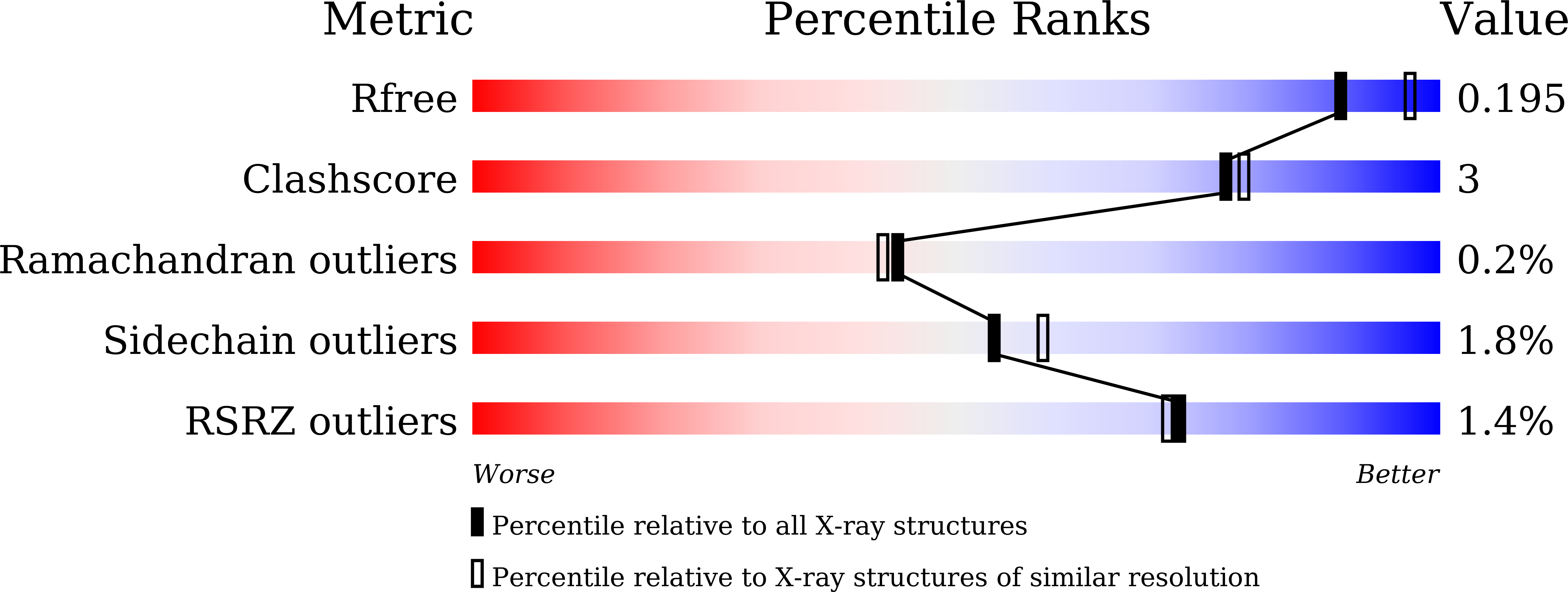
Macromolecular Entities
Structures with similar UniProt ID
Protein Blast
Polymer Type:polypeptide(L)
Molecule:Tlr0193 protein
Gene (Uniprot):tlr0193
Chain IDs:A, B
Chain Length:809
Number of Molecules:2
Biological Source:Thermosynechococcus vestitus BP-1
Primary Citation
The structure of Thermosynechococcus elongatus glycoside hydrolase family 116 beta-glucosidase shows the role of the noncatalytic N-terminal domain in controlling substrate specificity.
Int.J.Biol.Macromol. 332 148566 148566 (2025)
PMID: 41161445 DOI: 10.1016/j.ijbiomac.2025.148566

Abstact

β-Glucosidases play essential roles in nature as well as in industrial applications. Glycoside hydrolase family 116 (GH116) is a relatively sparsely characterized family of β-glucosidases. We describe the functional and structural characterization of Thermosynechococcus elongatus BP-1 TeGH116, the one β-glucosidase in this model cyanobacterium. TeGH116 was expressed in Escherichia coli and purified by heating, immobilized metal affinity chromatography, and size exclusion chromatography. TeGH116 hydrolyzes p-nitrophenyl β-d-glucopyranoside most rapidly at pH 5.5 and 55 °C, and other p-nitrophenyl glycosides 3% or less of this rate. TeGH116 also hydrolyzes natural phenolic glucosides and β-1,3- and β-1,4-linked gluco-oligosaccharides. Kinetic analysis suggests that TeGH116 binds three glucosyl residues in these oligosaccharides. TeGH116 is inhibited by glucose but is only weakly inhibited by δ-gluconolactone. The X-ray crystallographic structures of TeGH116 and its complex with glucose were similar to those of Thermoanaerobacterium xylanolyticum TxGH116. However, a long loop extending from the noncatalytic N-terminal domain helps form the mouth of the TeGH116 active site, making it narrower. TxGH116 was found to hydrolyze barley β-glucan, laminarin, and lichenan, but not carboxymethylcellulose, while TeGH116 hydrolyzed the same polysaccharides at relatively lower rates. Deletion of the loop in TeGH116 resulted in poor stability and low activity, but higher relative activity on laminarin compared to p-nitrophenyl β-d-glucoside. The narrowed active site and lower activity on large substrates highlight the contribution of N-terminal domain loops to the substrate specificity of GH116 enzymes.

Legend

Protein

Chemical

Disease

Primary Citation of related structures
Feedback Form
Name
Email
Institute
Feedback