Planned Maintenance: Some services may turn out to be unavailable from 15th January, 2026 to 16th January, 2026. We apologize for the inconvenience!

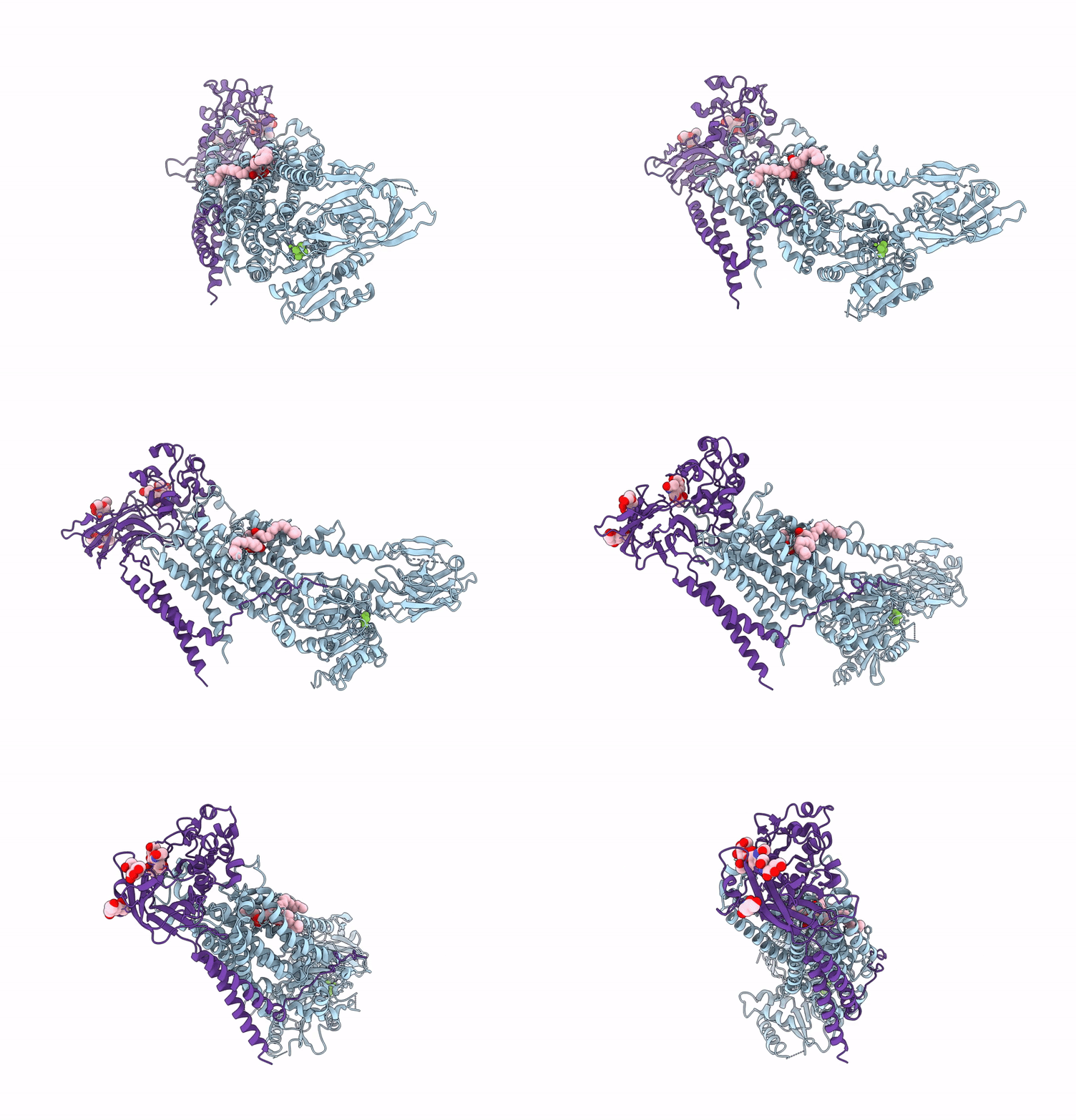
9VKG image
Deposition Date 2025-06-23
Release Date 2025-11-26
Last Version Date 2025-12-17
Entry Detail
PDB ID:
9VKG
Title:
Cryo-EM structure of a human flippase mutant ATP11C Q79E-CDC50A in PtdCho-occluded E2-AlF state
Biological Source:
Source Organism(s):
Homo sapiens (Taxon ID: 9606)
Expression System(s):
Method Details:
Experimental Method:
Resolution:
2.39 Å
Aggregation State:
PARTICLE
Reconstruction Method:
SINGLE PARTICLE
Macromolecular Entities
Structures with similar UniProt ID
Protein Blast
Polymer Type:polypeptide(L)
Molecule:Phospholipid-transporting ATPase IG
Gene (Uniprot):ATP11C
Mutagens:Q79E
Chain IDs:A
Chain Length:1073
Number of Molecules:1
Biological Source:Homo sapiens
Structures with similar UniProt ID
Protein Blast
Polymer Type:polypeptide(L)
Molecule:Cell cycle control protein 50A
Gene (Uniprot):TMEM30A
Chain IDs:B (auth: C)
Chain Length:324
Number of Molecules:1
Biological Source:Homo sapiens
Primary Citation
Cryo-EM structure of the ATP11C Q79E mutant reveals the structural basis for altered Phospholipid recognition.
J.Biol.Chem. 302 110935 110935 (2025)
PMID: 41237907 DOI: 10.1016/j.jbc.2025.110935

Abstact

Closely related P4-ATPases, ATP11A and ATP11C, act as major phospholipid flippases in the plasma membrane of mammalian cells, with strict substrate specificity for phosphatidylserine (PS) and phosphatidylethanolamine (PE), but not for phosphatidylcholine (PC), thereby contributing to the asymmetric distribution of PS and PE across bilayers. A previously reported disease-associated Q84E mutation in ATP11A confers the ability to flip PC, implicating the involvement of this conserved residue in substrate specificity. We performed cryo-EM analysis for the equivalent mutant Q79E of ATP11C to address the structural basis for its unusual substrate specificity. Measurement of ATPase activity revealed that the ATP11C Q79E mutant retained PS-dependent activity, whilst gaining robust PC-dependent activity, indicative of expanded substrate specificity, consistent with reported properties in ATP11A Q84E. The cryo-EM structure of ATP11C Q79E mutant in the PC-occluded E2-Pi state revealed a PC molecule in a reshaped binding pocket. Due to the Q79E mutation and associated conformational changes in its surrounding residues, including Ser91and Asn352, the binding pocket has additional space to accommodate the bulky choline headgroup. Our results provide structural and functional insights into how a single point mutation can alter substrate specificity in a P4-ATPase.

Legend

Protein

Chemical

Disease

Primary Citation of related structures
Feedback Form
Name
Email
Institute
Feedback