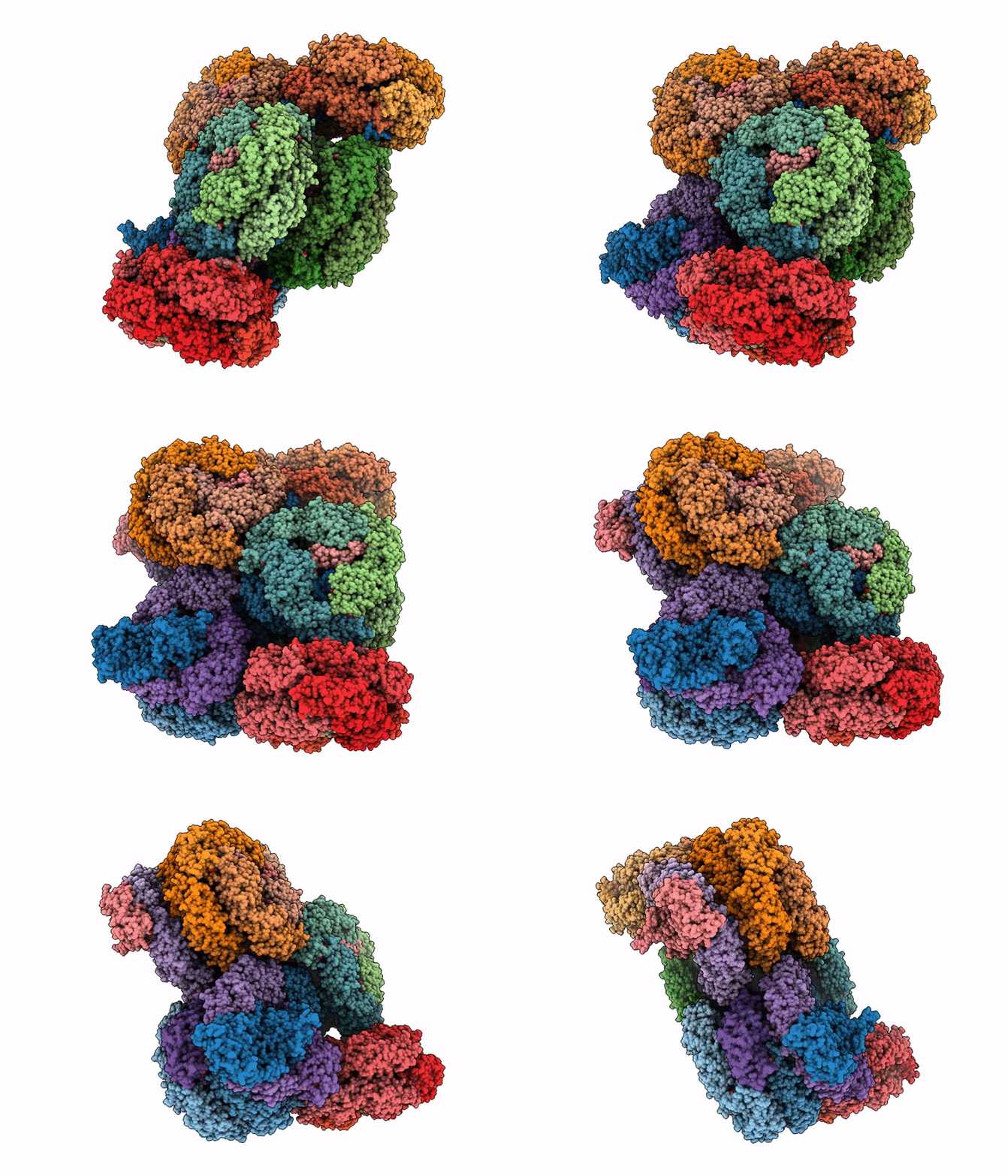
9V7J image
Deposition Date 2025-05-28
Release Date 2025-09-24
Last Version Date 2025-10-29
Entry Detail
PDB ID:
9V7J
Keywords:
Title:
Phycobilisome core from Gloeobacter violaceus PCC 7421
Biological Source:
Source Organism:
Method Details:
Experimental Method:
Resolution:
2.85 Å
Aggregation State:
PARTICLE
Reconstruction Method:
SINGLE PARTICLE

Macromolecular Entities
Structures with similar UniProt ID
Protein Blast
Polymer Type:polypeptide(L)
Molecule:Phycobiliprotein ApcE
Gene (Uniprot):apcE
Chain IDs:A, B (auth: C)
Chain Length:161
Number of Molecules:2
Biological Source:Gloeobacter violaceus PCC 7421
Structures with similar UniProt ID
Protein Blast
Polymer Type:polypeptide(L)
Molecule:Phycobilisome 7.8 kDa linker polypeptide, allophycocyanin-associated, core
Gene (Uniprot):apcC
Chain IDs:GC (auth: AY), HC (auth: AZ), IC (auth: Aa), JC (auth: Ab), KC (auth: Ac), LC (auth: Ad)
Chain Length:161
Number of Molecules:6
Biological Source:Gloeobacter violaceus PCC 7421
Structures with similar UniProt ID
Protein Blast
Polymer Type:polypeptide(L)
Molecule:Allophycocyanin alpha subunit
Gene (Uniprot):apcA
Chain IDs:C (auth: M), E (auth: O), G (auth: E), I (auth: G), K (auth: I), M (auth: K), O (auth: Q), Q (auth: S), S (auth: U), U (auth: W), W (auth: Y), Y (auth: a), AA (auth: c), CA (auth: e), EA (auth: g), GA (auth: i), IA (auth: k), KA (auth: m), MA (auth: o), PA (auth: r), RA (auth: t), UA (auth: w), WA (auth: y), YA (auth: 1), AB (auth: 3), CB (auth: 5), EB (auth: 7), GB (auth: 9), IB (auth: AA), KB (auth: AC), MB (auth: AE), OB (auth: AG), QB (auth: AI), SB (auth: AK), UB (auth: AM), WB (auth: AO), YB (auth: AQ), AC (auth: AS), CC (auth: AU), EC (auth: AW)
Chain Length:161
Number of Molecules:40
Biological Source:Gloeobacter violaceus PCC 7421
Structures with similar UniProt ID
Protein Blast
Polymer Type:polypeptide(L)
Molecule:Allophycocyanin beta subunit
Gene (Uniprot):apcB
Chain IDs:D (auth: N), F (auth: P), H (auth: F), J (auth: H), L (auth: J), N (auth: L), P (auth: R), R (auth: T), T (auth: V), V (auth: X), X (auth: Z), Z (auth: b), BA (auth: d), DA (auth: f), FA (auth: h), HA (auth: j), JA (auth: l), LA (auth: n), NA (auth: p), OA (auth: q), TA (auth: v), VA (auth: x), XA (auth: z), ZA (auth: 2), BB (auth: 4), DB (auth: 6), FB (auth: 8), HB (auth: 0), JB (auth: AB), LB (auth: AD), NB (auth: AF), PB (auth: AH), RB (auth: AJ), TB (auth: AL), VB (auth: AN), XB (auth: AP), ZB (auth: AR), BC (auth: AT), DC (auth: AV), FC (auth: AX)
Chain Length:161
Number of Molecules:40
Biological Source:Gloeobacter violaceus PCC 7421
Structures with similar UniProt ID
Protein Blast
Polymer Type:polypeptide(L)
Molecule:Phycobilisome core component
Gene (Uniprot):apcF
Chain IDs:QA (auth: s), SA (auth: u)
Chain Length:161
Number of Molecules:2
Biological Source:Gloeobacter violaceus PCC 7421
Modified Residue
Compound ID Chain ID Parent Comp ID Details 2D Image
MEN D ASN modified residue
Ligand Molecules
Primary Citation
Structure and quenching of a bundle-shaped phycobilisome.
Sci Adv 11 eadz6774 eadz6774 (2025)
PMID: 41091862 DOI: 10.1126/sciadv.adz6774

Abstact

Cyanobacteria use soluble antenna megacomplexes, phycobilisomes (PBSs), to maximize light-harvesting efficiency and small photoswitchable orange carotenoid proteins (OCPs) to down-regulate PBSs in high light. Among known PBS morphologies, the one from the basal cyanobacterial genus Gloeobacter still lacks detailed structural characterization. Here, we reconstructed a cryo-electron microscopy structure of the >10-megadalton Gloeobacter violaceus PBS, with diverging, conformationally mobile bundles of rods composed of stacked phycoerythrin and phycocyanin hexamers, stemming from a pentacylindrical allophycocyanin core belted by auxiliary phycocyanin hexamers. We show how two Gloeobacter-specific multidomain linker proteins, Glr1262 and Glr2806, maintain this bundle-shaped architecture and reveal its differential regulation via nonphotochemical quenching by two OCP types of G. violaceus that recognize separate binding sites within the allophycocyanin core, including lateral cylinders absent in tricylindrical cores.

Legend

Protein

Chemical

Disease

Primary Citation of related structures
Feedback Form
Name
Email
Institute
Feedback