9UAT image
Deposition Date 2025-04-01
Release Date 2026-02-11
Last Version Date 2026-02-11
Entry Detail
PDB ID:
9UAT
Title:
The structure of mCAT1 in complex with its substrate ornithine and the RBD of FrMLV.
Biological Source:
Source Organism(s):
Expression System(s):
Method Details:
Experimental Method:
Resolution:
3.65 Å
Aggregation State:
PARTICLE
Reconstruction Method:
SINGLE PARTICLE
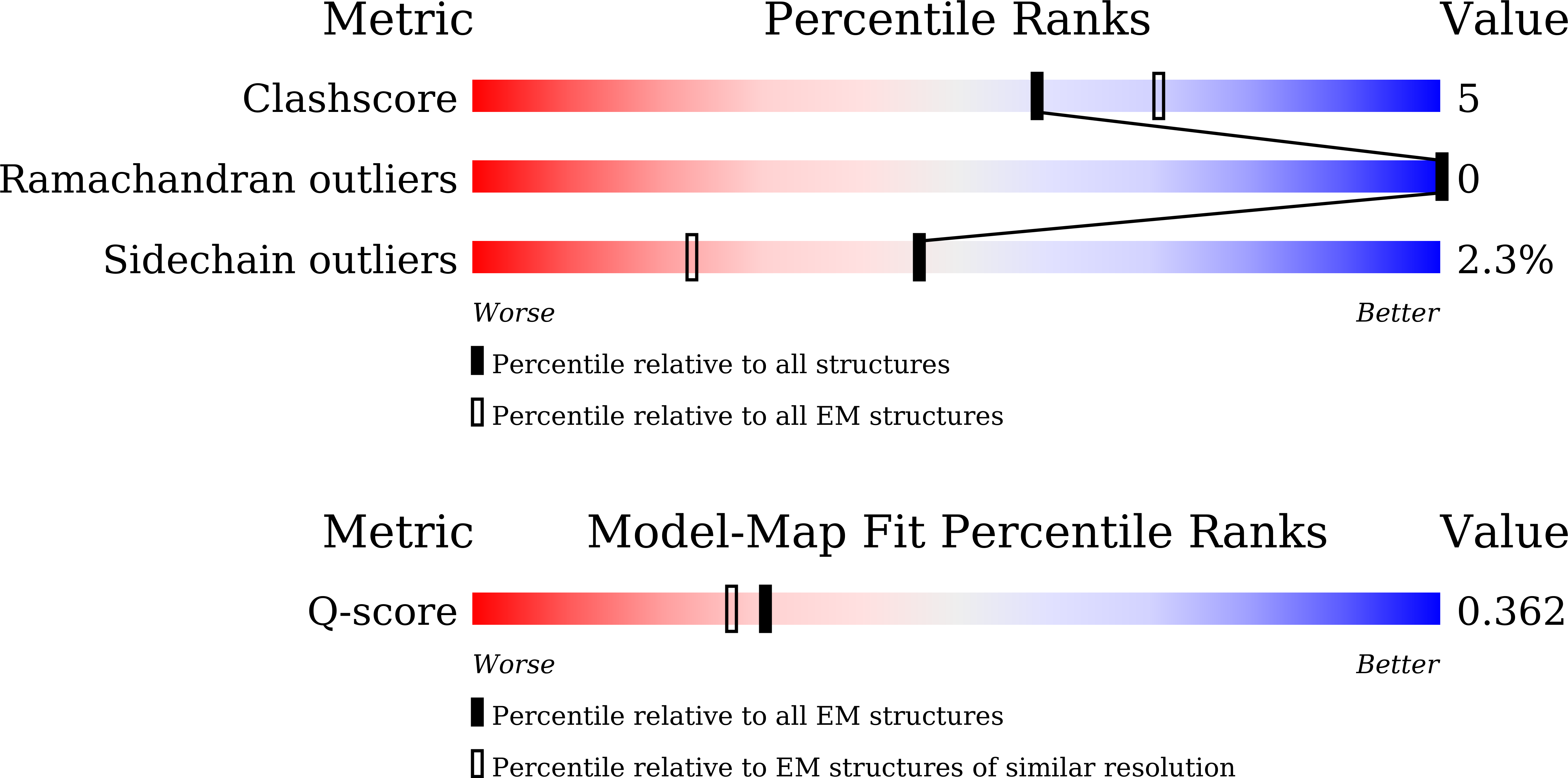
Macromolecular Entities
Structures with similar UniProt ID
Protein Blast
Polymer Type:polypeptide(L)
Molecule:High affinity cationic amino acid transporter 1
Gene (Uniprot):Slc7a1
Chain IDs:A
Chain Length:601
Number of Molecules:1
Biological Source:Mus musculus
Structures with similar UniProt ID
Protein Blast
Polymer Type:polypeptide(L)
Molecule:Surface protein
Gene (Uniprot):env
Chain IDs:B
Chain Length:229
Number of Molecules:1
Biological Source:Friend murine leukemia virus (ISOLATE 57)
Primary Citation
Structural insights into cationic amino acid transport and viral receptor engagement by CAT1.
Nat Commun 17 1108 1108 (2025)
PMID: 41408058 DOI: 10.1038/s41467-025-67704-6

Abstact

Cationic amino acid transporter 1 (CAT1) transports cationic amino acids and plays pivotal roles in cancer proliferation, immune modulation, and nitric oxide metabolism. It also serves as the specific cellular receptor for certain murine leukemia viruses. Here, we report the cryo-electron microscopy (cryo-EM) structure of mammalian CAT1 in complex with its substrate ornithine and the receptor-binding domain (RBD) of Friend murine leukemia virus (FrMLV). CAT1 specifically recognizes the side-chain amino group of ornithine via residue S347 on transmembrane helix 8 (TM8), capturing the transporter in an inward-facing occluded conformation. Notably, the FrMLV RBD (frRBD) primarily engages the third extracellular loop (ECL3) of CAT1-a region marked by substantial species-specific variation that likely governs cross-species viral tropism. Together, our structural and biochemical results elucidate the molecular mechanism of substrate recognition and transport by mCAT1, and unveil the molecular basis for FrMLV receptor specificity. These findings provide a valuable framework for structure-based drug design targeting CAT1 in cancer and infectious diseases.

Legend

Protein

Chemical

Disease

Primary Citation of related structures
Feedback Form
Name
Email
Institute
Feedback