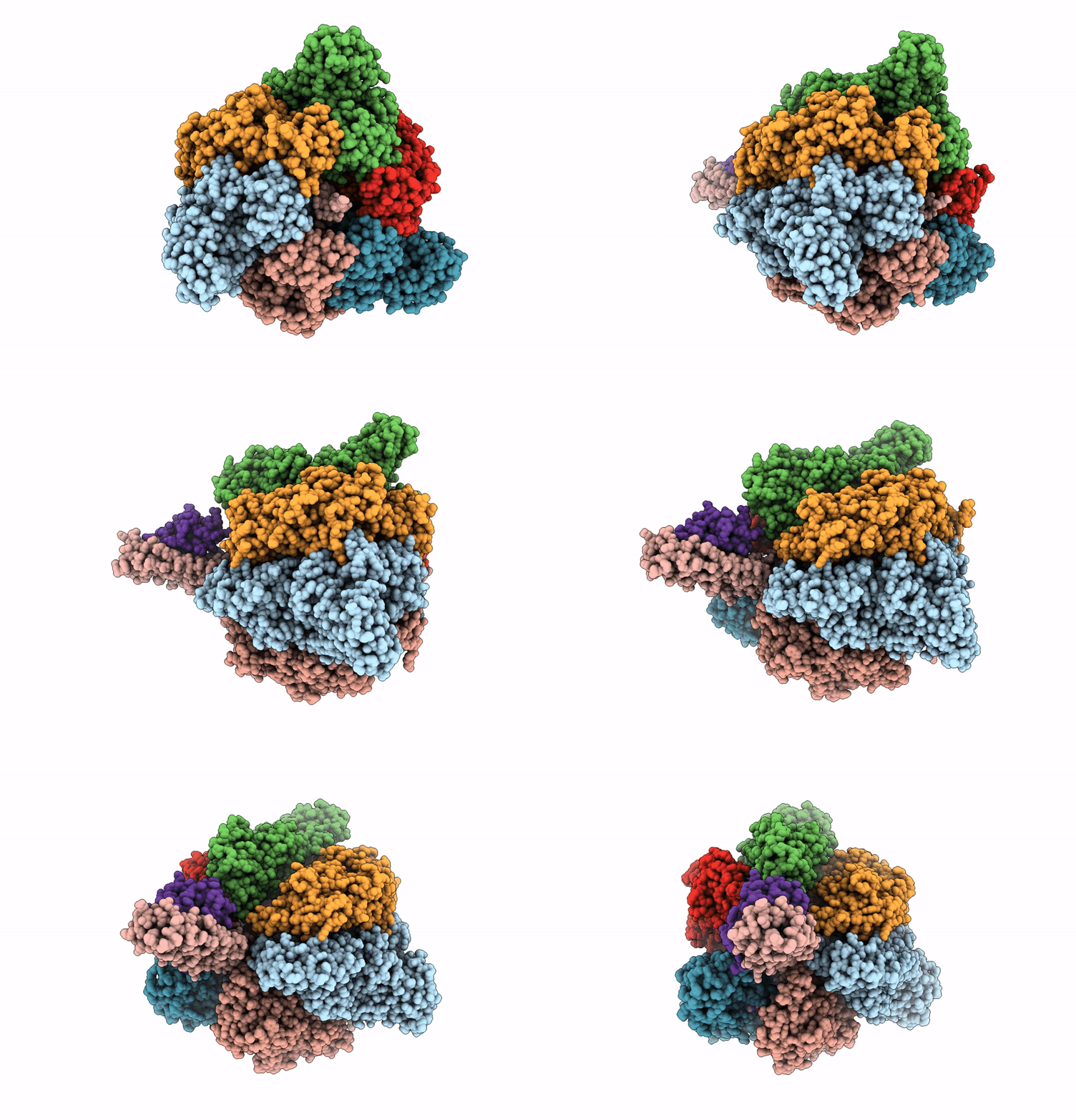
9U6Y image
Deposition Date 2025-03-23
Release Date 2025-10-29
Last Version Date 2025-10-29
Entry Detail
PDB ID:
9U6Y
Keywords:
Title:
Cryo-EM structure of the V1 domain of V/A-ATPase in liposomes under pmf condition, state3N
Biological Source:
Source Organism:
Method Details:
Experimental Method:
Resolution:
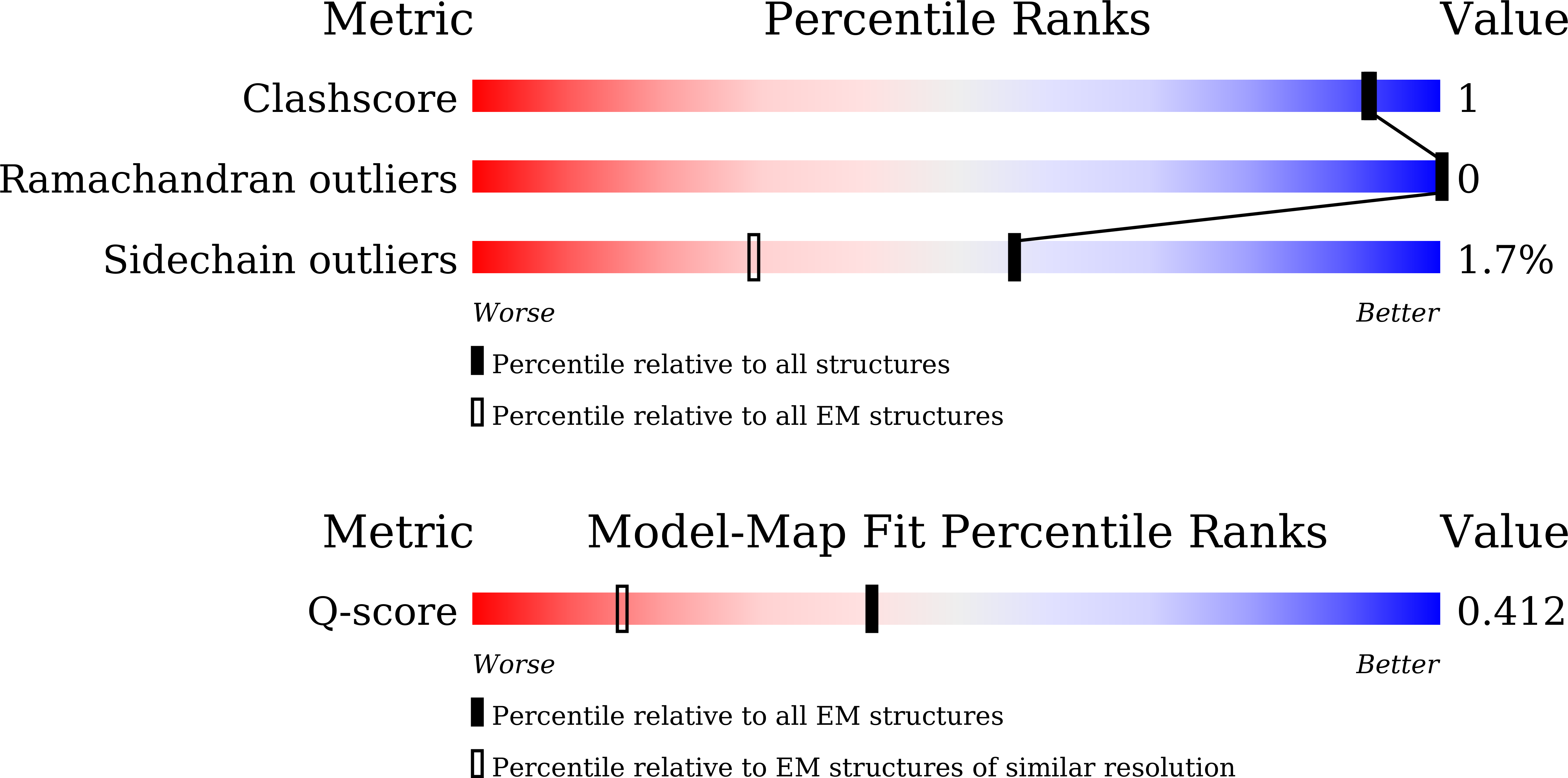
2.90 Å
Aggregation State:
PARTICLE
Reconstruction Method:
SINGLE PARTICLE
Macromolecular Entities
Structures with similar UniProt ID
Protein Blast
Polymer Type:polypeptide(L)
Molecule:V-type ATP synthase alpha chain
Gene (Uniprot):atpA
Chain IDs:A, B, C
Chain Length:578
Number of Molecules:3
Biological Source:Thermus thermophilus HB8
Structures with similar UniProt ID
Protein Blast
Polymer Type:polypeptide(L)
Molecule:V-type ATP synthase beta chain
Gene (Uniprot):atpB
Chain IDs:D, E, F
Chain Length:473
Number of Molecules:3
Biological Source:Thermus thermophilus HB8
Structures with similar UniProt ID
Protein Blast
Polymer Type:polypeptide(L)
Molecule:V-type ATP synthase subunit D
Gene (Uniprot):atpD
Chain IDs:G
Chain Length:206
Number of Molecules:1
Biological Source:Thermus thermophilus HB8
Structures with similar UniProt ID
Protein Blast
Polymer Type:polypeptide(L)
Molecule:V-type ATP synthase subunit F
Gene (Uniprot):atpF
Chain IDs:H
Chain Length:104
Number of Molecules:1
Biological Source:Thermus thermophilus HB8
Primary Citation
Structures of rotary ATP synthase from Thermus thermophilus during proton powered ATP synthesis.
Sci Adv 11 eadx8771 eadx8771 (2025)
PMID: 41105777 DOI: 10.1126/sciadv.adx8771

Abstact

ATP synthases are rotary molecular machines that use the proton motive force to rotate the central rotor complex relative to the surrounding stator apparatus, thereby coupling the ATP synthesis. We reconstituted the V/A-ATPase into liposomes and performed structural analysis using cryo-EM under conditions where the proton motive force was applied in the presence of ADP and Pi. ATP molecules were bound at two of the three catalytic sites of V/A-ATPase, confirming that the structure represents a state adopted during ATP synthesis. In this structure, the catalytic site closes upon binding of ADP and Pi through an induced fit mechanism. Multiple structures were obtained where the membrane-embedded rotor ring was in a different position relative to the stator. By comparing these structures, we found that torsion occurs in both the central rotor and the peripheral stator during 31° rotation of rotor ring. These structural snapshots of V/A-ATPase provide crucial insights into the mechanism of rotary catalysis of ATP synthesis.

Legend

Protein

Chemical

Disease

Primary Citation of related structures
Feedback Form
Name
Email
Institute
Feedback