9SYJ image
Deposition Date 2025-10-13
Release Date 2026-01-28
Last Version Date 2026-01-28
Entry Detail
PDB ID:
9SYJ
Title:
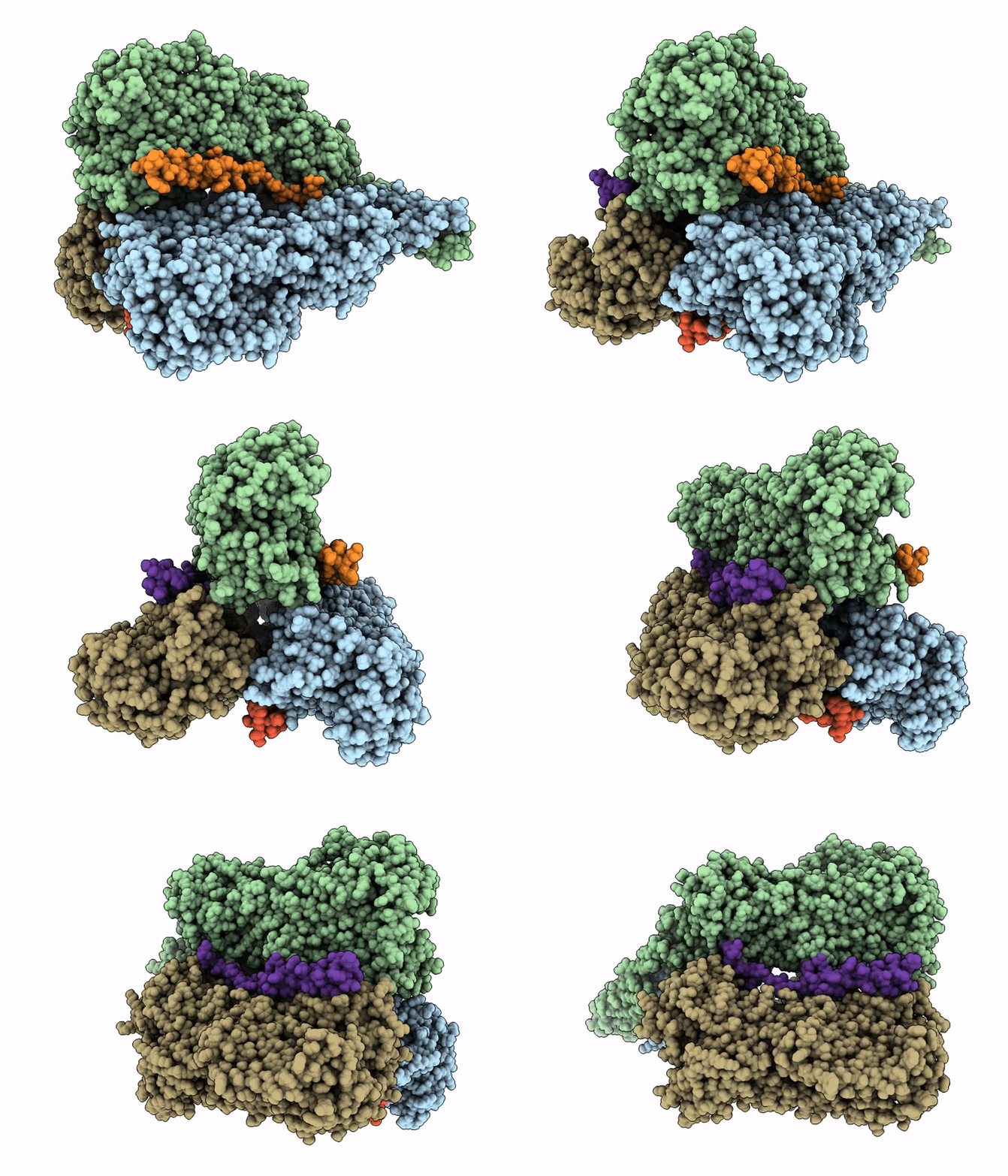
Asymmetric hexameric MmpS4-MmpL4 complex from Mycobacterium tuberculosis with "short" coiled-coil domain
Biological Source:
Source Organism(s):
Expression System(s):
Method Details:
Experimental Method:
Resolution:
3.09 Å
Aggregation State:
PARTICLE
Reconstruction Method:
SINGLE PARTICLE
Macromolecular Entities
Structures with similar UniProt ID
Protein Blast
Polymer Type:polypeptide(L)
Molecule:Siderophore exporter MmpL4
Gene (Uniprot):mmpL4
Mutagens:S434C
Chain IDs:A, B, C
Chain Length:974
Number of Molecules:3
Biological Source:Mycobacterium tuberculosis
Structures with similar UniProt ID
Protein Blast
Polymer Type:polypeptide(L)
Molecule:Siderophore export accessory protein MmpS4
Gene (Uniprot):mmpS4
Mutagens:D39C
Chain IDs:D, E, F
Chain Length:141
Number of Molecules:3
Biological Source:Mycobacterium tuberculosis
Ligand Molecules
Primary Citation
Structural elucidation of the hexameric MmpS4-MmpL4 complex from Mycobacterium tuberculosis.
Biorxiv ? ? ? (2026)
PMID: 41542548 DOI: 10.64898/2026.01.07.698164

Abstact

Mycobacterium tuberculosis contains thirteen Mycobacterial membrane protein Large (MmpL) transporters, which belong to the family of secondary active RND transporters. MmpL4 and MmpL5, together with their operon partners MmpS4 and MmpS5, export the mycobacterial siderophore mycobactin and the last resort TB drug bedaquiline. Recently, we determined a structure of the MmpL4 monomer in complex with desferrated mycobactin, which lacked a functionally essential coiled-coil domain predicted to extend far into the periplasm. Here, we present a cryo-EM structure of the hexameric (MmpS4)3-(MmpL4)3 complex, which was enabled by rational disulfide cross-links based on AlphaFold predictions. We observed density for the coiled-coil domain, which protrudes into the periplasmic space at an angle of around 60° relative to the symmetry axis of the MmpL4 trimer. In the context of the hexameric complex, MmpL4's conformation differs strikingly from the one observed for monomeric MmpL4, which includes formation of a large cavity in the periplasmic domain and rearrangements of conserved proton coupling residues at the transmembrane domain. Our work provides an experimental workflow to obtain single particle cryo-EM structures of labile multiprotein complexes by AlphaFold-informed stabilization of predicted protein interfaces.

Legend

Protein

Chemical

Disease

Primary Citation of related structures
Feedback Form
Name
Email
Institute
Feedback