9SJL image
Deposition Date 2025-08-31
Release Date 2026-02-18
Last Version Date 2026-02-18
Entry Detail
PDB ID:
9SJL
Title:
Type I-F_HNH variant Cascade bound to dsDNA, HNH domain in inwards position
Biological Source:
Source Organism(s):
Expression System(s):
Method Details:
Experimental Method:
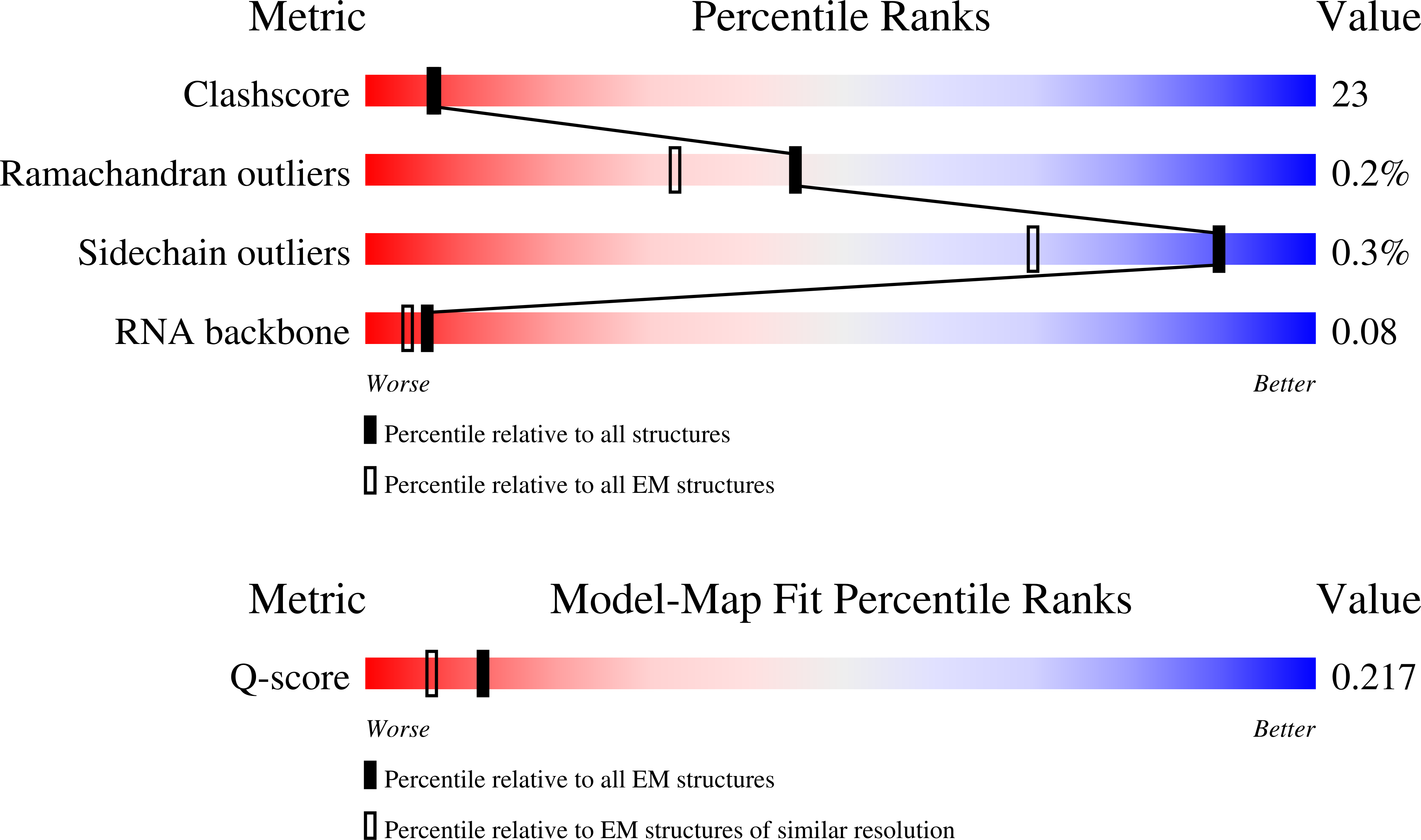
Resolution:
3.93 Å
Aggregation State:
PARTICLE
Reconstruction Method:
SINGLE PARTICLE
Macromolecular Entities
Structures with similar UniProt ID
Protein Blast
Polymer Type:polypeptide(L)
Molecule:Cas8f
Chain IDs:A
Chain Length:344
Number of Molecules:1
Biological Source:Selenomonas sp.
Structures with similar UniProt ID
Protein Blast
Polymer Type:polypeptide(L)
Molecule:Cas5f
Chain IDs:B
Chain Length:255
Number of Molecules:1
Biological Source:Selenomonas sp.
Structures with similar UniProt ID
Protein Blast
Polymer Type:polypeptide(L)
Molecule:Cas7f
Chain IDs:E (auth: D), F (auth: E), G (auth: F), H (auth: C), I (auth: G), J (auth: H)
Chain Length:335
Number of Molecules:6
Biological Source:Selenomonas sp.
Structures with similar UniProt ID
Protein Blast
Polymer Type:polypeptide(L)
Molecule:Cas6f
Chain IDs:C (auth: I)
Chain Length:181
Number of Molecules:1
Biological Source:Selenomonas sp.
Polymer Type:polyribonucleotide
Molecule:crRNA
Chain IDs:L (auth: J)
Chain Length:60
Number of Molecules:1
Biological Source:Selenomonas sp.
Polymer Type:polydeoxyribonucleotide
Molecule:Target strand
Chain IDs:K
Chain Length:46
Number of Molecules:1
Biological Source:Selenomonas sp.
Polymer Type:polydeoxyribonucleotide
Molecule:Non-target strand
Chain IDs:D (auth: L)
Chain Length:46
Number of Molecules:1
Biological Source:Selenomonas sp.
Ligand Molecules
Primary Citation
Conformational dynamics of CRISPR-Cas type I-F-HNH inform nickase engineering in a cascade scaffold.
Nucleic Acids Res. 54 ? ? (2026)
PMID: 41603736 DOI: 10.1093/nar/gkag053

Abstact

The type I-FHNH CRISPR-Cas system is a non-canonical Class 1 effector complex distinguished by the replacement of the Cas3 recruitment domain with a catalytic HNH domain in Cas8, enabling autonomous DNA cleavage without accessory nucleases. Using cryo-EM, we determined high-resolution structures of the effector complex in three catalytic states-precatalytic, NTS-cleaved, and post-catalytic-revealing a dynamic trajectory of the HNH domain through inward, middle, and outward conformations. Biochemical assays demonstrated that the complex cleaves the nontarget strand (NTS) prior to the target strand (TS), consistent with a sequential cleavage mechanism similar to Cas12 effectors but notably lacking trans-cleavage activity on single-stranded DNA. Structural comparisons confirmed a minimal PAM requirement (5'-CN) and a constrained HNH catalytic site poised for precise strand scission. We engineered a ΔLinker variant of Cas8 that repositions the HNH domain, selectively abolishing TS cleavage and converting the system into a programmable NTS-specific nickase. Importantly, we validated the functionality of both wild-type and mutant complexes in human cells. While the wild-type system induced indels and base substitutions, the ΔLinker variant triggered targeted single-strand nicks without double-stranded breaks. Together, our work establishes type I-FHNH as a compact and precise genome editing platform with in vivo efficacy.

Legend

Protein

Chemical

Disease

Primary Citation of related structures
Feedback Form
Name
Email
Institute
Feedback