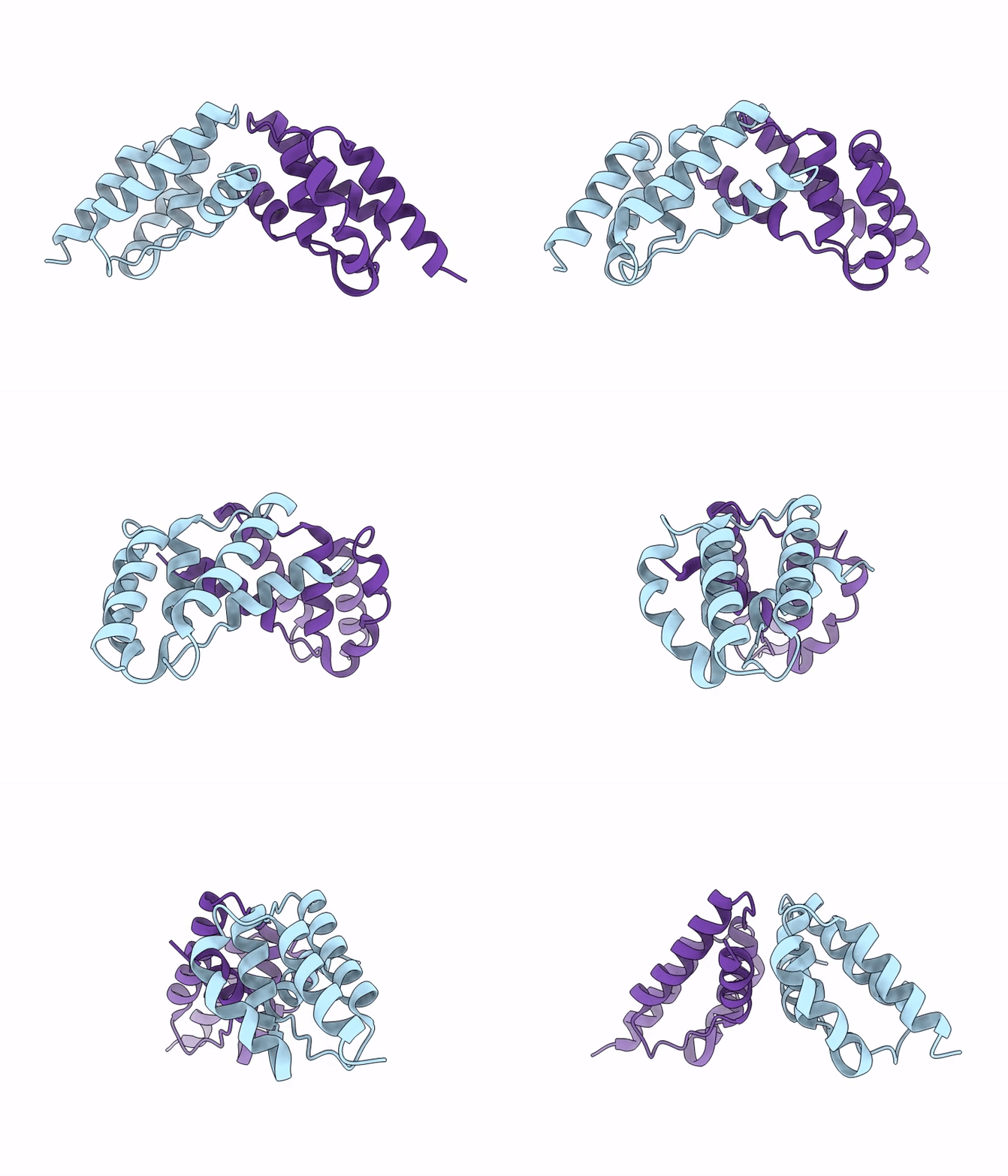
9RXX image
Deposition Date 2025-07-13
Release Date 2025-10-08
Last Version Date 2025-10-22
Entry Detail
PDB ID:
9RXX
Title:
Ty1 Prime Retrotransposon Capsid C-Terminal Domain, F323S
Biological Source:
Source Organism:
Host Organism:
Method Details:
Experimental Method:
Resolution:
1.62 Å
R-Value Free:
0.26
R-Value Work:
0.22
Space Group:
P 1 21 1

Macromolecular Entities
Structures with similar UniProt ID
Protein Blast
Polymer Type:polypeptide(L)
Molecule:Capsid protein
Gene (Uniprot):TY1A-MR1
Mutagens:F323S
Chain IDs:A, B
Chain Length:97
Number of Molecules:2
Biological Source:Saccharomyces cerevisiae
Primary Citation
Probing the molecular determinants of Ty1 retrotransposon restriction specificity in yeast.
Plos Genet. 21 e1011898 e1011898 (2025)
PMID: 41066520 DOI: 10.1371/journal.pgen.1011898

Abstact

The evolutionary history of retrotransposons and their hosts shapes the dynamics of transposition and restriction. The Pseudoviridae of yeast includes multiple Ty1 LTR-retrotransposon subfamilies. Saccharomyces cerevisiae prevents uncontrolled retrotransposition of Ty1 subfamilies using distinct mechanisms: canonical Ty1 is inhibited by a self-encoded restriction factor, p22/p18, whereas Ty1' is inhibited by an endogenized restriction factor, Drt2. The minimal inhibitory fragment of both restriction factors (p18m and Drt2m) is a conserved C-terminal capsid domain. Here, we use biophysical and genetic approaches to demonstrate that p18m and Drt2m are highly specific to their subfamilies. Although the crystal structures of p18m and Drt2m are similar, three divergent residues found in a conserved hydrophobic interface direct restriction specificity. By mutating these three residues, we re-target each restriction factor to the opposite transposon. Our work highlights how a common lattice-poisoning mechanism of restriction evolved from independent evolutionary trajectories in closely related retrotransposon subfamilies. These data raise the possibility that similar capsid-capsid interactions may exist in other transposons/viruses and that highly specific inhibitors could be engineered to target capsid interfaces.

Legend

Protein

Chemical

Disease

Primary Citation of related structures
Feedback Form
Name
Email
Institute
Feedback