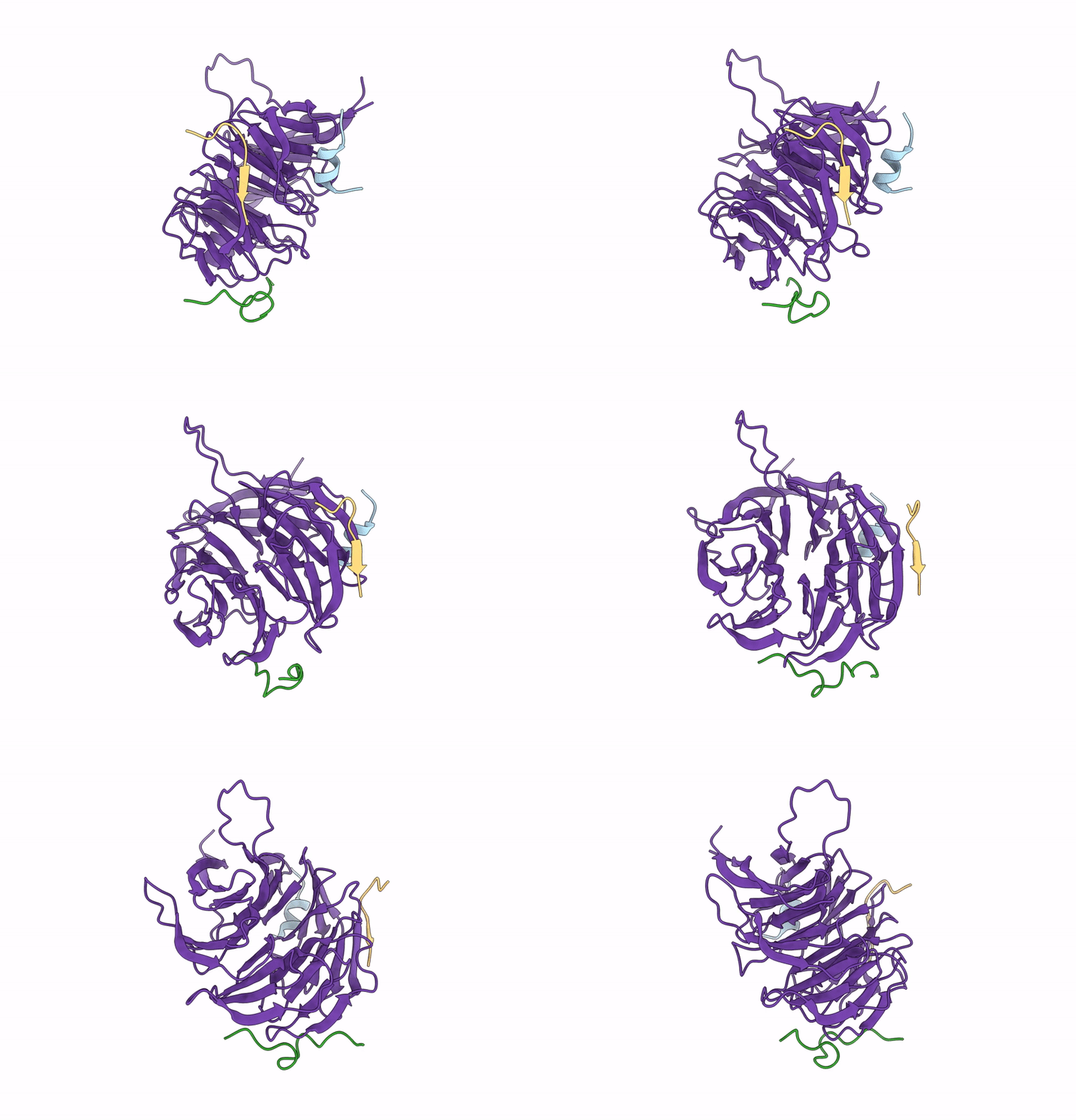
9RSX image
Deposition Date 2025-07-01
Release Date 2025-12-10
Last Version Date 2025-12-10
Entry Detail
PDB ID:
9RSX
Keywords:
Title:
Structure of RACK1 bound to the C-terminus of SERBP1 and the RIH region of ZAK
Biological Source:
Source Organism:
Homo sapiens (Taxon ID: 9606)
Method Details:
Experimental Method:
Resolution:
2.91 Å
Aggregation State:
PARTICLE
Reconstruction Method:
SINGLE PARTICLE
Macromolecular Entities
Structures with similar UniProt ID
Protein Blast
Polymer Type:polypeptide(L)
Molecule:Mitogen-activated protein kinase kinase kinase 20
Gene (Uniprot):MAP3K20
Chain IDs:A (auth: N2)
Chain Length:800
Number of Molecules:1
Biological Source:Homo sapiens
Structures with similar UniProt ID
Protein Blast
Polymer Type:polypeptide(L)
Molecule:Plasminogen activator inhibitor 1 RNA-binding protein
Gene (Uniprot):SERBP1
Chain IDs:B (auth: N3)
Chain Length:408
Number of Molecules:1
Biological Source:Homo sapiens
Structures with similar UniProt ID
Protein Blast
Polymer Type:polypeptide(L)
Molecule:40S ribosomal protein S3
Gene (Uniprot):RPS3
Chain IDs:C (auth: RD)
Chain Length:243
Number of Molecules:1
Biological Source:Homo sapiens
Structures with similar UniProt ID
Protein Blast
Polymer Type:polypeptide(L)
Molecule:Receptor of activated protein C kinase 1
Gene (Uniprot):RACK1
Chain IDs:D (auth: Rg)
Chain Length:317
Number of Molecules:1
Biological Source:Homo sapiens
Ligand Molecules
Primary Citation
ZAK activation at the collided ribosome.
Nature ? ? ? (2025)
PMID: 41261136 DOI: 10.1038/s41586-025-09772-8

Abstact

Ribosome collisions activate the ribotoxic stress response mediated by the MAP3K ZAK, which in turn regulates cell-fate consequences through downstream phosphorylation of the MAPKs p38 and JNK1. Despite the critical role of ZAK during cellular stress, a mechanistic and structural understanding of ZAK-ribosome interactions and how these lead to activation remain elusive. Here we combine biochemistry and cryo-electron microscopy to discover distinct ZAK-ribosome interactions required for constitutive recruitment and for activation. We find that upon induction of ribosome collisions, interactions between ZAK and the ribosomal protein RACK1 enable its activation by dimerization of its SAM domains at the collision interface. Furthermore, we discover how this process is negatively regulated by the ribosome-binding protein SERBP1 to prevent constitutive ZAK activation. Characterization of novel SAM variants as well as a known pathogenic variant of the SAM domain of ZAK supports a key role of the SAM domain in regulating kinase activity on and off the ribosome, with some mutants bypassing the ribosome requirement for ZAK activation. Collectively, our data provide a mechanistic blueprint of the kinase activity of ZAK at the collided ribosome interface.

Legend

Protein

Chemical

Disease

Primary Citation of related structures
Feedback Form
Name
Email
Institute
Feedback