Planned Maintenance: Some services may turn out to be unavailable from 15th January, 2026 to 16th January, 2026. We apologize for the inconvenience!

9RCC image
Deposition Date 2025-05-27
Release Date 2025-09-03
Last Version Date 2025-12-24
Entry Detail
PDB ID:
9RCC
Title:
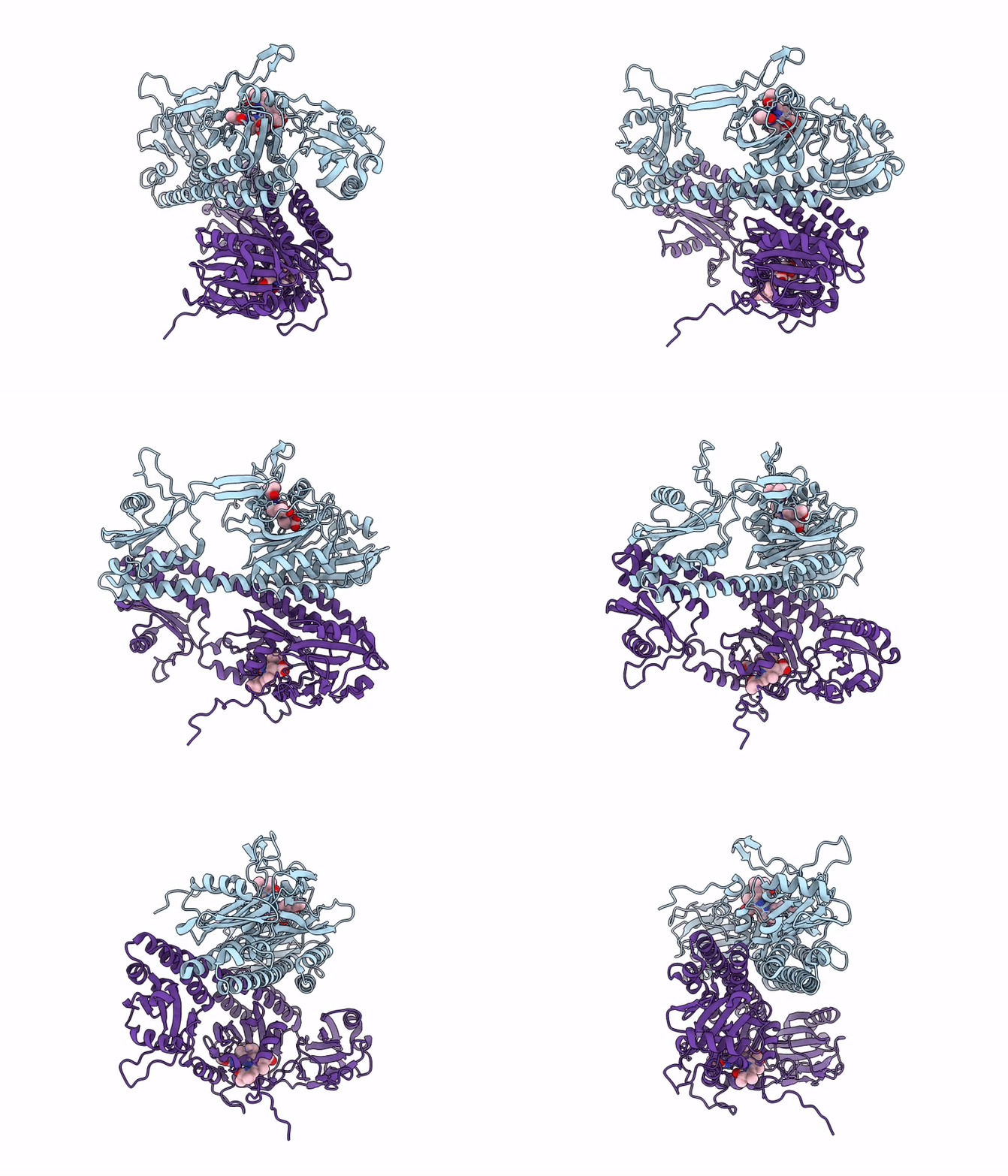
PrPfr hybrid state of the Pseudomonas aeruginosa bacteriophytochrome / PaBphP
Biological Source:
Source Organism(s):
Expression System(s):
Method Details:
Experimental Method:
Resolution:
2.80 Å
Aggregation State:
PARTICLE
Reconstruction Method:
SINGLE PARTICLE

Macromolecular Entities
Structures with similar UniProt ID
Protein Blast
Polymer Type:polypeptide(L)
Molecule:Bacteriophytochrome
Gene (Uniprot):bphP
Chain IDs:A, B
Chain Length:728
Number of Molecules:2
Biological Source:Pseudomonas aeruginosa
Ligand Molecules
Primary Citation
Chemical Mechanism of Allosteric and Asymmetric Dark Reversion in a Bacterial Phytochrome Uncovered by Cryo-EM.
J.Am.Chem.Soc. 147 45701 45711 (2025)
PMID: 41317121 DOI: 10.1021/jacs.5c17531

Abstact

Phytochromes are light-sensitive proteins that are found in plants, fungi, and bacteria. They exist in two functional states, Pr and Pfr, distinguished by Z/E isomers of their bilin chromophore. The chromophore can photoswitch between these states but also thermally converts in darkness. Despite the importance of the latter reaction, it is unknown how it is controlled by the phytochrome's structure. Here, we present single-particle cryo-EM measurements on the Pseudomonas aeruginosa bacteriophytochrome (PaBphP) carried out at multiple time points during dark reversion from Pr to Pfr. These experiments resolved the structure of a PrPfr hybrid state as a transient intermediate. Surprisingly, we find that only protomer B converts back to Pfr in the hybrid, while protomer A remains in Pr. We identify structural asymmetries in the precursor Pr state, which extend from the homodimer interface to a conserved histidine (H277). The hydrogen-bonding network around the chromophore is modulated, explaining how a phytochrome exerts control over the isomerization reaction. These findings establish that dark reversion is governed by conformational selection between two substates, whereby one is "dark-reversion ready" and the other blocks the reaction. Moreover, we explain how the equilibrium of the states is allosterically controlled across the dimer. Together, these findings provide a structural framework for tuning phytochrome signaling lifetimes in optogenetic applications.

Legend

Protein

Chemical

Disease

Primary Citation of related structures
Feedback Form
Name
Email
Institute
Feedback