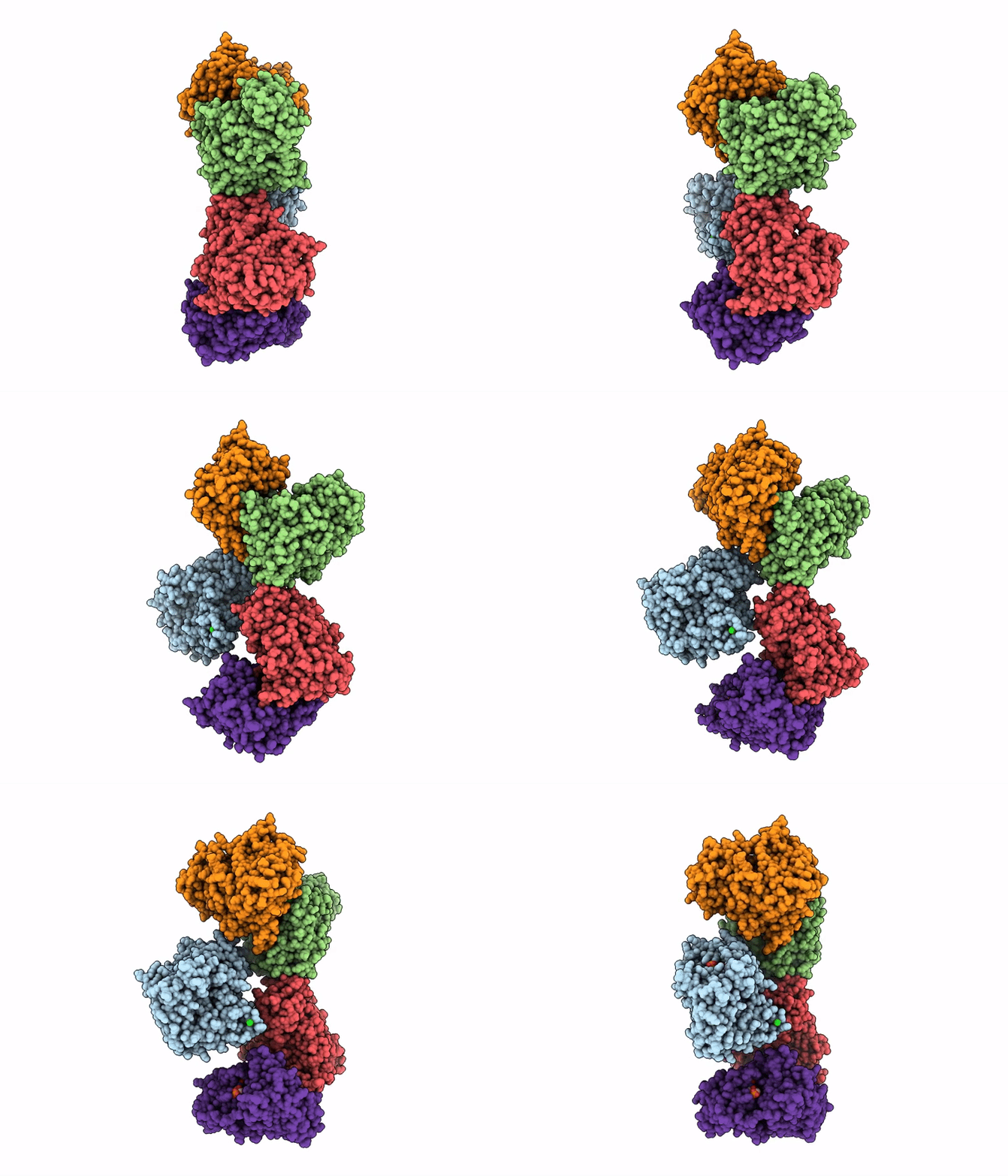
9R0W image
Deposition Date 2025-04-24
Release Date 2026-01-28
Last Version Date 2026-01-28
Entry Detail
PDB ID:
9R0W
Keywords:
Title:
Crystal structure of glutathione transferase iota 1 from Synechocystis sp. PCC 6803 in complex with FMN
Biological Source:
Source Organism(s):
Expression System(s):
Method Details:
Experimental Method:
Resolution:
2.71 Å
R-Value Free:
0.24
R-Value Work:
0.20
Space Group:
C 2 2 21
Macromolecular Entities
Structures with similar UniProt ID
Protein Blast
Polymer Type:polypeptide(L)
Molecule:Sll1902 protein
Gene (Uniprot):sll1902
Chain IDs:A, B, C, D, E
Chain Length:399
Number of Molecules:5
Biological Source:Synechocystis sp. PCC 6803
Primary Citation
A novel glutathione transferase harboring an FMN redox cofactor.
Febs J. ? ? ? (2026)
PMID: 41527426 DOI: 10.1111/febs.70394

Abstact

Glutathione transferases (GSTs) constitute a widespread superfamily of multifunctional enzymes with roles in cellular detoxification and secondary metabolism. We report that the poorly characterized Iota-class enzymes (GSTIs) are mainly found in photosynthetic prokaryotes and eukaryotes, excluding Spermatophyta, and in a few fungi of the order Chytridiomycota. GSTIs are distinguished from other GSTs by the presence of N- and C-terminal extensions of unknown function flanking the central GST domain. Focusing on the GSTI enzyme (SynGSTI1) of the model cyanobacterium Synechocystis sp. PCC 6803 (S.6803), we showed that recombinant SynGSTI1 protein purified from Escherichia coli and S.6803 exhibited thiol-transferase and dehydroascorbate reductase activities consistent with the presence of a CPYC catalytic motif in its GST domain. SynGSTI1 was found to be monomeric and to exhibit a spectrophotometric signature between 300 and 500 nm, which was attributed to a flavin mononucleotide (FMN). The C-terminal domain of SynGSTI1 contained a conserved PRDM/L motif involved in the binding of an FMN ligand and showed a structure similar to that of the α-subunit of phycoerythrin components of the light-harvesting antenna of some cyanobacteria, most red algae and some cryptophytes. The deletion of the SynGSTI1 encoding gene in S.6803 (i) caused a slight decrease in the photosynthetic pigment content without impairing growth in standard photoautotrophic conditions; (ii) increased sensitivity to moderate and high light intensities; (iii) reduced glutathione levels and consistently; (iv) decreased tolerance to oxidative and metal stresses triggered by H2O2, diamide and cobalt. Thus, SynGSTI1 defines a unique GST subclass with critical roles in redox homeostasis and stress tolerance.

Legend

Protein

Chemical

Disease

Primary Citation of related structures
Feedback Form
Name
Email
Institute
Feedback