9QYL image
Deposition Date 2025-04-18
Release Date 2025-10-29
Last Version Date 2025-12-10
Entry Detail
PDB ID:
9QYL
Keywords:
Title:
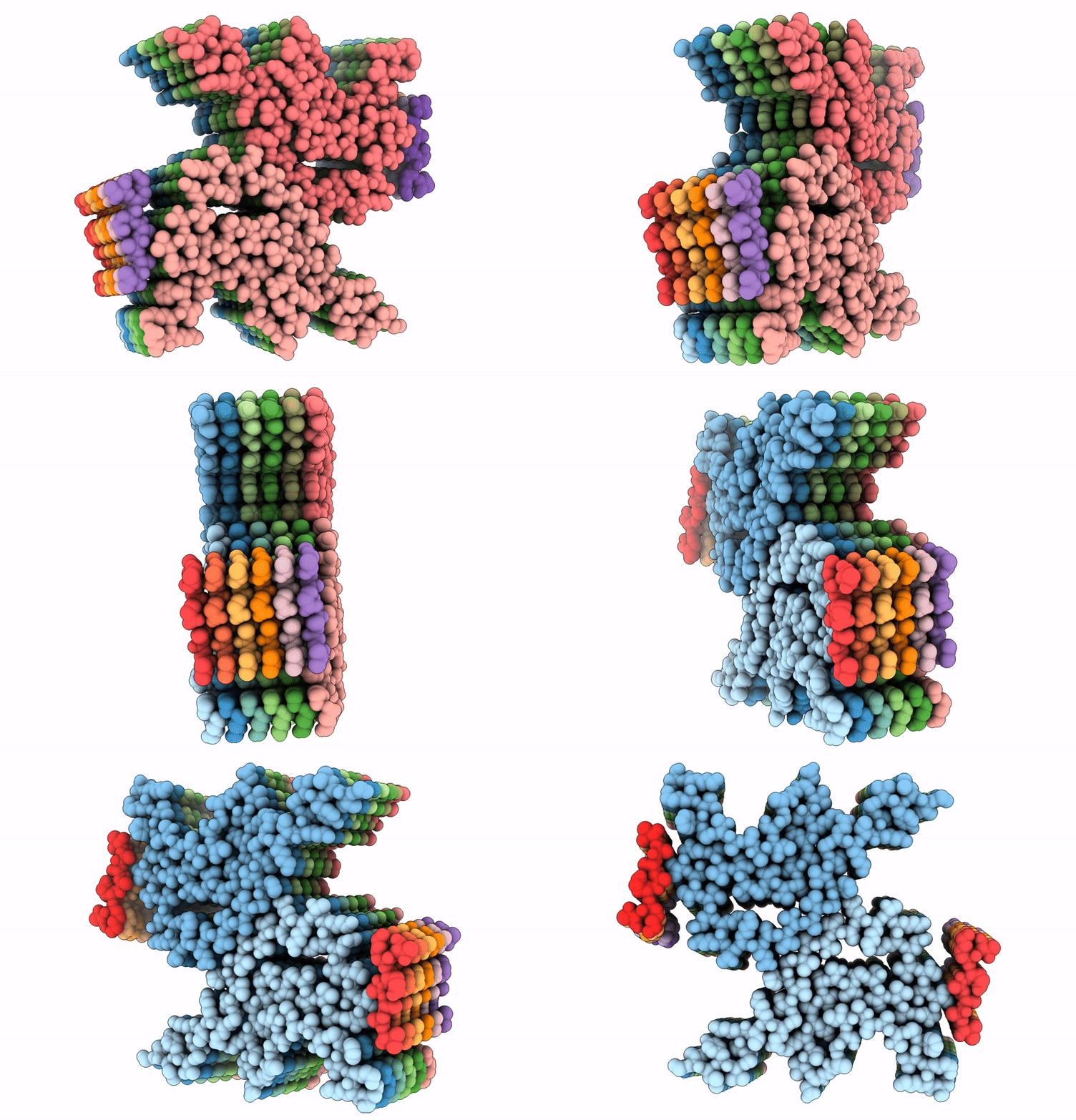
Alpha-synuclein fibril type 1A polymorph in the presence of ATP
Biological Source:
Source Organism:
Homo sapiens (Taxon ID: 9606)
Method Details:
Experimental Method:
Resolution:
3.08 Å
Aggregation State:
FILAMENT
Reconstruction Method:
HELICAL
Macromolecular Entities
Structures with similar UniProt ID
Protein Blast
Polymer Type:polypeptide(L)
Molecule:Alpha-synuclein
Gene (Uniprot):SNCA
Chain IDs:A (auth: E), B (auth: F), C (auth: G), D (auth: H), E (auth: J), F (auth: K), G (auth: L), H (auth: M), I (auth: N), J (auth: O), K (auth: P), L (auth: Q), M (auth: e), N (auth: f), O (auth: g), P (auth: h), Q (auth: j), R (auth: k), S (auth: l), T (auth: m), U (auth: n), V (auth: o), W (auth: p), X (auth: q)
Chain Length:140
Number of Molecules:24
Biological Source:Homo sapiens
Ligand Molecules
Primary Citation
ATP Hydrolysis by alpha-Synuclein Amyloids is Mediated by Enclosing beta-Strand.
Adv Sci 12 e08441 e08441 (2025)
PMID: 41099718 DOI: 10.1002/advs.202508441

Abstact

Pathological amyloids, like those formed by α-synuclein in Parkinson's disease, are recently found to catalyze the hydrolysis of model substrates in vitro. Here it is reported that the universal energy molecule ATP is another substrate for α-synuclein amyloid chemical catalysis. To reveal the underlying mechanism, the high-resolution cryo-EM structure of the amyloids in the presence of ATP is solved. The structure reveals a type 1A amyloid fold with an additional β-strand involving residues 16-22 that wraps around the ATP, creating an enclosed cavity at the interface of the protofilaments. Mutations of putative ATP-interacting residues in the cavity and the additional β-strand showed that replacing any one of Lys21, Lys23, Lys43, Lys45, and Lys60 with Ala reduced amyloid-mediated ATPase activity. High-resolution structural analysis of Lys21Ala α-synuclein amyloids in the presence of ATP reveals the same fold as wild-type α-synuclein amyloids but without the extra β-strand and with ATP oriented differently. It is concluded that positively-charged side chains, along with ordering of the N-terminal part into a β-strand, enclosing the cavity, are essential parameters governing ATP hydrolysis by α-synuclein amyloids. Amyloid-catalyzed ATP hydrolysis may hamper ATP-dependent rescue systems near amyloid deposits in vivo.

Legend

Protein

Chemical

Disease

Primary Citation of related structures
Feedback Form
Name
Email
Institute
Feedback