9QV5 image
Deposition Date 2025-04-11
Release Date 2025-10-29
Last Version Date 2025-12-03
Entry Detail
PDB ID:
9QV5
Title:
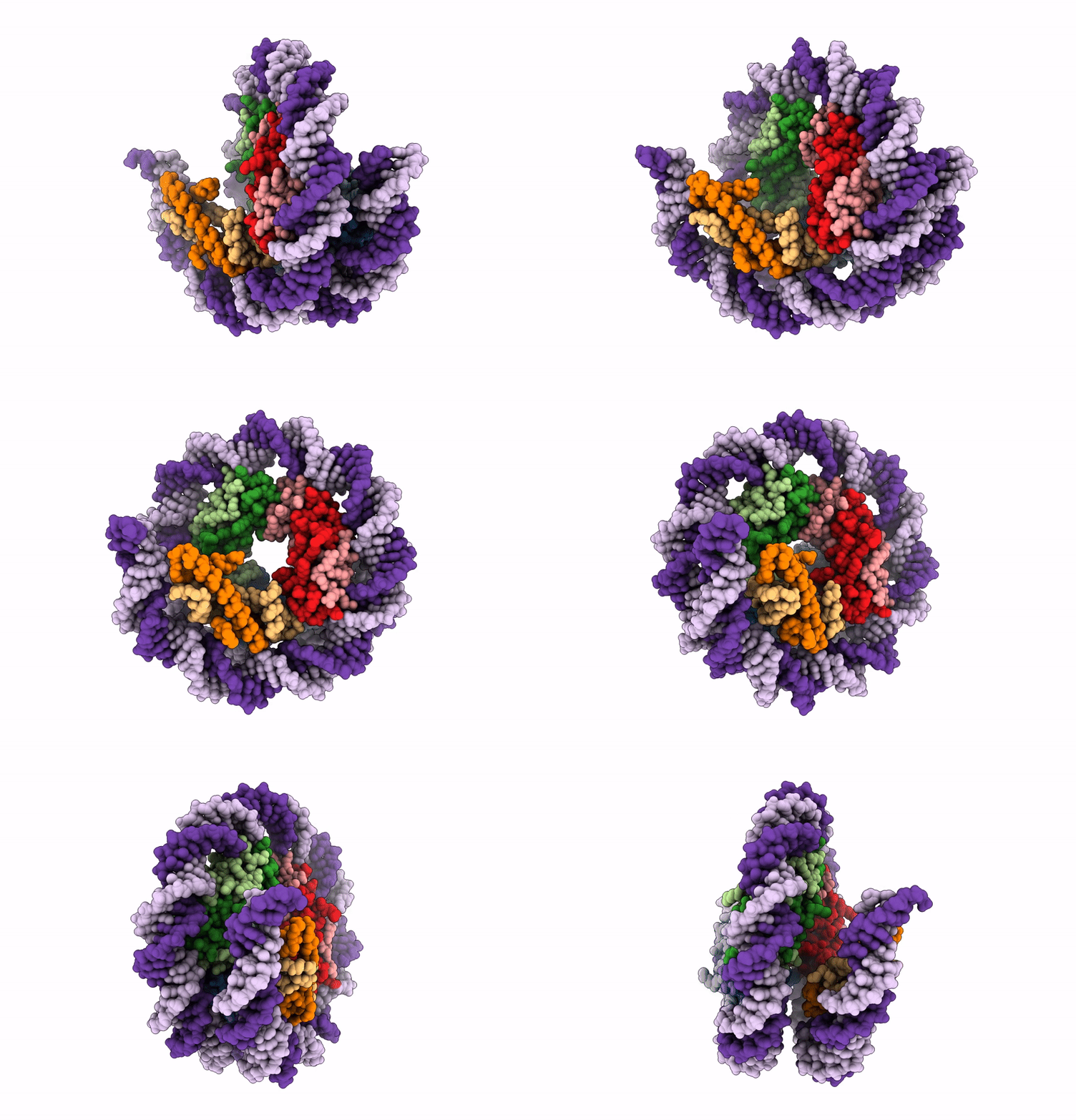
Asgard Archaeal HHoB nucleosome in the closed conformation
Biological Source:
Host Organism:
Method Details:
Experimental Method:
Resolution:
3.50 Å
Aggregation State:
PARTICLE
Reconstruction Method:
SINGLE PARTICLE
Macromolecular Entities
Polymer Type:polypeptide(L)
Molecule:Archaeal histone A
Chain IDs:A, B, C, D, E, F, G, H
Chain Length:68
Number of Molecules:8
Biological Source:Candidatus Heimdallarchaeota archaeon LC_3
Polymer Type:polydeoxyribonucleotide
Molecule:DNA (120-MER) part of a full 147 bp Widom601 DNA
Chain IDs:I (auth: X)
Chain Length:120
Number of Molecules:1
Biological Source:synthetic construct
Polymer Type:polydeoxyribonucleotide
Molecule:DNA (120-MER) part of a full 147 bp Widom601 DNA
Chain IDs:J (auth: Y)
Chain Length:120
Number of Molecules:1
Biological Source:synthetic construct
Ligand Molecules
Primary Citation
Cryo-EM reveals open and closed Asgard chromatin assemblies.
Mol.Cell 85 4152 ? (2025)
PMID: 41161312 DOI: 10.1016/j.molcel.2025.10.001

Abstact

Asgards are the closest archaeal relatives of eukaryotes, representing an important step in chromatin evolution. However, their chromatin organization has remained enigmatic until now. In this study, we present the first structures of Asgard chromatin assemblies formed by the Hodarchaeal histone HHoB. Our high-resolution cryo-electron microscopy (cryo-EM) structures reveal that this Asgard histone assembles into compact "closed" and into extended "open" hypernucleosomes. Thus, the closed hypernucleosome conformation is conserved across archaeal lineages, while the open conformation resembles a eukaryotic H3-H4 octasome and likely represents an Asgard-specific innovation. Moreover, we show that Mg²⁺ ions influence Asgard chromatin conformation, suggesting a regulatory role. Overall, our study provides the first structure-based model of Asgard chromatin organization, expanding our understanding of chromatin architecture in an evolutionary context.

Legend

Protein

Chemical

Disease

Primary Citation of related structures
Feedback Form
Name
Email
Institute
Feedback