9QUG image
Deposition Date 2025-04-10
Release Date 2026-01-21
Last Version Date 2026-01-21
Entry Detail
PDB ID:
9QUG
Keywords:
Title:
Structure of a UBC-Ubiquitin conjugate
Biological Source:
Source Organism(s):
Homo sapiens (Taxon ID: 9606)
Expression System(s):
Method Details:
Experimental Method:
Resolution:
1.80 Å
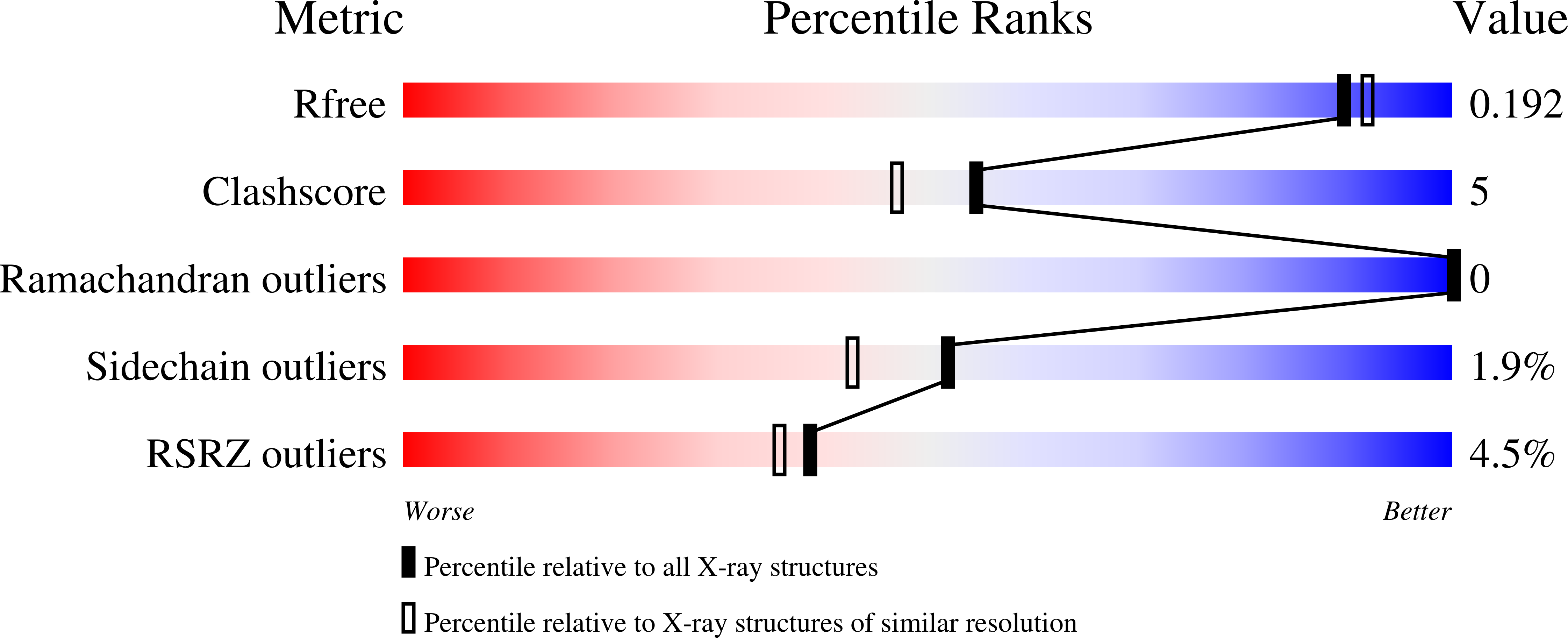
R-Value Free:
0.19
R-Value Work:
0.16
R-Value Observed:
0.16
Space Group:
P 21 21 21
Macromolecular Entities
Structures with similar UniProt ID
Protein Blast
Polymer Type:polypeptide(L)
Molecule:(E3-independent) E2 ubiquitin-conjugating enzyme
Gene (Uniprot):UBE2O
Chain IDs:B (auth: A)
Chain Length:382
Number of Molecules:1
Biological Source:Homo sapiens
Structures with similar UniProt ID
Protein Blast
Polymer Type:polypeptide(L)
Molecule:Polyubiquitin-B
Gene (Uniprot):UBB
Chain IDs:A (auth: C)
Chain Length:76
Number of Molecules:1
Biological Source:Homo sapiens
Primary Citation
Structural basis for substrate recruitment and catalytic ubiquitin transfer by the E2/E3 hybrid enzyme UBE2O.
J.Biol.Chem. 302 111073 111073 (2025)
PMID: 41419192 DOI: 10.1016/j.jbc.2025.111073

Abstact

UBE2O is a promiscuous ubiquitin ligase involved in cellular quality control pathways. Along with BIRC6, UBE2O is one of only two E2 enzymes that can ubiquitinate substrates in an E3-independent manner. The E2/E3 hybrid targets and multi-monoubiquitinates a multitude of orphan proteins; however, the mechanisms underlying substrate specificity and ubiquitin transfer remain poorly understood. By combining structural and biochemical approaches, we show that substrate binding by UBE2O occurs through a conserved acidic pocket formed by the N-terminal SH3-like domains and that this platform allows the recruitment of a broad range of proteins. Furthermore, we identified specific residues in the catalytic UBC domain that position ubiquitin in a closed state, confirming its confirmation, and priming it for nucleophilic attack by the incoming substrate. Importantly, the activated E2∼Ub conjugate is protected by a tryptophan residue, avoiding premature hydrolysis. By incorporating these findings into the UBC domain of BIRC6 our data provide the molecular basis of how specialized E2/E3 hybrid proteins function as potent ubiquitination enzymes reminiscent of the catalytic principle of RING E3 ligases.

Legend

Protein

Chemical

Disease

Primary Citation of related structures
Feedback Form
Name
Email
Institute
Feedback