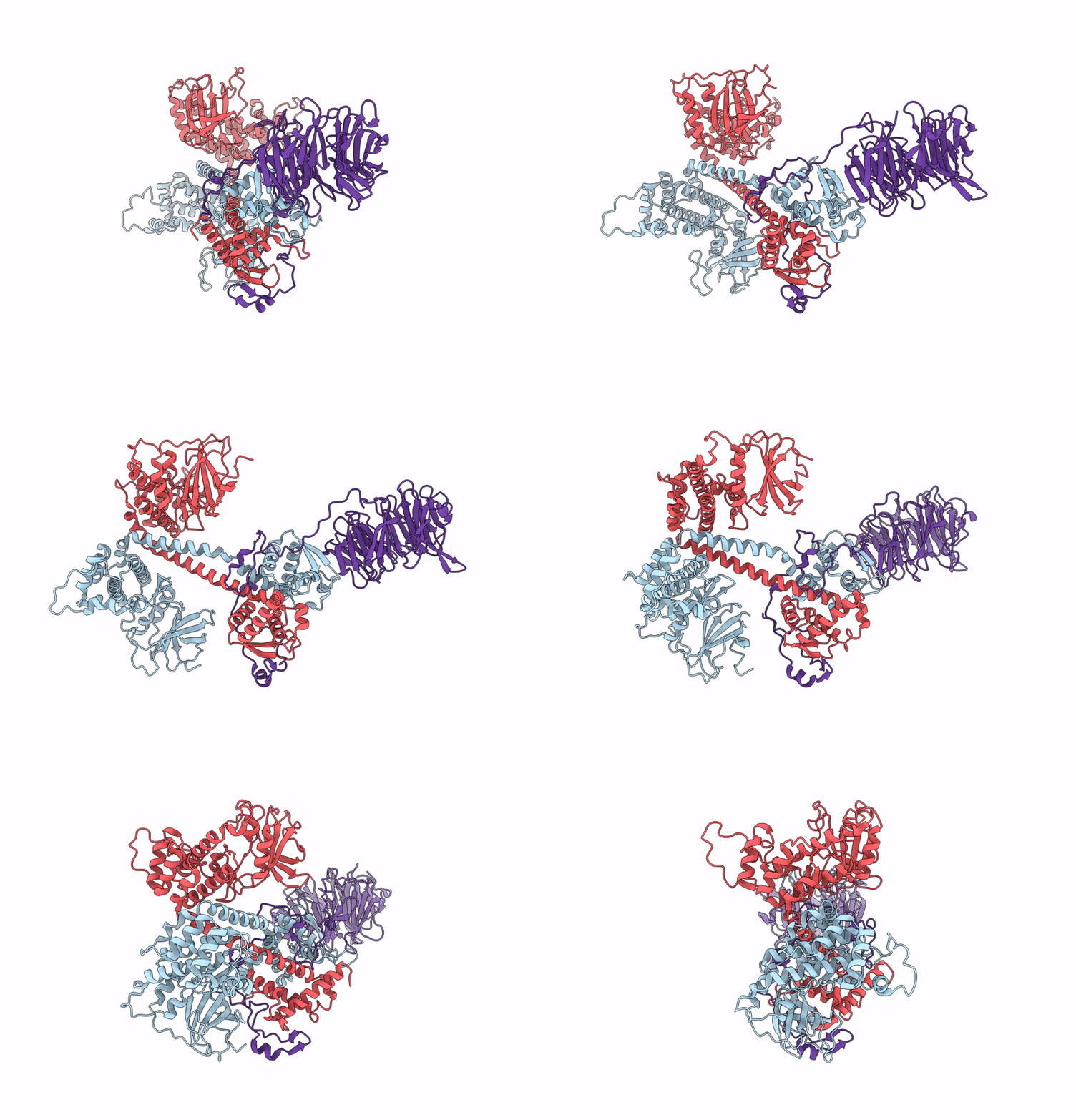
9QTU image
Deposition Date 2025-04-09
Release Date 2025-12-10
Last Version Date 2025-12-10
Entry Detail
PDB ID:
9QTU
Title:
human PAN2-PAN3 deadenylase complex in the apo state
Biological Source:
Source Organism:
Homo sapiens (Taxon ID: 9606)
Host Organism:
Method Details:
Experimental Method:
Resolution:
4.60 Å
Aggregation State:
PARTICLE
Reconstruction Method:
SINGLE PARTICLE
Macromolecular Entities
Structures with similar UniProt ID
Protein Blast
Polymer Type:polypeptide(L)
Molecule:Isoform 3 of PAN2-PAN3 deadenylation complex subunit PAN3
Gene (Uniprot):PAN3
Chain IDs:A, B
Chain Length:863
Number of Molecules:2
Biological Source:Homo sapiens
Structures with similar UniProt ID
Protein Blast
Polymer Type:polypeptide(L)
Molecule:PAN2-PAN3 deadenylation complex catalytic subunit PAN2
Gene (Uniprot):PAN2
Chain IDs:C
Chain Length:1202
Number of Molecules:1
Biological Source:Homo sapiens
Ligand Molecules
Primary Citation
Mechanisms governing poly(A)-tail-length specificity of the human PAN2-PAN3 deadenylase complex.
Cell Rep 44 116609 116609 (2025)
PMID: 41275497 DOI: 10.1016/j.celrep.2025.116609

Abstact

The lifespan of most eukaryotic mRNAs is modulated by the gradual shortening of the poly(A) tail and removal of the associated poly(A)-binding protein. The human PAN2-PAN3 complex catalyzes initial deadenylation by shortening long poly(A) tails associated with PABPC1. Both PAN2-PAN3 and PABPC1 are evolutionarily conserved from fungi to humans. How the human complex has adapted to recognize and act on longer poly(A) tails characteristic of mammalian mRNAs remains unclear. Here, we report a method to obtain homo-polymeric poly(A) RNAs up to 240 nt, mimicking the synthesis length of poly(A) tails in mammals. We recapitulate human deadenylation properties in vitro, with PAN2-PAN3 showing greater activity on long poly(A)-PABPC1 ribonucleoprotein substrates. Single-particle cryo-electron microscopy (cryo-EM) analyses of PAN2-PAN3 bound to poly(A)-PABPC1 ribonucleoproteins uncover a longer substrate-binding path in the case of the human deadenylase compared to fungi. Altogether, these data provide a rationale for the co-evolution of deadenylase properties and poly(A) tail lengths.

Legend

Protein

Chemical

Disease

Primary Citation of related structures
Feedback Form
Name
Email
Institute
Feedback