9QTJ image
Deposition Date 2025-04-09
Release Date 2026-02-18
Last Version Date 2026-02-18
Entry Detail
PDB ID:
9QTJ
Keywords:
Title:
Structure of Oceanobacillus iheyensis group II intron domains D1-D6
Biological Source:
Source Organism(s):
Method Details:
Experimental Method:
Resolution:
3.79 Å
Aggregation State:
PARTICLE
Reconstruction Method:
SINGLE PARTICLE
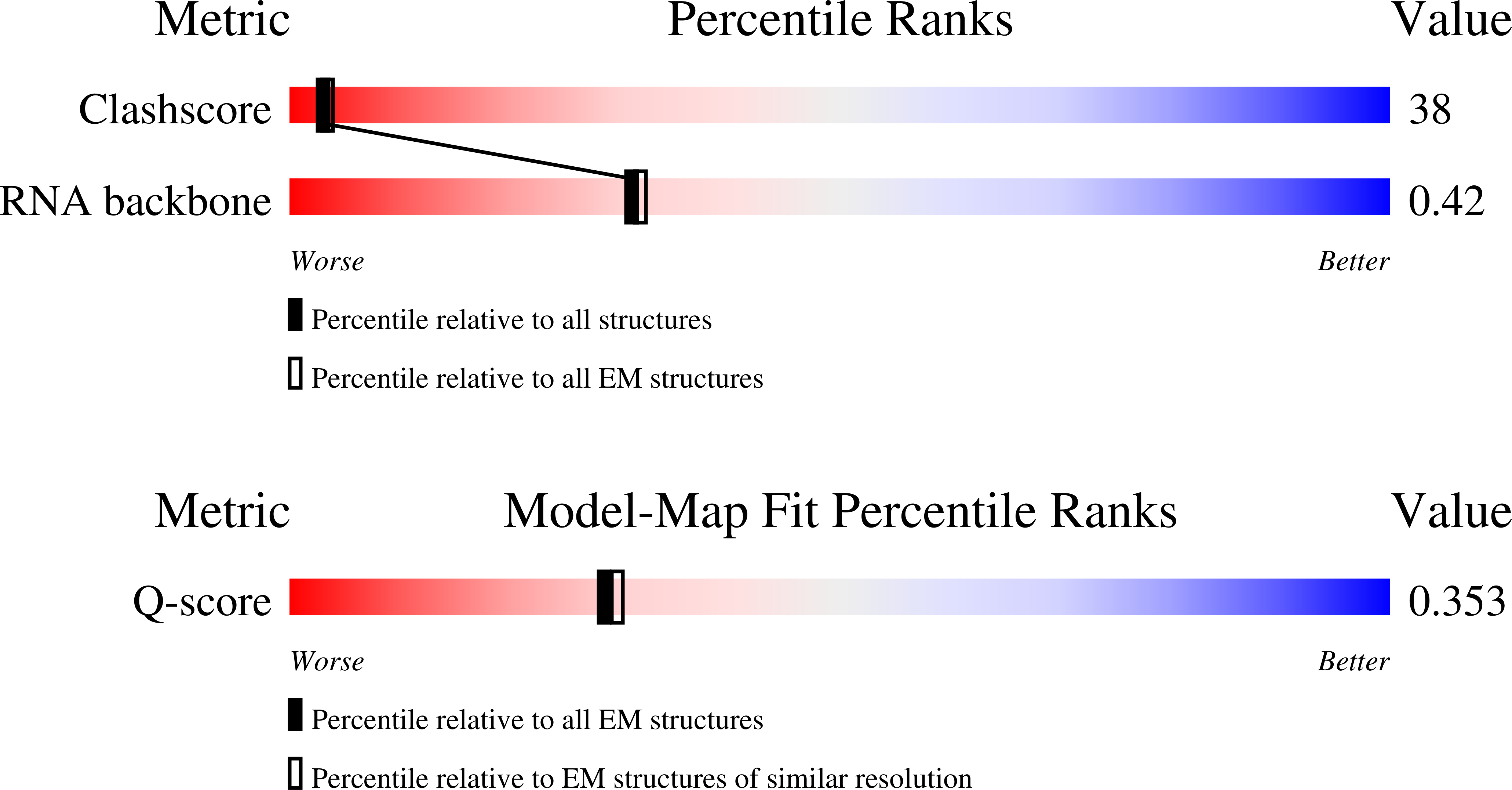
Macromolecular Entities
Polymer Type:polyribonucleotide
Molecule:RNA (461-MER)
Chain IDs:A (auth: 1)
Chain Length:481
Number of Molecules:1
Biological Source:Oceanobacillus iheyensis
Ligand Molecules
Primary Citation

Abstact

Accurate biomolecular structure prediction enables the prediction of mutational effects, the speculation of function based on predicted structural homology, the analysis of ligand binding modes, experimental model building, and many other applications. Such algorithms to predict essential functional and structural features remain out of reach for biomolecular complexes containing nucleic acids. Here, we report a quantitative and qualitative evaluation of nucleic acid structures for the CASP16 blind prediction challenge by 12 of the experimental groups who provided nucleic acid targets. Blind predictions accurately model secondary structure and some aspects of tertiary structure, including reasonable global folds for some complex RNAs; however, predictions often lack accuracy in the regions of highest functional importance. All models have inaccuracies in non-canonical regions where, for example, the nucleic-acid backbone bends, deviating from an A-form helix geometry, or a base forms a non-standard hydrogen bond (not a Watson-Crick base pair). These bends and non-canonical interactions are integral to forming functionally important regions such as RNA enzymatic active sites. Additionally, the modeling of conserved and functional interfaces between nucleic acids and ligands, proteins, or other nucleic acids remains poor. For some targets, the experimental structures may not represent the only structure the biomolecular complex occupies in solution or in its functional life cycle, posing a future challenge for the community.

Legend

Protein

Chemical

Disease

Primary Citation of related structures
Feedback Form
Name
Email
Institute
Feedback