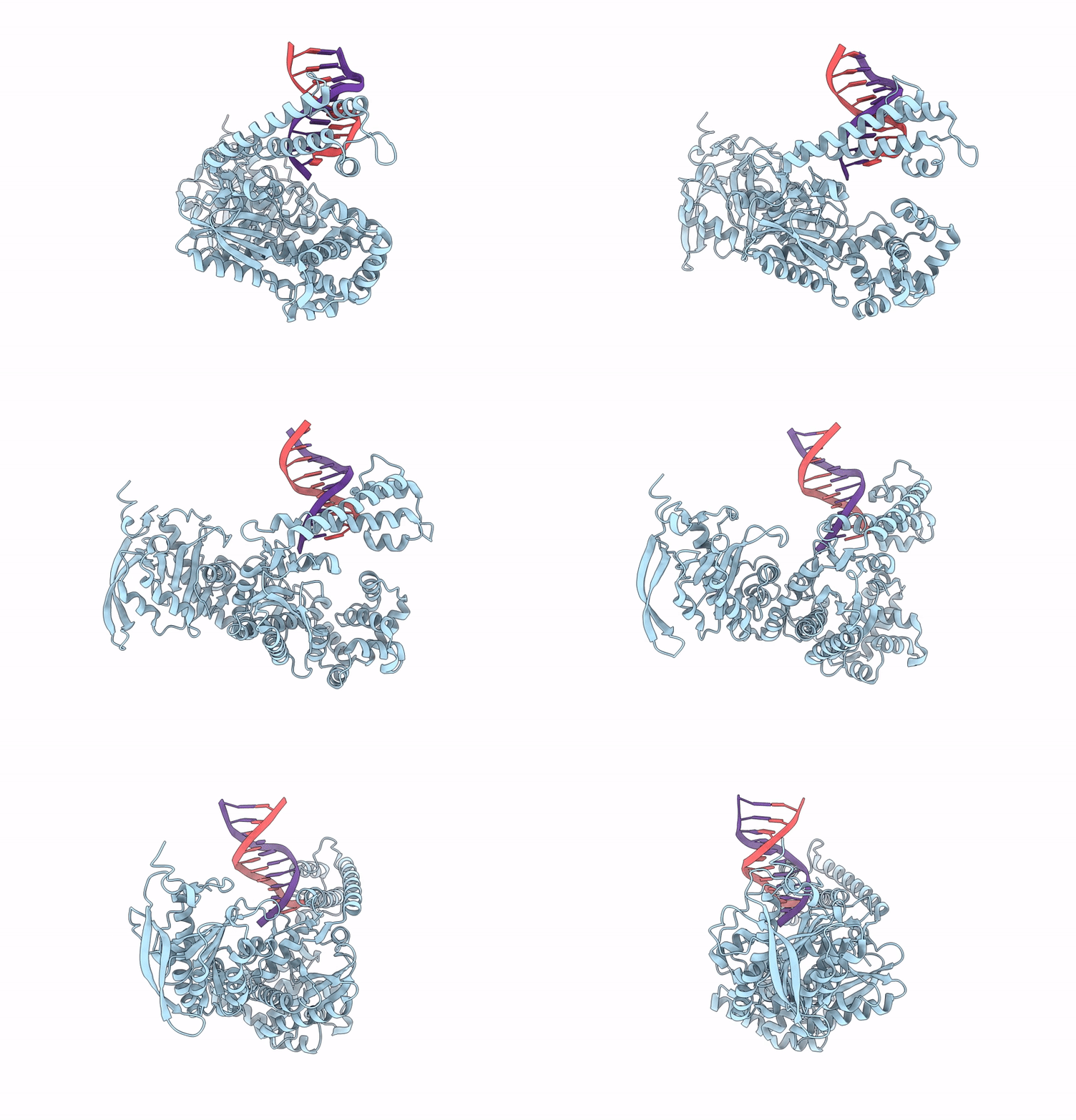
9QSC image
Deposition Date 2025-04-04
Release Date 2025-10-29
Last Version Date 2025-10-29
Entry Detail
PDB ID:
9QSC
Keywords:
Title:
apPol-DNA-nucleotide complex consensus refinement
Biological Source:
Source Organism:
Host Organism:
Method Details:
Experimental Method:
Resolution:
3.20 Å
Aggregation State:
PARTICLE
Reconstruction Method:
SINGLE PARTICLE
Macromolecular Entities
Structures with similar UniProt ID
Protein Blast
Polymer Type:polypeptide(L)
Molecule:Plastid replication-repair enzyme
Gene (Uniprot):PF3D7_1411400
Chain IDs:A
Chain Length:649
Number of Molecules:1
Biological Source:Plasmodium falciparum
Polymer Type:polydeoxyribonucleotide
Molecule:DNA primer strand
Chain IDs:B
Chain Length:25
Number of Molecules:1
Biological Source:DNA molecule
Polymer Type:polydeoxyribonucleotide
Molecule:DNA template strand
Chain IDs:C
Chain Length:36
Number of Molecules:1
Biological Source:DNA molecule
Ligand Molecules
Primary Citation
Structural basis of multitasking by the apicoplast DNA polymerase from Plasmodium falciparum.
Nucleic Acids Res. 53 ? ? (2025)
PMID: 41099714 DOI: 10.1093/nar/gkaf1005

Abstact

Plasmodium falciparum is a eukaryotic pathogen responsible for the majority of malaria-related fatalities. Plasmodium belongs to the phylum Apicomplexa and, like most members of this phylum, contains a non-photosynthetic plastid called the apicoplast. The apicoplast has its own genome, replicated by a dedicated replisome. Unlike other cellular replisomes, the apicoplast replisome uses a single DNA polymerase (apPol). This suggests that apPol can multitask and catalyse both replicative and lesion bypass synthesis. Replicative synthesis relies on a restrictive active site for high accuracy while lesion bypass typically requires an open active site. This raises the question: how does apPol combine the structural features of multiple DNA polymerases in a single protein? Using single-particle electron cryomicroscopy (cryoEM), we have solved the structures of apPol bound to its undamaged DNA and nucleotide substrates in five pre-chemistry conformational states. We found that apPol can accommodate a nascent base pair with the fingers in an open configuration, which might facilitate the lesion bypass activity. In the fingers-open state, we identified a nascent base pair checkpoint that preferentially selects Watson-Crick base pairs, an essential requirement for replicative synthesis. Taken together, these structural features might explain how apPol balances replicative and lesion bypass synthesis.

Legend

Protein

Chemical

Disease

Primary Citation of related structures
Feedback Form
Name
Email
Institute
Feedback