9QS9 image
Deposition Date 2025-04-04
Release Date 2025-12-03
Last Version Date 2026-01-14
Entry Detail
PDB ID:
9QS9
Keywords:
Title:
Structure and mechanism of the broad spectrum CRISPR-associated ring nuclease Crn4
Biological Source:
Source Organism(s):
Expression System(s):
Method Details:
Experimental Method:
Resolution:
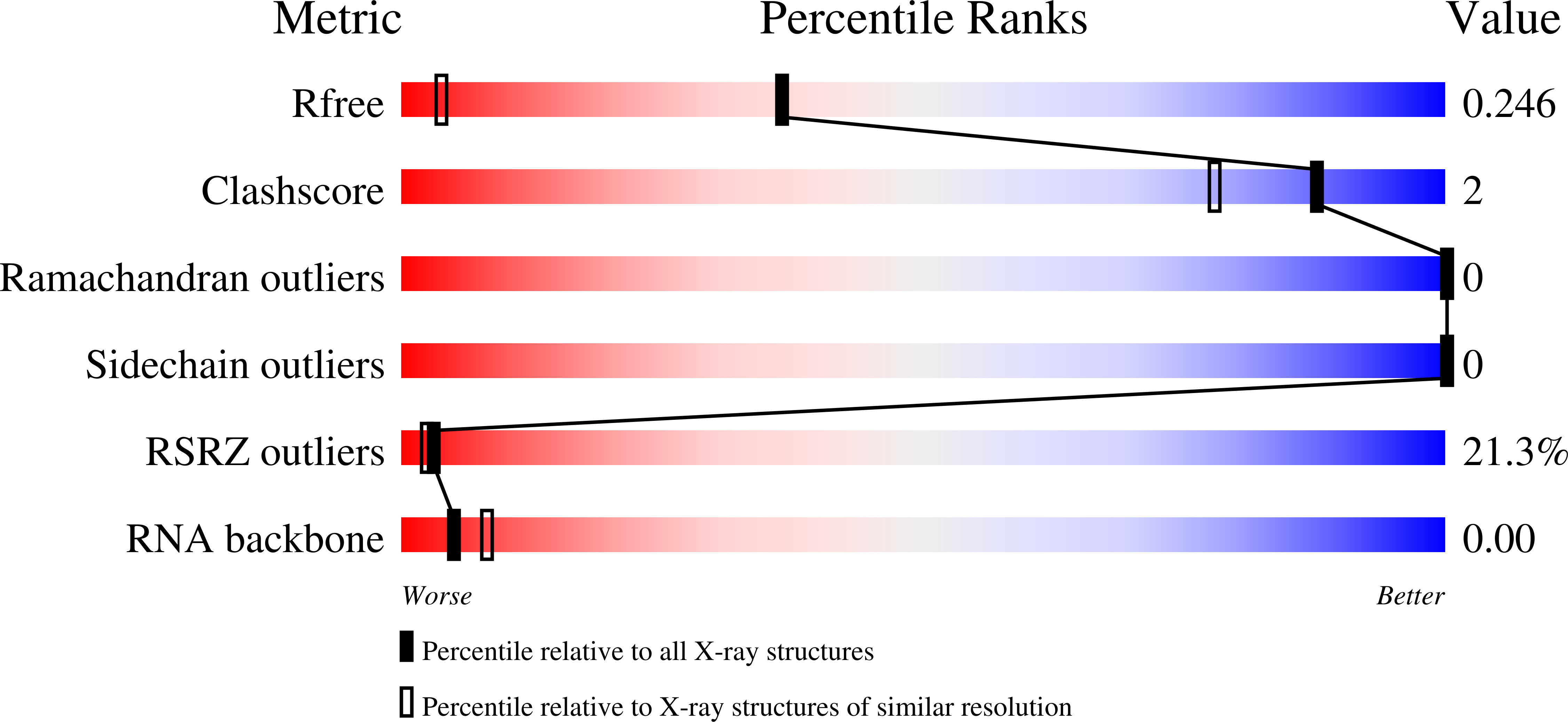
1.44 Å
R-Value Free:
0.23
R-Value Work:
0.22
Space Group:
P 1 21 1
Macromolecular Entities
Structures with similar UniProt ID
Protein Blast
Polymer Type:polypeptide(L)
Molecule:Crn4 H15A
Chain IDs:A, B, C (auth: F), D (auth: E), E (auth: C), F (auth: D)
Chain Length:149
Number of Molecules:6
Biological Source:Actinomyces procaprae
Polymer Type:polyribonucleotide
Molecule:Cyclic polyA
Chain IDs:G, H (auth: J), I (auth: K)
Chain Length:6
Number of Molecules:3
Biological Source:synthetic construct
Ligand Molecules
Primary Citation
Structure and mechanism of the broad spectrum CRISPR-associated ring nuclease Crn4.
Nat Commun ? ? ? (2025)
PMID: 41398410 DOI: 10.1038/s41467-025-67607-6

Abstact

Type III CRISPR systems detect the presence of RNA from mobile genetic elements (MGE) in prokaryotes, providing antiviral immunity. On activation, the catalytic Cas10 subunit conjugates ATP to form cyclic oligoadenylate (cOA) signalling molecules that activate ancillary effectors, providing an immune response. Cellular ring nucleases degrade cOA to reset the system. Here, we describe the structure and mechanism of a new family of ring nucleases, Crn4, associated with type III-D CRISPR systems. The crystal structure of Crn4 reveals a small homodimeric protein with a fold unrelated to any known ring nuclease or, indeed, any known protein structure. Crn4 degrades a wide range of cOA species to linear oligoadenylates in vitro and ameliorates type III CRISPR immunity in vivo. Phage and plasmids also encode Crn4 orthologues that may function as anti-CRISPRs. These observations expand our understanding of ring nucleases and reveal a new protein fold for cyclic nucleotide recognition.

Legend

Protein

Chemical

Disease

Primary Citation of related structures
Feedback Form
Name
Email
Institute
Feedback