9QRM image
Deposition Date 2025-04-03
Release Date 2025-09-03
Last Version Date 2025-10-01
Entry Detail
PDB ID:
9QRM
Keywords:
Title:
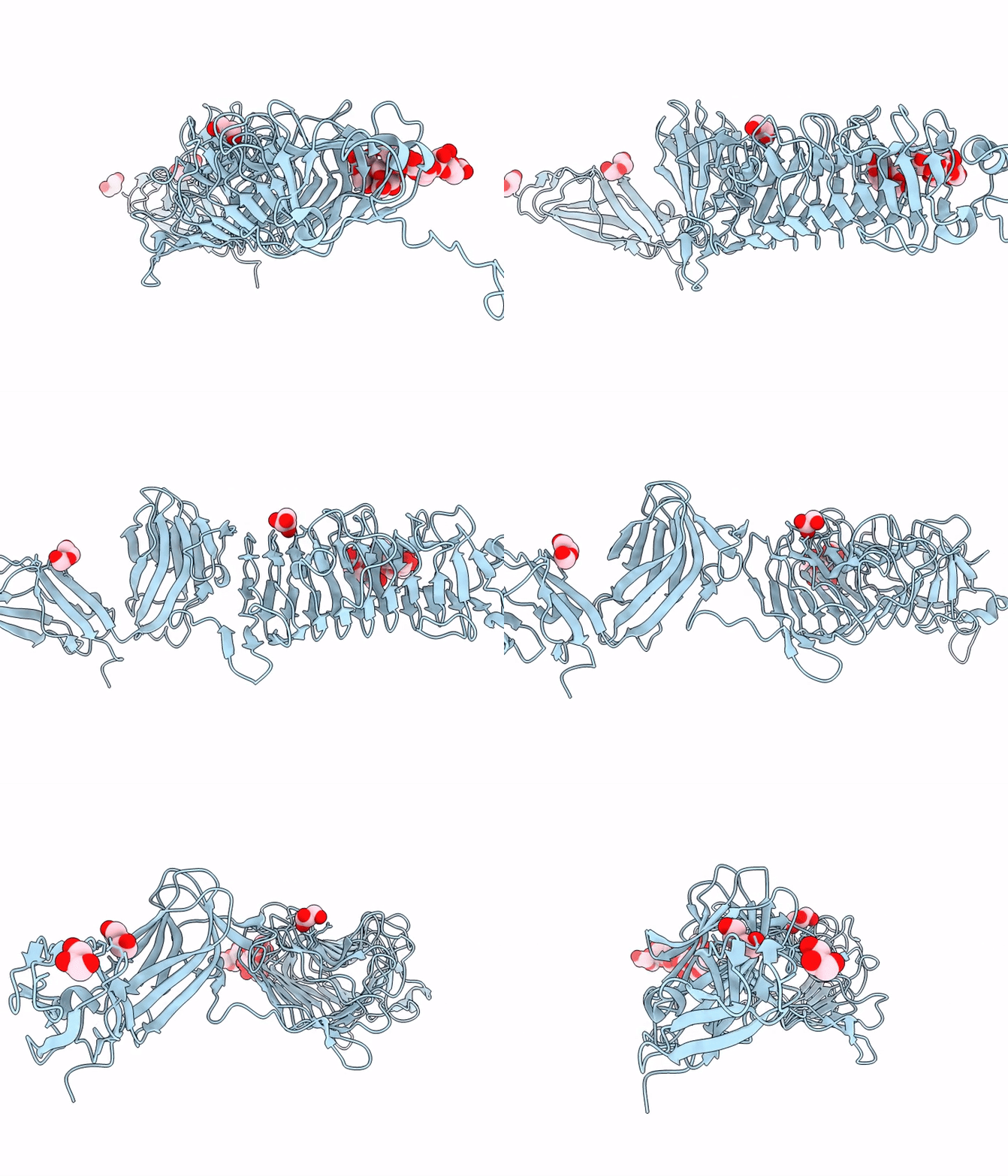
X-ray structure of Kp32gp38 in complex with K21 pyr5
Biological Source:
Source Organism:
Host Organism:
Method Details:
Experimental Method:
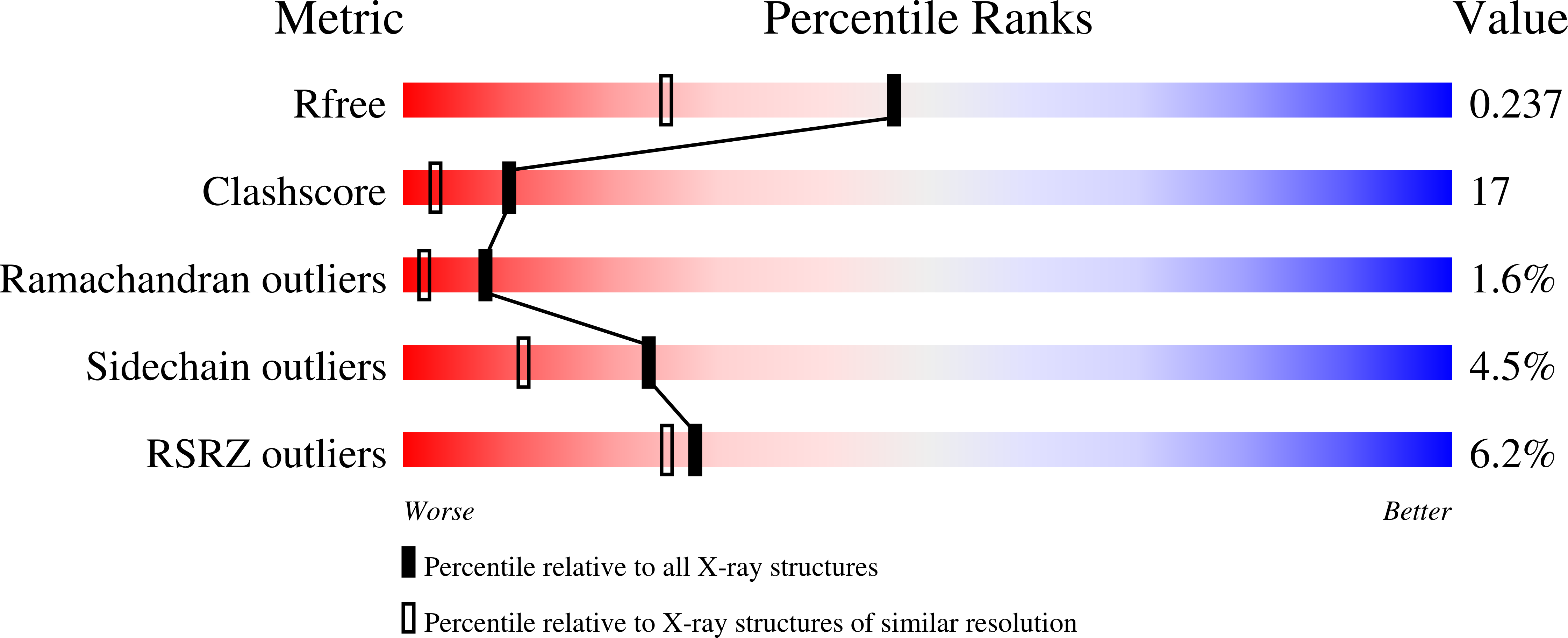
Resolution:
1.80 Å
R-Value Free:
0.23
R-Value Work:
0.18
R-Value Observed:
0.19
Space Group:
P 3 2 1
Macromolecular Entities
Structures with similar UniProt ID
Protein Blast
Polymer Type:polypeptide(L)
Molecule:Depolymerase 2, capsule K21-specific
Gene (Uniprot):38
Chain IDs:A (auth: B)
Chain Length:584
Number of Molecules:1
Biological Source:Klebsiella pneumoniae
Primary Citation
Structural and functional features of Klebsiella pneumoniae capsular degradation by the phage depolymerase KP32gp38: Implications for vaccination against K. pneumoniae.
Int J Antimicrob Agents 66 107596 107596 (2025)
PMID: 40846037 DOI: 10.1016/j.ijantimicag.2025.107596

Abstact

The Klebsiellapneumoniae Przondovirus KP32 presents a complex capsular degradation machinery, composed of the two serotype-specific depolymerases KP32gp38 and KP32gp37. In this work, we performed CPS degradation assays combined with mass spectrometry approaches to identify the reaction product of the K21 serotype CPS degradation by KP32gp38. We determined the crystal structure of the KP32gp38 depolymerase in complex with the identified degradation product, a pyruvated pentasaccharide, named K21-pyr5. The structure shows that K21-pyr5 binds to the inter-chain catalytic site, allowing the identification of important residues for CPS recognition. Importantly, we observed that the production of K21-pyr5 through CPS degradation by KP32gp38 can induce the maturation and differentiation of Monocyte-Derived Dendritic Cells which, in turn, induce lymphocyte proliferation and Th polarisation. On analogy with the T7 phage of Escherichia coli, we provide insights into the portal assembly of the Przondovirus K32. Our modelling studies suggest that the KP32 portal, attached to its icosahedral capsid shell, carries twelve depolymerase molecules on a single virion, arranged in six branches; in each branch, KP32gp38 depolymerase is grabbed on KP32gp37, which directly connected to the phage portal. Overall, our results suggest that depolymerases act as anti-virulent agents not only by depleting bacteria of their CPS but also by producing immunostimulatory CPS degradation products. This points to the use of CPS degradation products by depolymerases as potential antigens in vaccination strategies against K. pneumoniae.

Legend

Protein

Chemical

Disease

Primary Citation of related structures
Feedback Form
Name
Email
Institute
Feedback