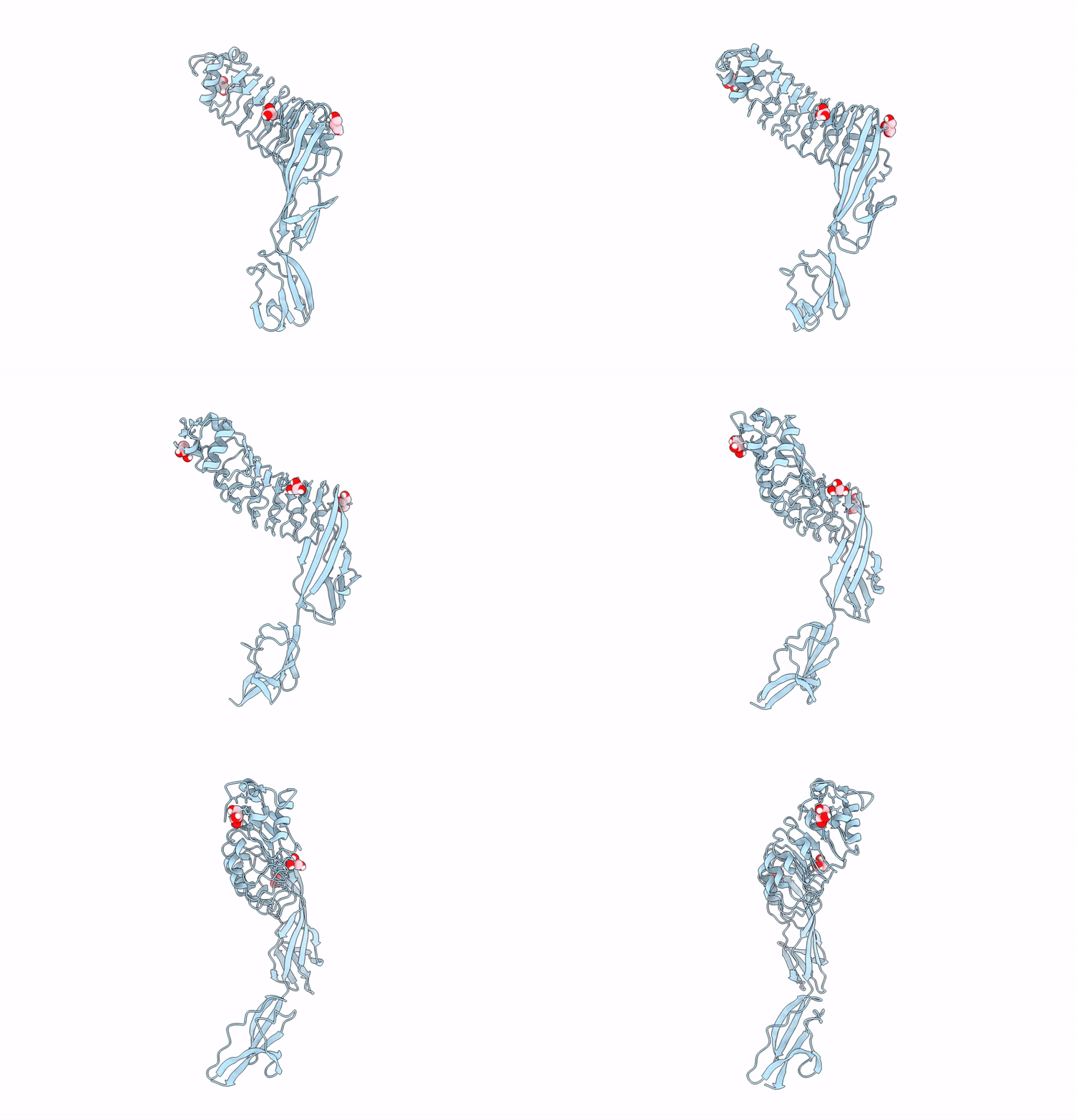
9QR5 image
Deposition Date 2025-04-03
Release Date 2025-11-26
Last Version Date 2025-12-31
Entry Detail
PDB ID:
9QR5
Keywords:
Title:
InlB392_V333E: V333E variant of Listeria monocytogenes InlB (internalin B) residues 36-392
Biological Source:
Source Organism(s):
Expression System(s):
Method Details:
Experimental Method:
Resolution:
1.45 Å
R-Value Free:
0.17
R-Value Work:
0.15
R-Value Observed:
0.15
Space Group:
P 21 21 21

Macromolecular Entities
Structures with similar UniProt ID
Protein Blast
Polymer Type:polypeptide(L)
Molecule:Internalin B
Gene (Uniprot):inlB
Mutagens:V333E
Chain IDs:A
Chain Length:362
Number of Molecules:1
Biological Source:Listeria monocytogenes EGD-e
Ligand Molecules
Primary Citation
Single mutations to tyrosine or glutamate improve the crystallizability and crystal diffraction properties of a flexible two-domain protein.
Acta Crystallogr.,Sect.F 82 4 13 (2026)
PMID: 41324409 DOI: 10.1107/S2053230X25010416

Abstact

This case report describes single surface substitutions that improve the crystallizability and diffraction properties of a flexible two-domain protein. InlB392 comprises the internalin domain and the B repeat of the Listeria monocytogenes invasion protein InlB. The InlB392 wild type yielded very few poorly reproducible hits in crystallization screens and the crystals had a diffraction limit of worse than 3.0 Å. It seems reasonable to assume that this crystallization bottleneck is caused by interdomain flexibility, given that crystals of the isolated internalin domain or B repeat diffract to high resolution. A previously identified variant, T332E, showed improved crystallization and diffraction. Here, two additional InlB392 variants are described with single threonine-to-tyrosine or valine-to-glutamate substitutions that produced crystals directly in initial screens and, without optimization, diffracted to 1.6 and 1.45 Å resolution, respectively. The mutated residues do not participate in intramolecular interdomain interactions but mediate crystal contacts, indicating that specific surface properties, rather than interdomain flexibility per se, impede the crystallization of wild-type InlB392. Notably, the beneficial glutamate substitutions contrast with the generally recognized underrepresentation of glutamate in crystal contacts and the high entropic cost of fixing an otherwise flexible side chain with many rotatable bonds in a crystal contact. The reported results suggest that surface mutations can help crystallization even if they increase the entropy of the respective residue. More broadly, the observations are consistent with the hypothesis that negative evolutionary design limits fortuitous lattice formation of proteins and the resulting expectation that random mutations of surface residues are likely to improve crystallizability.

Legend

Protein

Chemical

Disease

Primary Citation of related structures
Feedback Form
Name
Email
Institute
Feedback