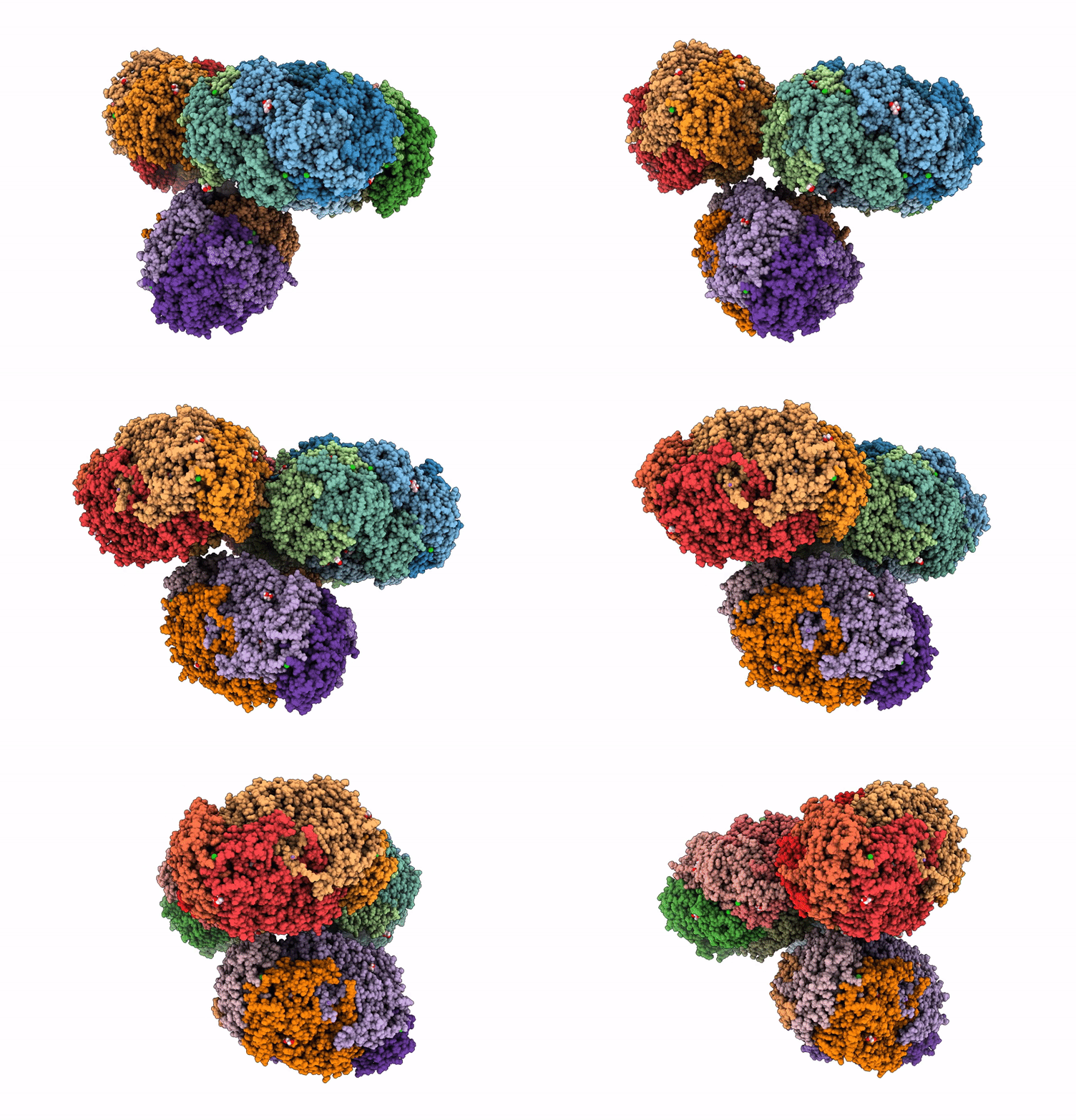
9QR3 image
Deposition Date 2025-04-02
Release Date 2025-07-16
Last Version Date 2025-09-17
Entry Detail
PDB ID:
9QR3
Keywords:
Title:
Methyl-coenzyme M reductase of an ANME-2c from a microbial enrichment
Biological Source:
Source Organism:
Method Details:
Experimental Method:
Resolution:
1.34 Å
R-Value Free:
0.14
R-Value Work:
0.11
R-Value Observed:
0.11
Space Group:
P 1 21 1

Macromolecular Entities
Structures with similar UniProt ID
Protein Blast
Polymer Type:polypeptide(L)
Molecule:Alpha subunit of the Methyl-coenzyme M reductase from ANME-2c
Chain IDs:A, D, G, J, M, P, S, V
Chain Length:561
Number of Molecules:8
Biological Source:Candidatus Methanogasteraceae archaeon
Structures with similar UniProt ID
Protein Blast
Polymer Type:polypeptide(L)
Molecule:Beta subunit of the Methyl-coenzyme M reductase from ANME-2c
Chain IDs:B, E, H, K, N, Q, T, W
Chain Length:434
Number of Molecules:8
Biological Source:Candidatus Methanogasteraceae archaeon
Structures with similar UniProt ID
Protein Blast
Polymer Type:polypeptide(L)
Molecule:Gamma subunit of the Methyl-coenzyme M reductase from ANME-2c
Chain IDs:C, F, I, L, O, R, U, X
Chain Length:265
Number of Molecules:8
Biological Source:Candidatus Methanogasteraceae archaeon
Primary Citation
Atomic resolution structures of the methane-activating enzyme in anaerobic methanotrophy reveal extensive post-translational modifications.
Nat Commun 16 8229 8229 (2025)
PMID: 40913044 DOI: 10.1038/s41467-025-63387-1

Abstact

Anaerobic methanotrophic archaea (ANME) are crucial to planetary carbon cycling. They oxidise methane in anoxic niches by transferring electrons to nitrate, metal oxides, or sulfate-reducing bacteria. No ANMEs have been isolated, hampering the biochemical investigation of anaerobic methane oxidation. Here, we obtained the true atomic resolution structure of their methane-capturing system (Methyl-Coenzyme M Reductase, MCR), circumventing the isolation barrier by exploiting microbial enrichments of freshwater nitrate-reducing ANME-2d grown in bioreactors, and marine ANME-2c in syntrophy with bacterial partners. Despite their physiological differences, these ANMEs have extremely conserved MCR structures, similar to homologs from methanogenic Methanosarcinales, rather than the phylogenetically distant MCR of ANME-1 isolated from Black Sea mats. The three studied enzymes have seven post-translational modifications, among them was a novel 3(S)-methylhistidine on the γ-chain of both ANME-2d MCRs. Labelling with gaseous krypton did not reveal any internal channels that would facilitate alkane diffusion to the active site, as observed in the ethane-specialised enzyme. Based on our data, the methanotrophic MCRs should follow the same radical reaction mechanism proposed for the methane-generating homologues. The described pattern of post-translational modifications underscores the importance of native purification as a powerful approach to discovering intrinsic enzymatic features in non-isolated microorganisms existing in nature.

Legend

Protein

Chemical

Disease

Primary Citation of related structures
Feedback Form
Name
Email
Institute
Feedback