9QPU image
Deposition Date 2025-03-29
Release Date 2025-11-19
Last Version Date 2025-11-26
Entry Detail
PDB ID:
9QPU
Keywords:
Title:
Structure of human butyrylcholinesterase inhibited by the Ellman's reaction product, 2-[(3-carboxy-4-nitrophenyl)disulfanyl]ethyl-trimethylazanium
Biological Source:
Source Organism:
Homo sapiens (Taxon ID: 9606)
Host Organism:
Method Details:
Experimental Method:
Resolution:
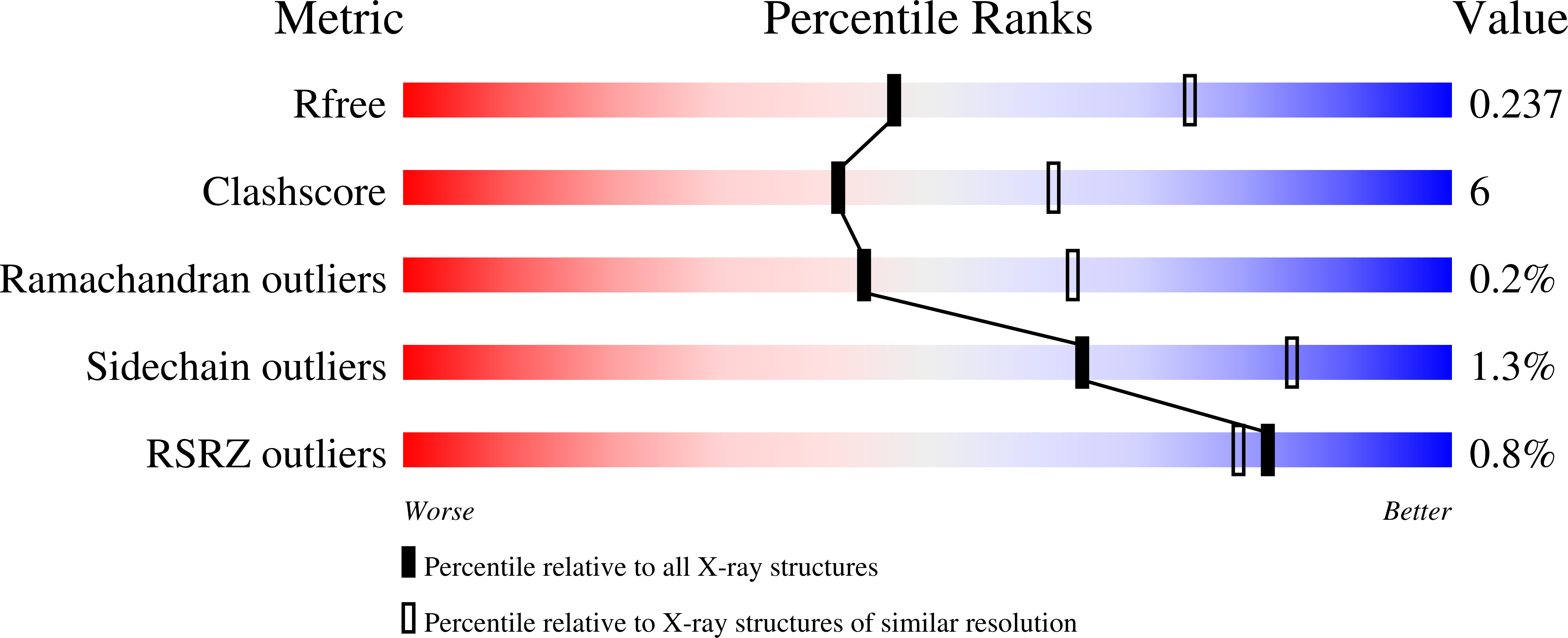
2.50 Å
R-Value Free:
0.23
R-Value Work:
0.18
R-Value Observed:
0.18
Space Group:
I 4 2 2
Macromolecular Entities
Structures with similar UniProt ID
Protein Blast
Polymer Type:polypeptide(L)
Molecule:Cholinesterase
Gene (Uniprot):BCHE
Mutagens:N17Q, N455Q, N481Q, N486Q mutations compared to mature wild type sequence to avoid too much N-glycozylation. Numeration on the maturated enzyme (devoid of the signal peptide)
Chain IDs:A
Chain Length:529
Number of Molecules:1
Biological Source:Homo sapiens
Primary Citation
The product of Ellman's reaction inhibits cholinesterases.
Protein Sci. 34 e70371 e70371 (2025)
PMID: 41229096 DOI: 10.1002/pro.70371

Abstact

Kinetic and crystallographic studies reveal that the binding of the thiocholine-thionitrobenzoic acid product, released during the measurement of thioester-analog substrates hydrolysis according to Ellman's method, inhibits cholinesterases by a pure competitive mechanism. This can only be recorded as the progressive accumulation of the product upon subsequent additions of substrate aliquots. A wide affinity variation was observed among several tested enzymes, with the highest values found in human butyrylcholinesterase and Torpedo acetylcholinesterase. Nearly two orders of magnitude lower affinities were determined with human, mouse, and electrophorus acetylcholinesterases, and human atypical butyrylcholinesterase. These findings can be explained by the unexpected accommodation of the thiocholine-thionitrobenzoic acid in the active site of human butyrylcholinesterase, with the positively charged trimethylammonium choline pointing to the enzyme's peripheral site. At the same time, the carboxyl group of the nitrobenzoic moiety interacts with the enzyme's oxyanion hole. This explains the virtual absence of product inhibition in atypical human butyrylcholinesterase (D70G), purified or in plasma.

Legend

Protein

Chemical

Disease

Primary Citation of related structures
Feedback Form
Name
Email
Institute
Feedback