9QO1 image
Deposition Date 2025-03-25
Release Date 2026-02-11
Last Version Date 2026-02-18
Entry Detail
PDB ID:
9QO1
Keywords:
Title:
Activated 9-subunit COP9 signalosome and neddylated SCF (SKP1-SKP2-CKS1) complex structure
Biological Source:
Source Organism(s):
Homo sapiens (Taxon ID: 9606)
Method Details:
Experimental Method:
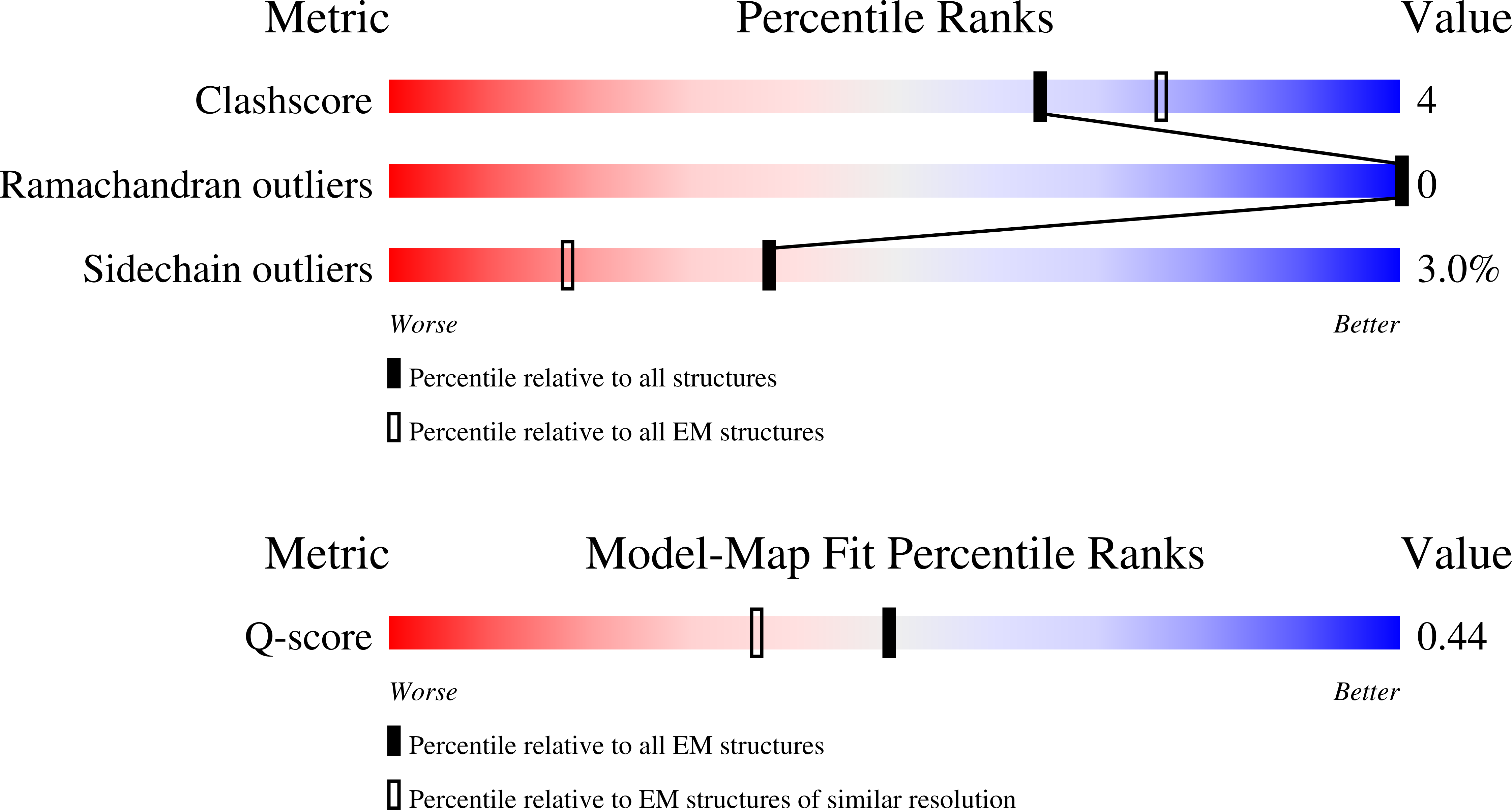
Resolution:
3.23 Å
Aggregation State:
PARTICLE
Reconstruction Method:
SINGLE PARTICLE
Macromolecular Entities
Structures with similar UniProt ID
Protein Blast
Polymer Type:polypeptide(L)
Molecule:COP9 signalosome complex subunit 1
Gene (Uniprot):GPS1
Chain IDs:A
Chain Length:491
Number of Molecules:1
Biological Source:Homo sapiens
Structures with similar UniProt ID
Protein Blast
Polymer Type:polypeptide(L)
Molecule:COP9 signalosome complex subunit 2
Gene (Uniprot):COPS2
Chain IDs:B
Chain Length:443
Number of Molecules:1
Biological Source:Homo sapiens
Structures with similar UniProt ID
Protein Blast
Polymer Type:polypeptide(L)
Molecule:COP9 signalosome complex subunit 3
Gene (Uniprot):COPS3
Chain IDs:C
Chain Length:423
Number of Molecules:1
Biological Source:Homo sapiens
Structures with similar UniProt ID
Protein Blast
Polymer Type:polypeptide(L)
Molecule:COP9 signalosome complex subunit 4
Gene (Uniprot):COPS4
Chain IDs:D
Chain Length:406
Number of Molecules:1
Biological Source:Homo sapiens
Structures with similar UniProt ID
Protein Blast
Polymer Type:polypeptide(L)
Molecule:COP9 signalosome complex subunit 5
Gene (Uniprot):COPS5
Chain IDs:E
Chain Length:334
Number of Molecules:1
Biological Source:Homo sapiens
Structures with similar UniProt ID
Protein Blast
Polymer Type:polypeptide(L)
Molecule:COP9 signalosome complex subunit 6
Gene (Uniprot):COPS6
Chain IDs:F
Chain Length:327
Number of Molecules:1
Biological Source:Homo sapiens
Structures with similar UniProt ID
Protein Blast
Polymer Type:polypeptide(L)
Molecule:COP9 signalosome complex subunit 7b
Gene (Uniprot):COPS7B
Chain IDs:G
Chain Length:264
Number of Molecules:1
Biological Source:Homo sapiens
Structures with similar UniProt ID
Protein Blast
Polymer Type:polypeptide(L)
Molecule:COP9 signalosome complex subunit 8
Gene (Uniprot):COPS8
Chain IDs:H
Chain Length:209
Number of Molecules:1
Biological Source:Homo sapiens
Structures with similar UniProt ID
Protein Blast
Polymer Type:polypeptide(L)
Molecule:Cullin-1
Gene (Uniprot):CUL1
Chain IDs:I
Chain Length:776
Number of Molecules:1
Biological Source:Homo sapiens
Structures with similar UniProt ID
Protein Blast
Polymer Type:polypeptide(L)
Molecule:E3 ubiquitin-protein ligase RBX1
Gene (Uniprot):RBX1
Chain IDs:J
Chain Length:108
Number of Molecules:1
Biological Source:Homo sapiens
Structures with similar UniProt ID
Protein Blast
Polymer Type:polypeptide(L)
Molecule:NEDD8
Gene (Uniprot):NEDD8
Chain IDs:L (auth: K)
Chain Length:76
Number of Molecules:1
Biological Source:Homo sapiens
Structures with similar UniProt ID
Protein Blast
Polymer Type:polypeptide(L)
Molecule:COP9 signalosome complex subunit 9
Gene (Uniprot):COPS9
Chain IDs:K (auth: P)
Chain Length:57
Number of Molecules:1
Biological Source:Homo sapiens
Primary Citation
Structural basis of CSN-mediated SCF deneddylation.
Nat Commun 17 951 951 (2026)
PMID: 41577659 DOI: 10.1038/s41467-025-67566-y

Abstact

Cullin-RING ligases (CRLs) are the largest family of E3 ligases, with ubiquitination activity dynamically regulated by neddylation and deneddylation by the COP9 signalosome (CSN). CSN-mediated deneddylation not only deactivates CRLs but also enables substrate receptor exchange. Although CSN is a promising drug target, the structural basis underlying its catalytic mechanism remains unclear. Here, we use cryo-electron microscopy (cryo-EM) to uncover distinct functional states of CSN-CRL (SCF) complexes, capturing key intermediates of the deneddylation cycle. We visualise an autoinhibited docking state and a catalytic intermediate in which CSN5 Ins-1 loop, RBX1 RING and neddylated Cullin WHB domains are repositioned for isopeptide cleavage. We further resolve four dissociation intermediates that define the stepwise release of CSN from its product, with RBX1 RING stabilising key interactions. Additionally, our structures locate CSNAP within a CSN3-CSN8 groove. Together, our study provides a mechanistic model for CSN function and informs the rational design of CSN-targeted therapeutics.

Legend

Protein

Chemical

Disease

Primary Citation of related structures
Feedback Form
Name
Email
Institute
Feedback