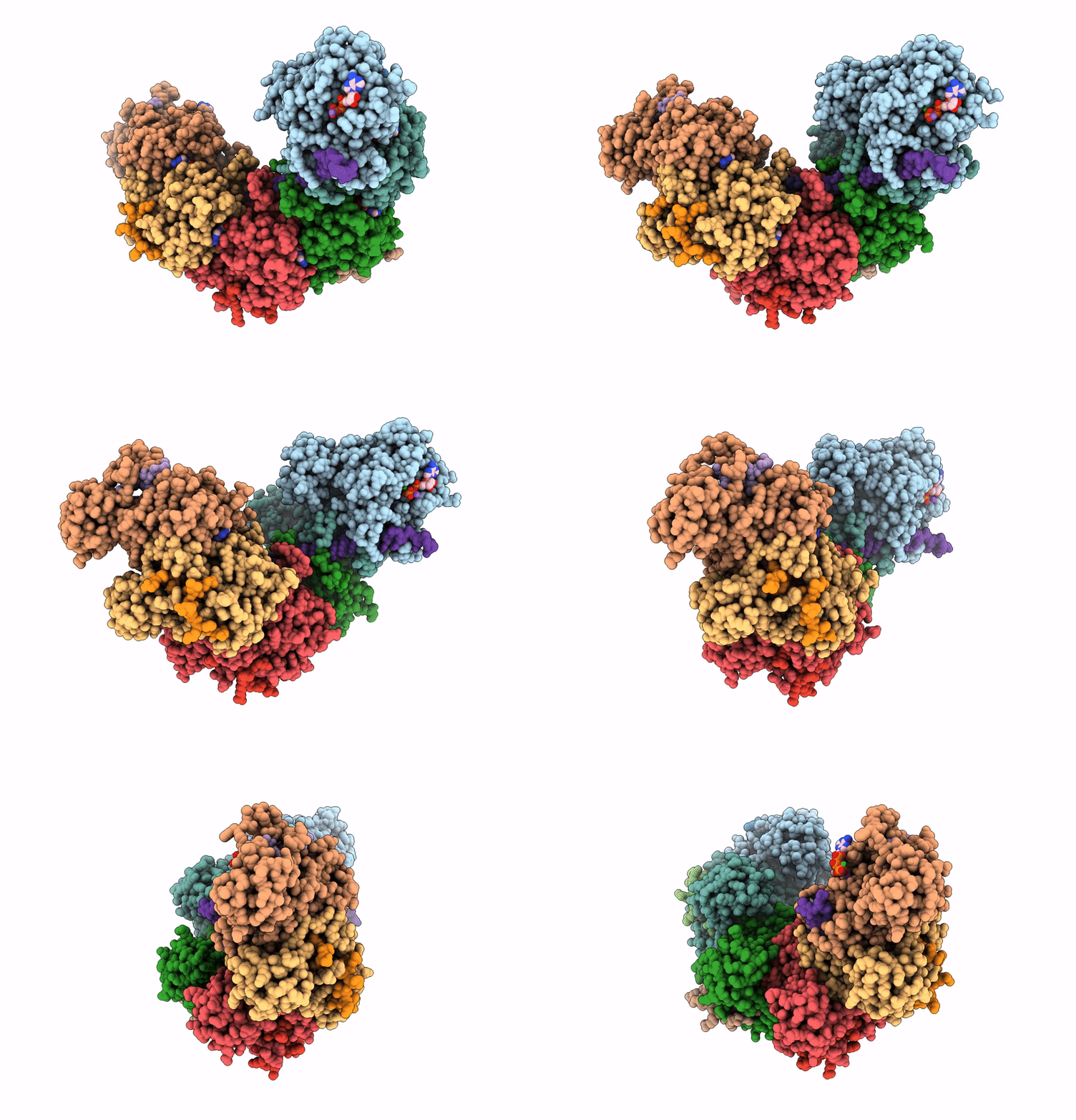
9QN8 image
Deposition Date 2025-03-24
Release Date 2025-12-03
Last Version Date 2025-12-17
Entry Detail
PDB ID:
9QN8
Title:
RAD51 filament in complex with calcium and ATP bound by the RAD51AP1 C-terminus
Biological Source:
Source Organism(s):
Expression System(s):
Method Details:
Experimental Method:
Resolution:
3.14 Å
Aggregation State:
FILAMENT
Reconstruction Method:
SINGLE PARTICLE
Macromolecular Entities
Structures with similar UniProt ID
Protein Blast
Polymer Type:polypeptide(L)
Molecule:DNA repair protein RAD51 homolog 1
Gene (Uniprot):RAD51
Chain IDs:A, C, E, G, I, K
Chain Length:339
Number of Molecules:6
Biological Source:Homo sapiens
Structures with similar UniProt ID
Protein Blast
Polymer Type:polypeptide(L)
Molecule:RAD51-associated protein 1
Gene (Uniprot):RAD51AP1
Chain IDs:B, D, F, H, J, L
Chain Length:364
Number of Molecules:6
Biological Source:Homo sapiens
Polymer Type:polydeoxyribonucleotide
Molecule:DNA
Chain IDs:M (auth: Z)
Chain Length:21
Number of Molecules:1
Biological Source:synthetic construct
Primary Citation
RAD51AP1 is a versatile RAD51 modulator.
Proc.Natl.Acad.Sci.USA 122 e2514728122 e2514728122 (2025)
PMID: 41337480 DOI: 10.1073/pnas.2514728122

Abstact

RAD51AP1 is an emergent key factor in homologous recombination (HR), the major pathway for accurate repair of DNA double-strand breaks, and in alternative lengthening of telomeres (ALT). Depletion of RAD51AP1 diminishes HR and overexpression is common in cancer, where it is associated with malignancy. Here, we show that RAD51AP1 has a hitherto unknown role in modulating the RAD51 recombinase, the central player in HR. Through a combination of biochemistry and structural biology, we reveal that RAD51AP1 possesses at least three RAD51-binding sites that facilitate its binding across two adjacent RAD51 molecules. We uncover a previously unidentified RAD51-binding mode that stabilizes the RAD51 N-terminal domain and protomer interface in the filaments. We uncover a previously undescribed role for RAD51AP1 in stabilizing RAD51-ssDNA filaments and promoting strand exchange. Our structural data provide the molecular basis for how RAD51AP1 binding induces conformational changes that promote RAD51 DNA association and oligomerization, therefore promoting filament nucleation, stabilization, and strand exchange. Further, we resolved structures of RAD51-ssDNA filaments in the presence of Mg2+-ATP and upon hydrolysis to Mg2+-ADP, revealing that RAD51 filaments expand upon ATP hydrolysis and explaining how ADP reduces RAD51-DNA binding. Our findings reveal RAD51AP1 as a versatile RAD51 modulator and RAD51 filament remodeler and shed previously unidentified insights into the modulation of HR, which is critical for the maintenance of genome stability.

Legend

Protein

Chemical

Disease

Primary Citation of related structures
Feedback Form
Name
Email
Institute
Feedback