9QGA image
Deposition Date 2025-03-13
Release Date 2025-10-15
Last Version Date 2025-10-22
Entry Detail
PDB ID:
9QGA
Keywords:
Title:
Structure of native leukocyte myeloperoxidase in complex with a truncated version of the Staphylococcal Peroxidase Inhibitor SPIN and bromide at pH 7.5
Biological Source:
Source Organism:
Host Organism:
Method Details:
Experimental Method:
Resolution:
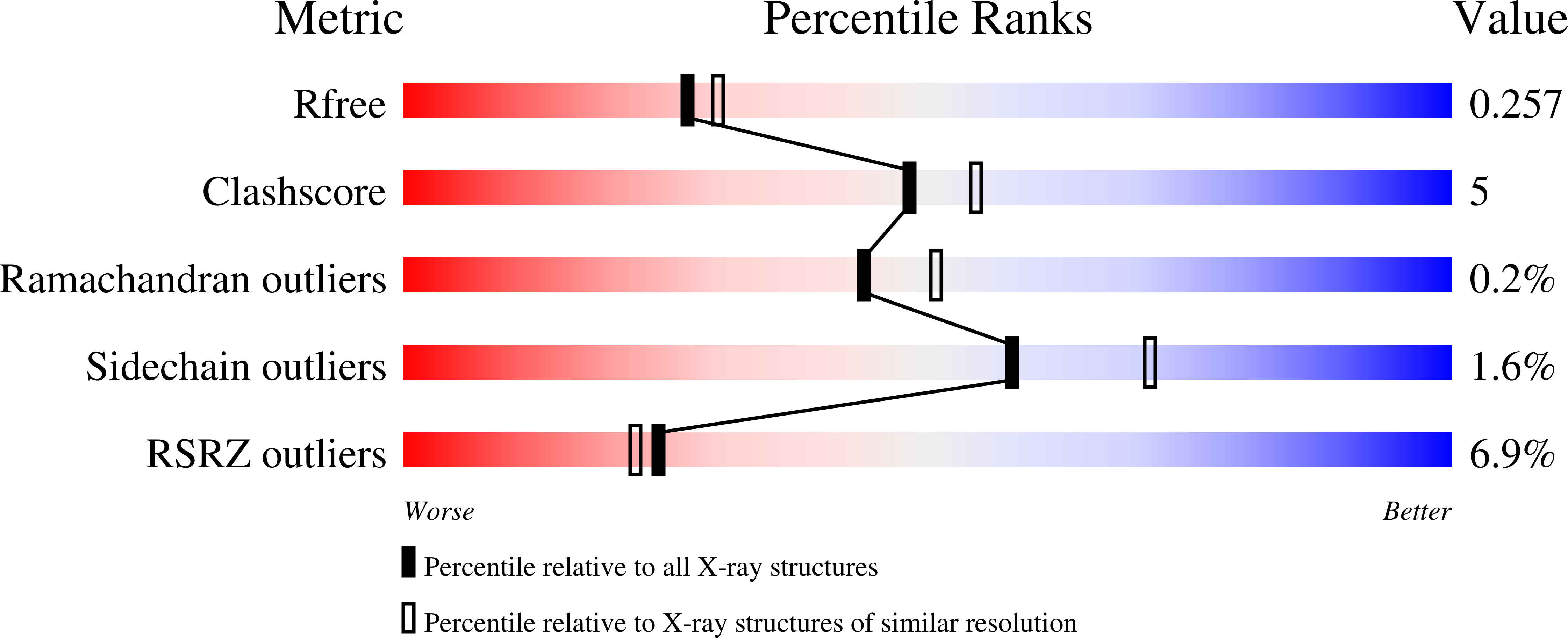
2.21 Å
R-Value Free:
0.25
R-Value Work:
0.19
R-Value Observed:
0.19
Space Group:
P 43 21 2
Macromolecular Entities
Structures with similar UniProt ID
Protein Blast
Polymer Type:polypeptide(L)
Molecule:Myeloperoxidase light chain
Gene (Uniprot):MPO
Chain IDs:A, B (auth: C)
Chain Length:114
Number of Molecules:2
Biological Source:Homo sapiens
Structures with similar UniProt ID
Protein Blast
Polymer Type:polypeptide(L)
Molecule:Myeloperoxidase heavy chain
Gene (Uniprot):MPO
Chain IDs:E (auth: B), F (auth: D)
Chain Length:467
Number of Molecules:2
Biological Source:Homo sapiens
Structures with similar UniProt ID
Protein Blast
Polymer Type:polypeptide(L)
Molecule:Myeloperoxidase inhibitor SPIN
Gene (Uniprot):SAOUHSC_00401
Chain IDs:C (auth: E), D (auth: F)
Chain Length:60
Number of Molecules:2
Biological Source:Staphylococcus aureus
Modified Residue
Compound ID Chain ID Parent Comp ID Details 2D Image
CSO E CYS modified residue
Primary Citation
Halide binding by myeloperoxidase is regulated by access channel dynamics and charge interactions.
Int.J.Biol.Macromol. 330 148038 148038 (2025)
PMID: 41043752 DOI: 10.1016/j.ijbiomac.2025.148038

Abstact

The heme enzyme myeloperoxidase is a key player in the innate immune defense. It uses hydrogen peroxide to produce bactericidal hypohalous acids from (pseudo)halides, foremost chloride, and thiocyanate in the neutrophil phagosome. However, the available structural data on the halide-binding site, the marked pH dependence of halide oxidation, and the atypical pKa of an active-site histidine 261 fail to fully account for the mechanism of halide oxidation by myeloperoxidase. In the present study, crystal structures of myeloperoxidase-halide complexes show that halides can integrate into the hydrogen-bonding network formed by conserved water molecules, without directly interacting with the deprotonated histidine at both acidic and neutral pH. Molecular dynamics simulations reveal that protonation of histidine 261 decreases active site rigidity and increases the flexibility of arginine 405. Together with the terminal residues of the myeloperoxidase heavy and light chains, arginine 405 contributes to halide transport into the active site. Kinetic analyses and simulations further demonstrate that sodium ions play a critical role as charge shields, enabling halides to traverse the negatively charged access channel, which represents a key bottleneck for halide binding. Thus, halide access to the active site is governed by a complex interplay of electrostatic interactions involving both solvent ions and charged amino acid residues.

Legend

Protein

Chemical

Disease

Primary Citation of related structures
Feedback Form
Name
Email
Institute
Feedback