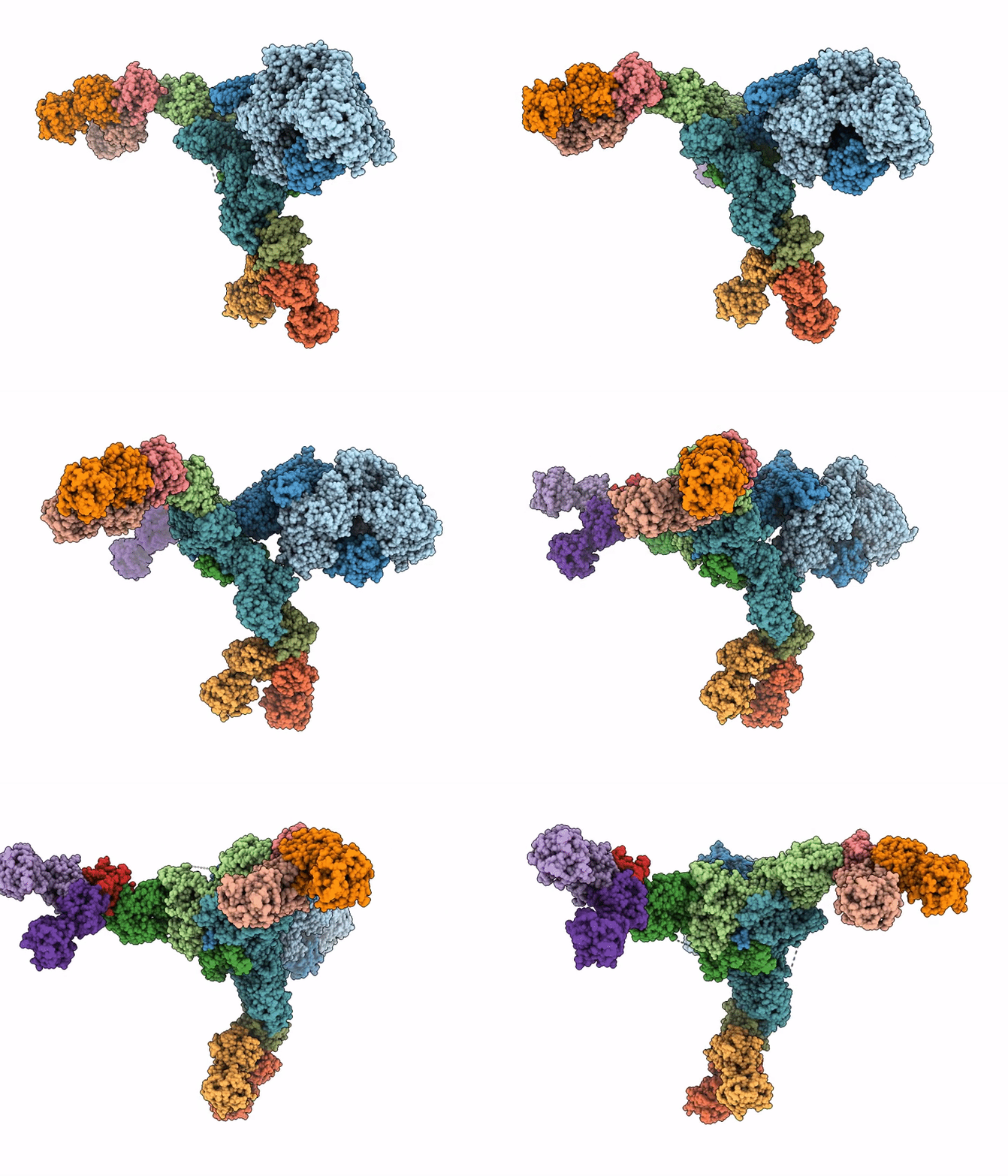
9QCM image
Deposition Date 2025-03-04
Release Date 2025-09-10
Last Version Date 2025-09-10
Entry Detail
PDB ID:
9QCM
Keywords:
Title:
Botulinum neurotoxin type B1, 14-subunit, Large Progenitor Toxin Complex (L-PTC)
Biological Source:
Source Organism:
Host Organism:
Method Details:
Experimental Method:
Resolution:
2.90 Å
Aggregation State:
PARTICLE
Reconstruction Method:
SINGLE PARTICLE
Macromolecular Entities
Structures with similar UniProt ID
Protein Blast
Polymer Type:polypeptide(L)
Molecule:Botulinum neurotoxin type B
Gene (Uniprot):botB
Mutagens:E232Q, H235Y
Chain IDs:A
Chain Length:1302
Number of Molecules:1
Biological Source:Clostridium botulinum
Structures with similar UniProt ID
Protein Blast
Polymer Type:polypeptide(L)
Molecule:Botulinum neurotoxin type B1, nontoxic-nonhemagglutinin component, NTNH
Gene (Uniprot):ntnH
Chain IDs:B
Chain Length:1197
Number of Molecules:1
Biological Source:Clostridium botulinum
Structures with similar UniProt ID
Protein Blast
Polymer Type:polypeptide(L)
Molecule:Hemagglutinin component HA70
Gene (Uniprot):ha70
Chain IDs:C, D, E
Chain Length:626
Number of Molecules:3
Biological Source:Clostridium botulinum
Structures with similar UniProt ID
Protein Blast
Polymer Type:polypeptide(L)
Molecule:Hemagglutinin component HA17
Gene (Uniprot):ha17
Chain IDs:F, G, H
Chain Length:146
Number of Molecules:3
Biological Source:Clostridium botulinum
Structures with similar UniProt ID
Protein Blast
Polymer Type:polypeptide(L)
Molecule:Hemagglutinin component HA33
Gene (Uniprot):ha33
Chain IDs:I, J, K, L, M, N
Chain Length:294
Number of Molecules:6
Biological Source:Clostridium botulinum
Ligand Molecules
Primary Citation
Structure of the complete 14-subunit botulinum neurotoxin B complex reveals a unique anchoring through the narrow central pore of HA70.
Sci Adv 11 eadx5058 eadx5058 (2025)
PMID: 40864696 DOI: 10.1126/sciadv.adx5058

Abstact

Botulinum neurotoxin serotype B1 (BoNT/B) is a highly potent neurotoxin and therapeutic agent. Here, we present the structure of the complete 14-subunit (780 kDa) progenitor toxin complex (L-PTC) and of five subcomplexes. The structures show how the toxin interacts with its associated components in their role to protect and deliver BoNT/B across epithelial barriers. Each subcomplex, including the M-PTC, M-PTC-HA70, NTNH-HA70, and HA70 trimer, provides detailed understanding of the assembly mechanism, in which the NTNH-nLoop adopts a unique fold that locks the M-PTC into a central pore formed by HA70. The HA subcomplex presents a tripod architecture with flexible legs that may adapt to the rugged cell surface. Mass photometry reveals the pH dependence of BoNT/B release from the complex which is unexpectedly influenced by the presence of HA70. This study provides the complete L-PTC structure, offering insights into its assemblage and supporting the development of countermeasures and therapeutic applications.

Legend

Protein

Chemical

Disease

Primary Citation of related structures
Feedback Form
Name
Email
Institute
Feedback