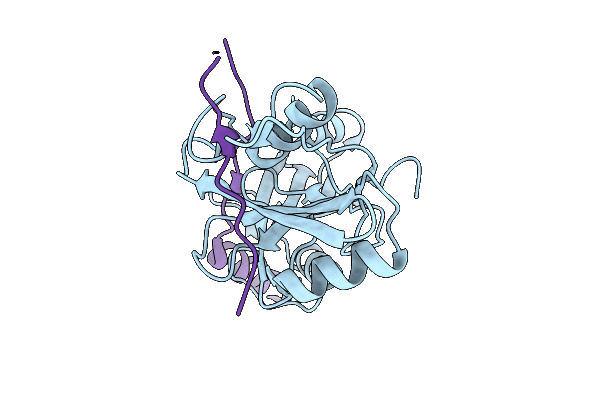
9QCD image
Deposition Date 2025-03-04
Release Date 2025-12-31
Last Version Date 2026-01-07
Entry Detail
PDB ID:
9QCD
Title:
Micro-ED structure of the NSH2-CSH2 tandem domain of SHP2 in complex with the bis-phosphorylated pY627-pY659-Gab1 (613-694) peptide
Biological Source:
Source Organism(s):
Homo sapiens (Taxon ID: 9606)
Expression System(s):
Method Details:
Experimental Method:
Resolution:
3.20 Å
R-Value Free:
0.35
R-Value Work:
0.30
R-Value Observed:
0.30
Space Group:
P 21 21 21

Macromolecular Entities
Structures with similar UniProt ID
Protein Blast
Polymer Type:polypeptide(L)
Molecule:Tyrosine-protein phosphatase non-receptor type 11
Gene (Uniprot):PTPN11
Chain IDs:A (auth: B)
Chain Length:223
Number of Molecules:1
Biological Source:Homo sapiens
Structures with similar UniProt ID
Protein Blast
Polymer Type:polypeptide(L)
Molecule:GRB2-associated-binding protein 1
Gene (Uniprot):GAB1
Chain IDs:B (auth: C)
Chain Length:69
Number of Molecules:1
Biological Source:Homo sapiens
Modified Residue
Compound ID Chain ID Parent Comp ID Details 2D Image
PTR B TYR modified residue
Ligand Molecules
Primary Citation

Abstact

The non-receptor tyrosine phosphatase SHP2 (SH2 domain-containing protein tyrosine phosphatase 2) (PTPN11) is a regulator of diverse cellular functions including mitogenic activation and cell migration. It comprises two tandem Src-homology 2 (SH2) domains followed by the catalytic domain and is autoinhibited by the N-terminal SH2 domain blocking access to the active site. Mutations influencing auto-inhibition have been implicated in cancer and other diseases, and allosteric inhibitors have been developed that stabilize the inactive state. Here, we show that the intrinsically disordered bis-phosphorylated SHP2-activating peptide pY627pY659-Gab1 binds to both SH2 domains, undergoing partial ordering in the process. In addition to eliciting changes in SH2 domain dynamics, the peptide reorganizes their relative orientations to generate a new SH2-SH2 interface. Our data suggest an active conformation for SHP2 that is also applicable to the hematopoietic cell-specific SHP1 (PTPN6), shedding light on the activation mechanism of both enzymes and paving the way for the development of novel compounds to modulate SHP2 activity.

Legend

Protein

Chemical

Disease

Primary Citation of related structures
Feedback Form
Name
Email
Institute
Feedback