9Q9V image
Deposition Date 2025-02-26
Release Date 2026-02-04
Last Version Date 2026-02-04
Entry Detail
PDB ID:
9Q9V
Title:
Crystal structure of Borrelia burgdorferi BB0238-BB0323 complex
Biological Source:
Source Organism(s):
Expression System(s):
Method Details:
Experimental Method:
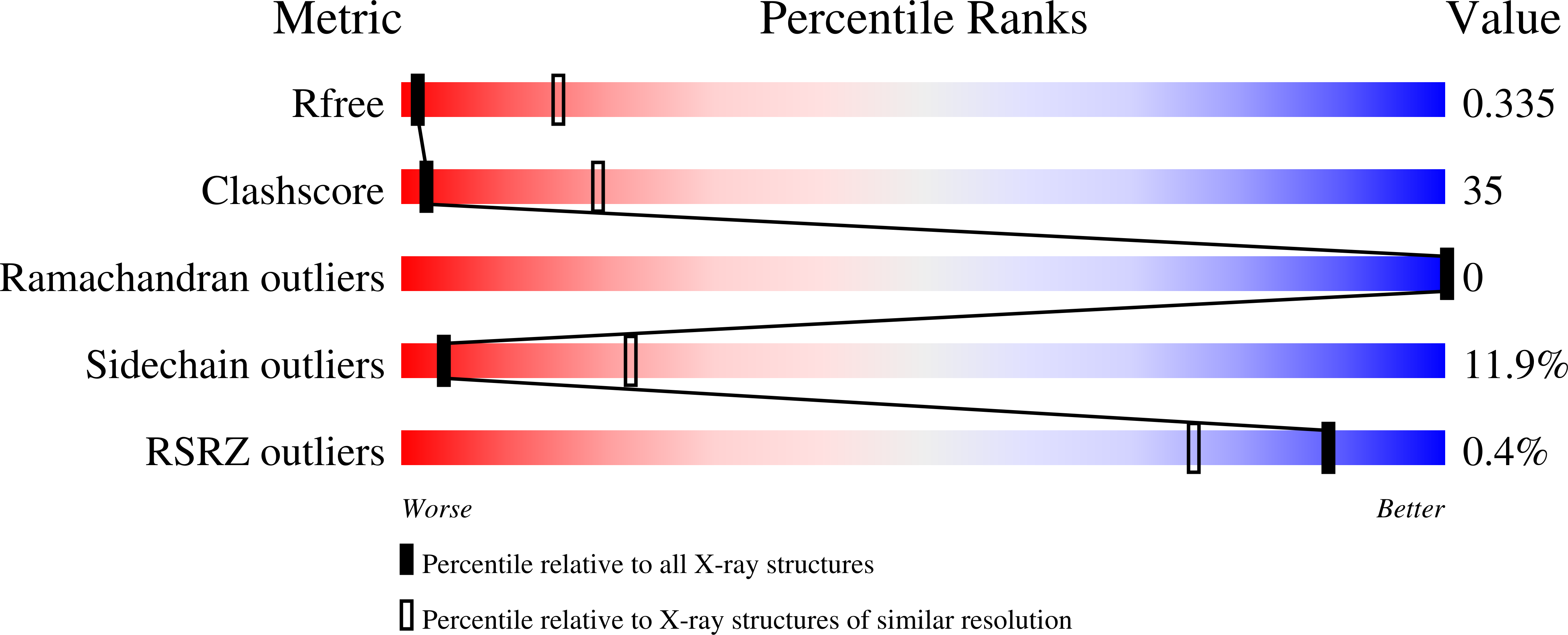
Resolution:
3.60 Å
R-Value Free:
0.33
R-Value Work:
0.19
R-Value Observed:
0.20
Space Group:
P 65
Macromolecular Entities
Structures with similar UniProt ID
Protein Blast
Polymer Type:polypeptide(L)
Molecule:LysM domain protein
Gene (Uniprot):BB_0323
Chain IDs:A
Chain Length:189
Number of Molecules:1
Biological Source:Borreliella burgdorferi B31
Structures with similar UniProt ID
Protein Blast
Polymer Type:polypeptide(L)
Molecule:BB0238
Gene (Uniprot):BB_0238
Chain IDs:B
Chain Length:129
Number of Molecules:1
Biological Source:Borreliella burgdorferi B31
Ligand Molecules
Primary Citation
Targeting of interaction between BB0323-BB0238 informs new paradigms in Lyme disease therapeutics.
Plos Pathog. 22 e1013805 e1013805 (2026)
PMID: 41481600 DOI: 10.1371/journal.ppat.1013805

Abstact

Borrelia burgdorferi, one of the most prevalent tick-borne pathogens, can cause a complex and multisystem illness called Lyme disease, where there has been an unmet need for novel therapeutic or preventive strategies. We previously identified an essential protein-protein interaction (PPI) event in B. burgdorferi involving two unique proteins, BB0323 and BB0238; herein, we show that this PPI is indispensable for long-term borrelial survival in mammals and explore its potential as a novel target for small molecule therapeutics. Using X-ray crystallography, we solved the structure of the BB0238-BB0323 complex and identified the hotspot residues that form the biomolecular PPI interface area of ~1000 square Ångstroms. We then performed quantitative high-throughput drug screens of 62,740 diverse small molecules utilizing an amplified luminescent proximity homogeneous assay linked immunosorbent assay (AlphaLISA). Following a comprehensive pipeline to confirm small molecule hits, we short-listed three distinct PPI inhibitors of BB0238-BB0323. One of these inhibitors, called lomibuvir (VX-222, VCH-222), displayed robust PPI inhibition inside B. burgdorferi cells and was shown to affect pathogen persistence in a tick-borne murine model of Lyme disease. Our study highlights targeted PPI disruption as a new therapeutic strategy against B. burgdorferi and may foster future antimicrobial discovery efforts to resolve clinical complications associated with Lyme disease.

Legend

Protein

Chemical

Disease

Primary Citation of related structures
Feedback Form
Name
Email
Institute
Feedback