9Q9E image
Deposition Date 2025-02-26
Release Date 2025-06-18
Last Version Date 2025-09-24
Entry Detail
PDB ID:
9Q9E
Title:
Crystal structure of a TELSAM-SUMO1 fusion protein
Biological Source:
Source Organism:
Homo sapiens (Taxon ID: 9606)
Host Organism:
Method Details:
Experimental Method:
Resolution:
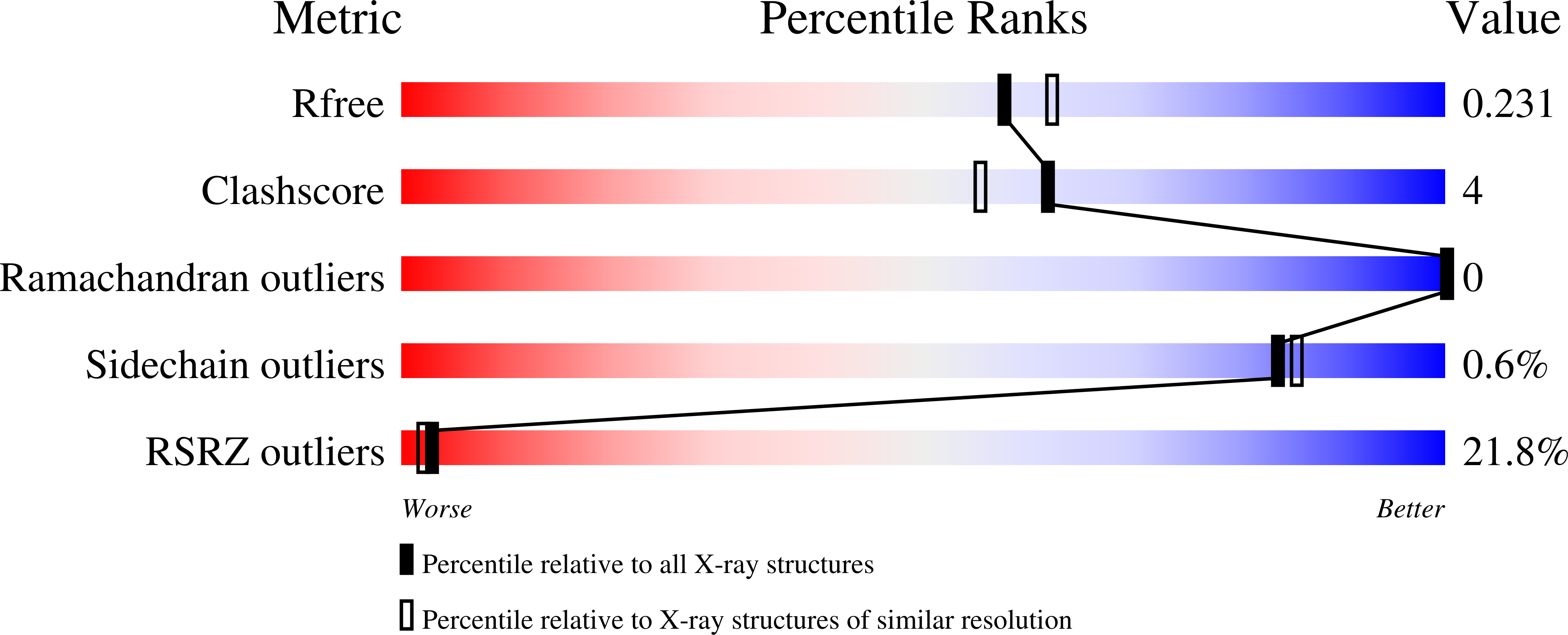
2.05 Å
R-Value Free:
0.23
R-Value Work:
0.20
R-Value Observed:
0.21
Space Group:
P 21 21 21
Macromolecular Entities
Protein Blast
Polymer Type:polypeptide(L)
Molecule:Transcription factor ETV6,Small ubiquitin-related modifier 1
Gene (Uniprot):ETV6, SUMO1
Mutagens:V73E
Chain IDs:A, B, C
Chain Length:167
Number of Molecules:3
Biological Source:Homo sapiens
Primary Citation
Fusion Protein-Assisted Crystallization of Human SUMO1.
Proteins 93 1767 1779 (2025)
PMID: 40406964 DOI: 10.1002/prot.26838

Abstact

In this study, we employed a fusion protein-assisted approach to crystallize human SUMO1, an essential covalent protein modifier that also interacts noncovalently with specific linear protein motifs called SUMO-interacting motifs (SIMs). SUMO1 has been crystallized previously as part of various complexes but never in isolation. Our strategy involved fusing a variant of a known crystallization facilitator, the TELSAM domain, upstream of the folded part of the SUMO1 protein (residues 18-97). Following a simple purification strategy, we obtained a 2.05-Å crystal structure of apo TELSAM-SUMO1, with three distinct SUMO1 chains per asymmetric unit, two of which have an accessible pocket for binding to a SIM. The crystal structure is composed of the expected left-handed helical filaments formed by TELSAM domains, with protruding SUMO1 molecules mediating connections within and between these filaments to stabilize a three-dimensional lattice. Since the TELSAM fusion does not affect the SUMO:SIM interaction, as confirmed in solution, our construct may potentially be used to structurally characterize complexes formed between SUMO and SIM-containing peptides. Neither does the TELSAM fusion interfere with the attachment of SUMO1 to substrates, potentially allowing for the creation of SUMOylated protein forms with improved crystallizability. The study represents a novel application of TELSAM-assisted crystallization to a small protein of major biological relevance.

Legend

Protein

Chemical

Disease

Primary Citation of related structures
Feedback Form
Name
Email
Institute
Feedback