9Q74 image
Deposition Date 2025-08-22
Release Date 2026-01-21
Last Version Date 2026-01-21
Entry Detail
PDB ID:
9Q74
Keywords:
Title:
Crystal structure of T. brucei EIF4E5 in complex with EIF4G1 peptide and cap-4.
Biological Source:
Source Organism(s):
Expression System(s):
Method Details:
Experimental Method:
Resolution:
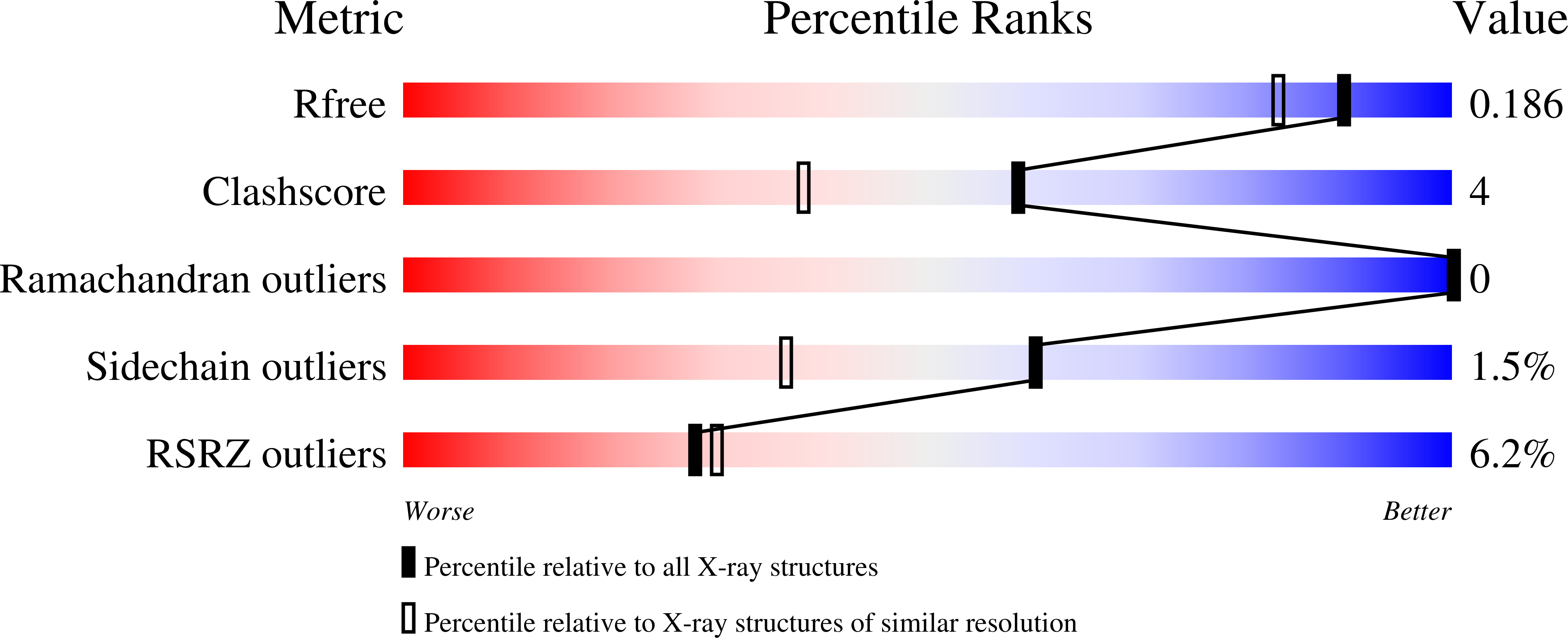
1.57 Å
R-Value Free:
0.18
R-Value Work:
0.14
R-Value Observed:
0.14
Space Group:
P 3 2 1
Macromolecular Entities
Structures with similar UniProt ID
Protein Blast
Polymer Type:polypeptide(L)
Molecule:Eukaryotic translation initiation factor 4E type 5
Gene (Uniprot):Tb10.70.2180
Chain IDs:A
Chain Length:195
Number of Molecules:1
Biological Source:Trypanosoma brucei brucei TREU927
Structures with similar UniProt ID
Protein Blast
Polymer Type:polypeptide(L)
Molecule:MIF4G domain-containing protein
Gene (Uniprot):Tb05.30H13.650
Chain IDs:B
Chain Length:48
Number of Molecules:1
Biological Source:Trypanosoma brucei brucei TREU927
Primary Citation
Selective eIF4E-eIF4G Pairing and Cap-4 Recognition Mechanisms in Trypanosomatids: Insights From EIF4E5-EIF4G1 and EIF4E6-EIF4G5 Complexes.
J.Mol.Biol. 438 169550 169550 (2026)
PMID: 41265746 DOI: 10.1016/j.jmb.2025.169550

Abstact

Translation initiation in eukaryotes is a highly regulated process involving the assembly of several transient protein complexes. A key step in this process is recognition of the mRNA 5' cap structure by the initiation factor eIF4E, a core component of the eIF4F complex. In trypanosomatids, this mechanism diverges from canonical eukaryotic systems, featuring five distinct eIF4F-like complexes formed through specific pairings of eIF4E and eIF4G homologs. Additionally, trypanosomatid mRNAs exhibit a unique hypermethylated cap-4 structure at the 5' end. To elucidate the molecular basis of selective eIF4E-eIF4G interactions and the modulation of cap binding upon eIF4G engagement, we determined high-resolution crystal structures of EIF4E5-EIF4G1 complexes from Trypanosoma brucei and T. cruzi, and the EIF4E6-EIF4G5 complex from T. cruzi. These structural studies, supported by biophysical analyses in the presence and absence of a cap-4 analog, reveal key determinants of cap recognition associated with cap-4 structural flexibility and plasticity in the cap-binding pockets. We observe conformational rearrangements upon eIF4G binding and propose a relationship between these structural changes and increased cap-4 affinity. In addition, comparative structural analysis of the EIF4E5-EIF4G1 and EIF4E6-EIF4G5 complexes offers atomic-level insights into the molecular determinants of specificity that govern selective eIF4E-eIF4G pairings in trypanosomatids.

Legend

Protein

Chemical

Disease

Primary Citation of related structures
Feedback Form
Name
Email
Institute
Feedback